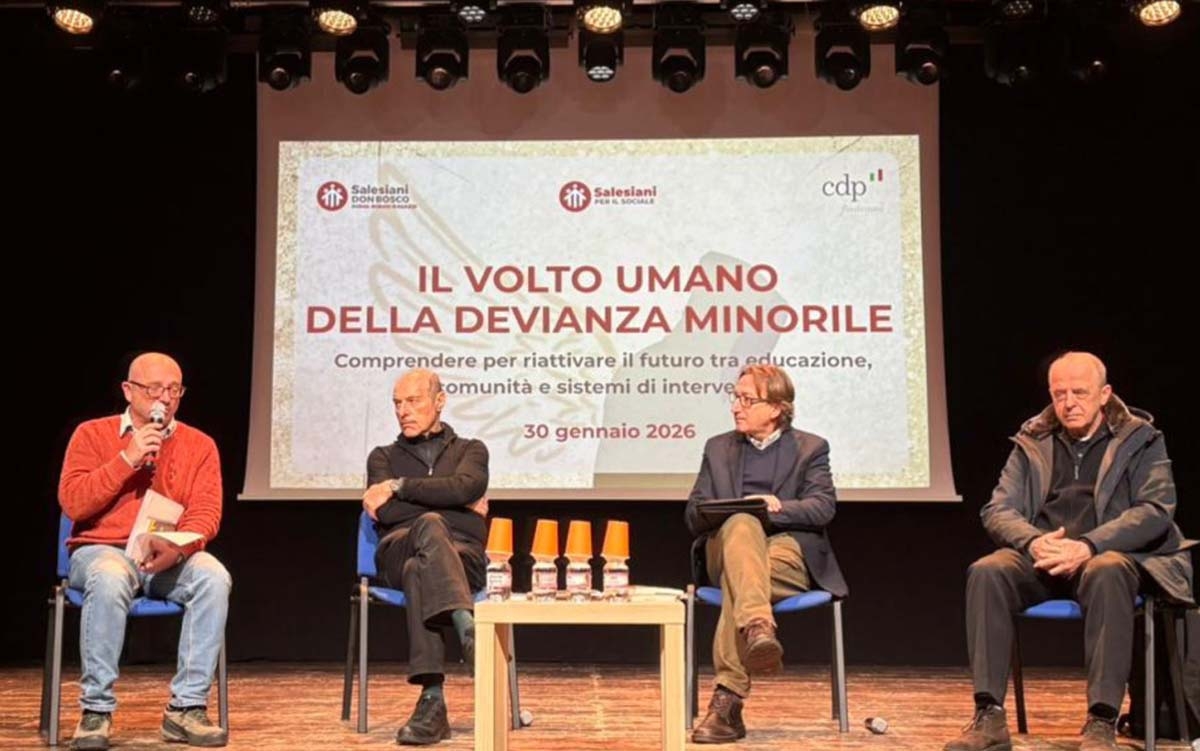
The conference was opened by Fr Emanuele De Maria, Director of the centre, who read a passage from the Memoirs of Don Bosco relating to his experience in prisons. This was a strong reminder of the roots of the Salesian Preventive System and the value of a perspective capable of seeing young people beyond their mistakes and crimes. Fr De Maria then presented the Borgo, its educational commitment in the area and the institutions present, emphasising the urgent need for an alliance between all social actors.
SEEING YOUNG PEOPLE BEYOND THE MASK
In his speech, Alessandro Iannini, Head of the “Rimettere le Ali” (Regaining Wings) Marginalisation and Disadvantage Education Area at Borgo Ragazzi Don Bosco, retraced the birth of the Juvenile Centre and the reception of the first young people from prison, dwelling on the meaning of the conference title. ‘It is necessary to be able to see young people without the mask that everyone sees,’ he explained, ‘because we often stop at what young people do, without questioning what they carry inside.’
Hence the appeal to institutions to invest seriously in education and prevention, especially at a time when public debate seems to be focused mainly on security and repression. This appeal was already made in 2022 at the conference entitled ‘I ragazzi sono di chi arriva prima’ (Young people belong to whoever gets there first): we cannot stand by and watch, we must ‘get there first’ before delinquency sets in, with youth policies capable of accompanying young people’s growth.
THE TERRITORY AND THE RESPONSIBILITIES OF THE INSTITUTIONS
Giuseppe Battaglia, Councillor for the Suburbs of the Municipality of Rome, recognised Borgo Ragazzi Don Bosco as an important contribution in working with young people, due to its history, the legacy of Don Bosco and the educational professionalism that distinguishes it.
Giovanni Battista Impagliazzo, Councillor for Youth Policies of Rome Capital, was of the same opinion, describing the Borgo as ‘a humane place, a home for everyone, especially for those who feel out of place’.
THE EDUCATIONAL PACT: A CONCRETE RESPONSE FROM THE COMMUNITY
Fr Francesco Preite, President of Salesians for Social, described Borgo Ragazzi Don Bosco as ‘an example of excellence in Salesian Italy’, emphasising how rediscovering the human face of delinquency means restoring dignity to people. ‘Repression is not the answer,’ he said. ‘Metal detectors do not eliminate delinquency. We need to prevent, educate and accompany.ì The Educational Pact represents precisely this: bringing together resources, skills and responsibilities to build an inclusive system.
DELINQUENCY TODAY: THE VOID, THE HERD, THE SHAME
The contribution of Silvio Ciappi, clinical criminologist and psychotherapist, offered a profound and complex reading of contemporary juvenile delinquency. Often, he explained, it is not a question of young people ‘who lack everything’, but of young people who are apparently integrated yet who live with a deep emotional and relational void.
‘There are no bad apples, but apples in a rotten container,’ he said, describing a society that feeds the herd, boredom, shame, difficulty in paying attention and obsession with performance. In this context, loss becomes intolerable and turns into revenge. The only possible response is to rebuild a community understood as civitas, made up of real relationships, encounters, gentleness and shared responsibility. A place where happiness and difference can be rediscovered, putting ‘head, hands and heart’ into education.
EDUCATING AS A LIFESTYLE CHOICE
Writer and teacher Eraldo Affinati offered both a personal and pedagogical testimony: ‘I became an educator because I was a restless boy.’ Referring explicitly to Don Bosco’s Preventive System, he emphasised the need to be both a friend and a teacher: capable of empathising with the young person’s pain, but also of setting limits.
According to Affinati, the educator is a credible witness, an ‘artist of downtime’, capable of creating attention in informal moments and accompanying the inner adventure of adolescents. Only if young people feel truly loved can they trust and confide. Hence the reference to Pope Francis’ ìEducational Village’: an educating community that takes care of young people together.
A LOOK ‘FROM INSIDE’ THE JUVENILE PRISON
The morning was concluded by Fr Silvano Oni, SDB, chaplain of the Ferrante Aporti juvenile prison in Turin, who offered a look ‘from insideì: not only from inside the prison institution, but above all from inside the lives of the young prisoners.
Fr Oni highlighted the structural difficulties of the system: overcrowding, structural deficiencies and a strong tendency towards repressive responses. Many of these young people, he explained, have never had anyone to help them form a conscience; they struggle to rework what they have done and view the adult world with suspicion.
The only way forward is to learn to look at life ‘from below’, without hasty judgements, intercepting questions before answers, recognising the good that still exists in everyone. Educating for dignity – including through self-care, school and learning – requires time, patience and trust. ‘What is not today will be tomorrow,’ he concluded.