RMG – Fr Silvio Roggia’s ‘Goodnight’ on the new Ratio: ‘A journey that has only just begun’
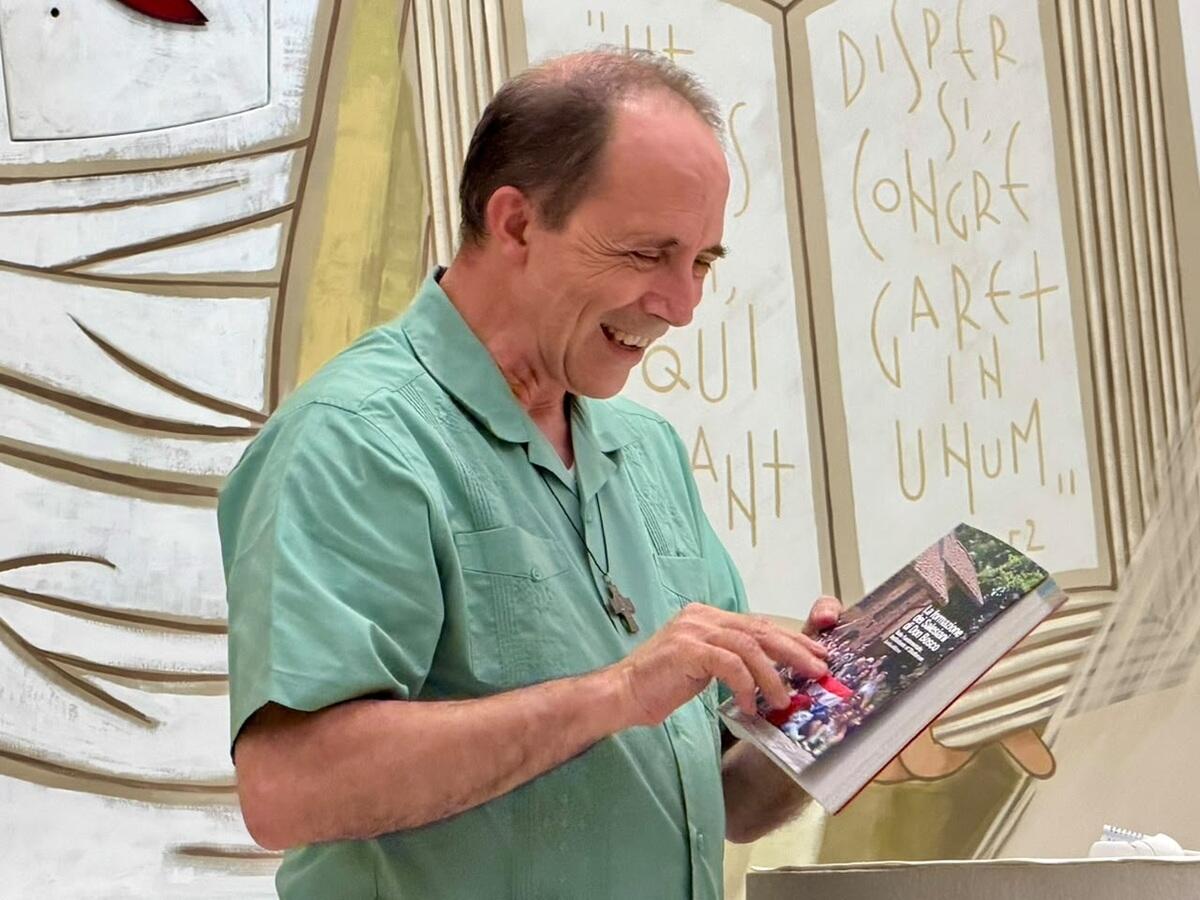
(ANS – Rome) – On the evening of 13 July 2026, the Sacred Heart Community held another gathering, featuring the “Goodnight” by the General Councillors. The main speaker was Fr Silvio Roggia, General Councillor for Formation, who presented the 5th edition of the Ratio Fundamentalis Formationis, recently promulgated by the Rector Major and his Council. To introduce his talk, Fr Roggia chose a striking image: a suitcase, symbolising “a long journey” — not only the one that led up to the publication of the text, but above all the one that is now beginning, which he himself described as “a journey far longer than these last five years”.
A shared journey, not the product of a single mind
The Councillor recalled that the new Ratio did not arise from the work of “some brilliant mind”, but is the result of an extensive consultation process and contributions developed over time, beginning with the guidelines of GC28. A journey which, he emphasised, had even benefited from its delays.
Fr Roggia recounted how, in July 2023, the finish line seemed close, with draft number 22 almost finalised. However, a series of factors led to a prolongation of the process — a delay which the Councillor described as “providential”.
To illustrate this idea, he drew a historical parallel: in 1426, in Florence, Brunelleschi found himself having to build the dome of Santa Maria del Fiore without being able to use traditional scaffolding, due to a lack of sufficient timber. From that difficulty arose his ingenious solution: a self-supporting dome, built with herringbone brickwork. In the same way, Fr Roggia explained, the extension of the timeframe had made it possible to incorporate the guidelines emerging from GC29 into the Ratio, distributing the text to the Councillors week by week — “a ratio a day keeps the doctor away”, he joked.
The structure of the text: concentrated energy in 150 pages
Describing the volume — “very small, very light, just 1,100 grams” — Fr Roggia urged people not to be put off by its apparent bulk. The beating heart of the document, he explained, lies in the first 150 pages: not an encyclopaedia, but a distillation of 25 years of magisterium, general chapters and reflections, including Pope Francis’s guidance to the 28th General Chapter on the preventive system as the guiding principle of formation.
Among the main new developments highlighted by the Councillor:
– The dimensions of formation have expanded from the four traditional ones (defined by the 2000 Ratio, inspired by the work of Pastores Dabo Vobis) to five: human and fraternal, spiritual, intellectual and cultural, educative and pastoral, and charismatic – the latter defined by Fr Roggia as the one that “gives colour to everything”.
– Chapter 6, dedicated to communication and the governance of formation, reverses the traditional approach: it does not start at the global level and work down to the local level, but rather begins with the individual — “always the first formator” — and then moves upwards through the local, provincial, regional and global levels. A new development is the call for a regional formation plan: after considering the possibility of a single, universal Ratio, the Council has chosen to ask each Region to adapt and contextualise it.
– Chapter 7 deals with the stages of Initial Formation, emphasising vocational discernment right from the pre-formation stage, in collaboration with youth ministry.
– An entirely new chapter (Chapter 8) is devoted to specialisation, a delicate phase during which many confreres devote years to study and which also represents one of the periods when drop-out rates are highest. Fr Roggia emphasised the need to prepare confreres in good time to take on high-level charismatic roles, so as not to lose the specific expertise of the Congregation.
– One section, highlighted in yellow, sets out the criteria and profiles of maturity for each phase, conceived not as tools for ‘solving problems’, but as a mirror to define the entry and exit profiles for each stage of formation.
Thousands of copies already requested
Regarding distribution, there had initially been discussion about whether to limit the guide to a digital version. Ultimately, it was decided to encourage the printing of at least two copies per community: one for each formator, one for each member of the Provincial Council, and one for each young person in formation. The result has exceeded expectations: almost 13,000 copies have already been requested worldwide.
In concluding his address, Fr Roggia thanked the translators in particular — working in Spanish, English, French, Portuguese, Vietnamese, Korean, Czech, Flemish and many other languages — for the immense work they had carried out, inviting everyone to allow the first five chapters of the Ratio to “sink in”, like the rain evoked by the prophet Isaiah in the liturgy of the previous Sunday.