Italy – The “Museo Casa Don Bosco” in Turin is exhibiting a previously unseen portrait of Don Bosco by Giuseppe Cavalla
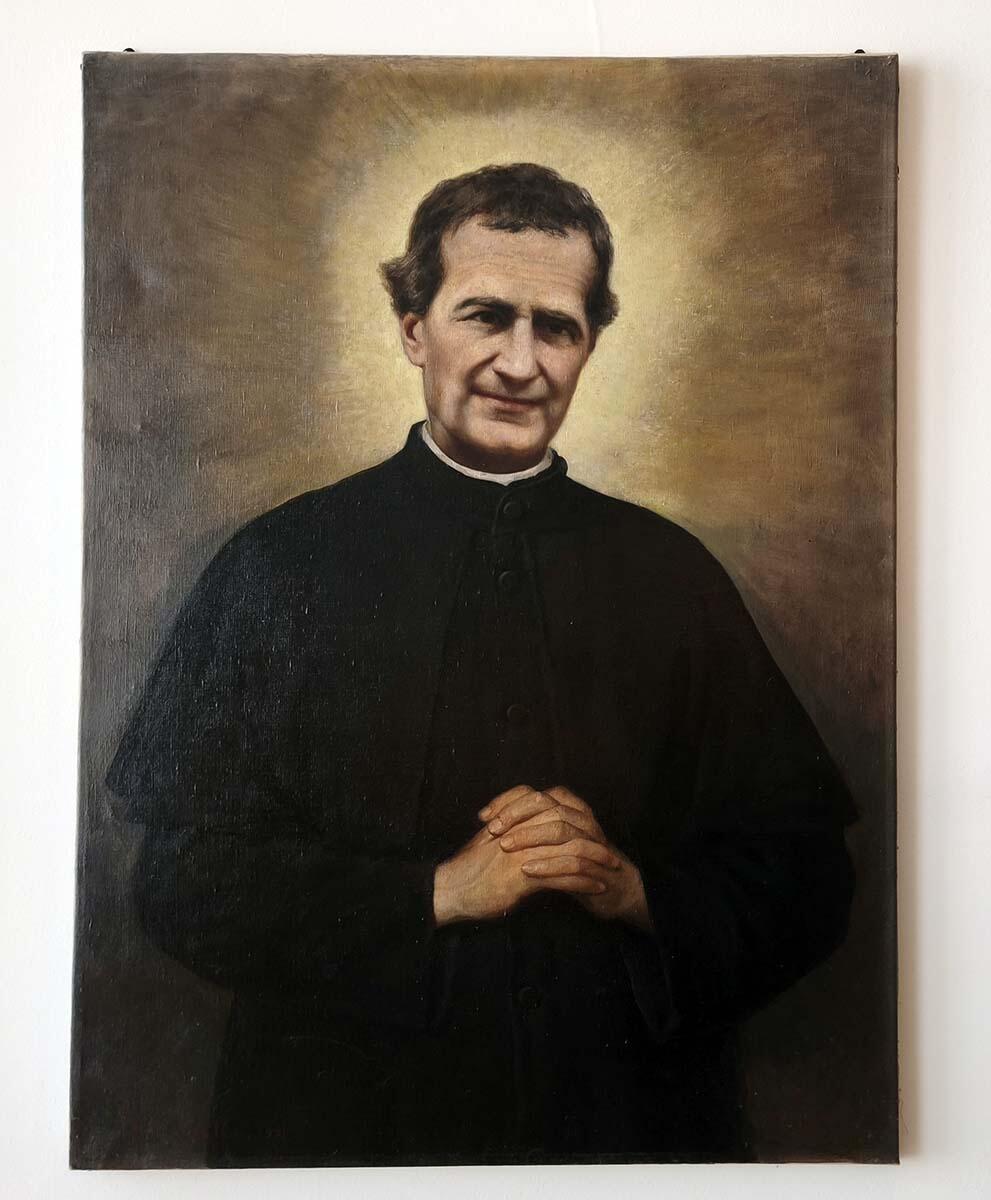
The work stands out for the precision of its brushwork and its expressive depth, thanks to the artist’s ability to capture Don Bosco’s authentic likeness on canvas. In all likelihood, the painter created a pictorial synthesis based on the famous photograph taken by Joaquin Pascual (Kimm) on 3 May 1886 in Barcelona, at Villa Martí-Codolar.
Giuseppe Cavalla occupies a prominent place in the history of Turin art. Born in Turin on 18 January 1859, Cavalla trained under the guidance of illustrious masters such as Angelo Moja, Rodolfo Morgari, Enrico Gamba and Andrea Gastaldi. His career was marked by critical acclaim: from his debut at the Società Promotrice in 1882 to his major sacred and secular commissions. In addition to Salesian subjects, his works include portraits of Cardinal Alimonda and prominent figures of Turin society. Already a lecturer at the Accademia Albertina, Cavalla was a well-known and respected name in Valdocco circles. In 1909, in fact, he produced what is considered one of the most faithful portraits of Fr Michael Rua, Don Bosco’s first successor at the helm of the Congregation. That work, executed ‘from life’ and supplemented by the study of contemporary photographs, was reproduced in Valdocco in countless lithographs which, having enjoyed widespread circulation, still adorn Salesian homes today. Today’s discovery thus confirms Cavalla as the pre-eminent interpreter of the physical features of the Founder and his first Successor.
For researchers and devotees, the emergence of this canvas represents a fundamental opportunity for study and reflection during the crucial transitional period between the Beatification (1929) and the Canonisation (1934). This discovery adds to the numerous recent studies on Salesian iconography and visual culture, delving deeper into the processes of codifying the image of the Saint through the visual arts. At the same time, the work serves as a powerful tool for devotion: in this portrait, art acts as a bridge between history and faith, allowing the viewer to glimpse, in Don Bosco’s gaze, the tireless charity of the ‘Father and Teacher of Youth’.
Ana Martín García,
General Coordinator of the Don Bosco House Museum