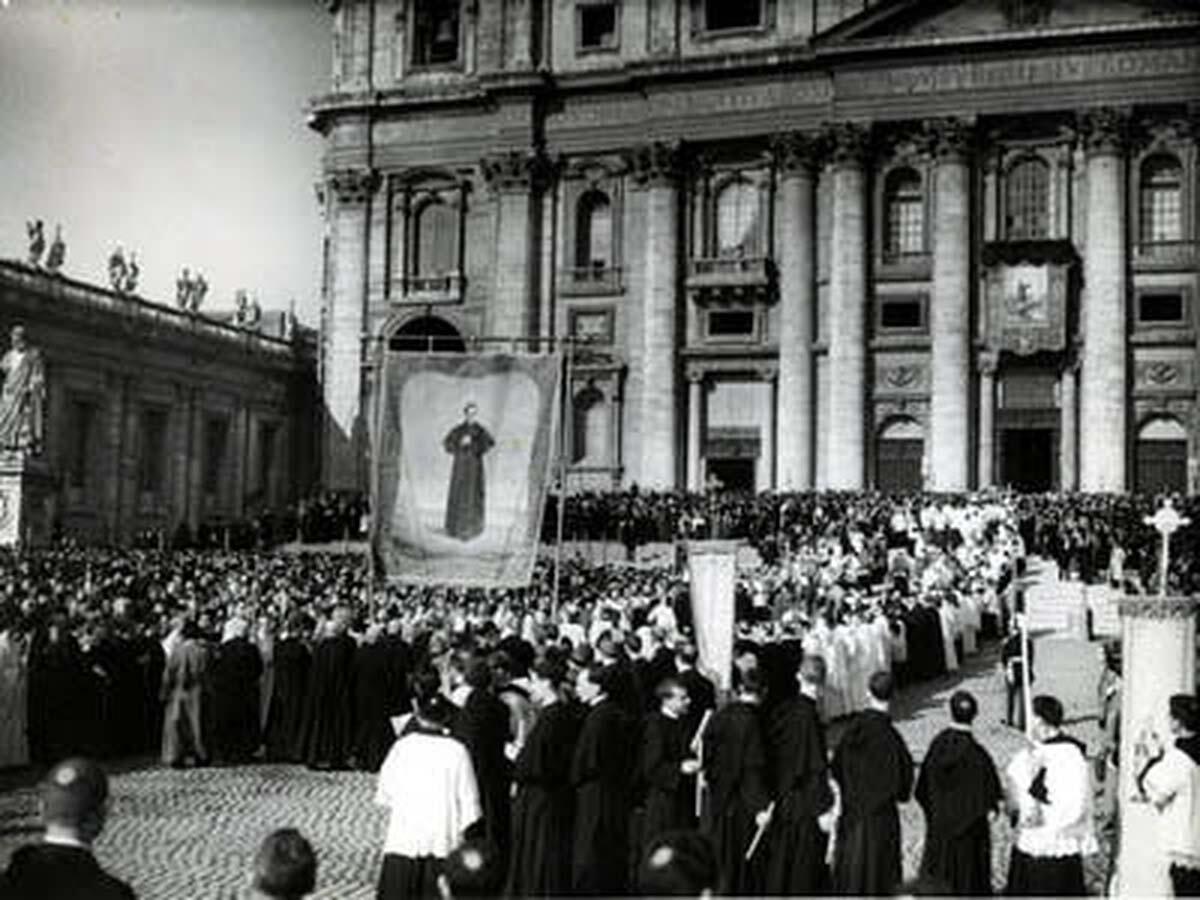
Today, that date is not simply a historical remembrance. It is a living memory that invites us to give thanks to the Lord for the wonders He continues to accomplish through Don Bosco’s intercession in the Salesian world and in the lives of so many young people.
The Miracles that Opened the Way to Canonisation
According to the norms in force at the time, in order to proclaim Don Bosco a saint, the Church required two miracles attributed to his intercession after his beatification. The journey that led Don Bosco to the honours of the altar as Blessed in 1929 had already recognised two prodigies: the miraculous healing of Teresa Callegari and that of Sister Provina Negro, a Daughter of Mary Help of Christians. However, further proofs were required for canonisation.
The two miracles officially approved for the canonisation of 1 April 1934 were the healing of Anna Maccolini and that of Caterina Lanfranchi. Both women suffered from serious illnesses that doctors considered almost hopeless. In the case of Anna Maccolini, it was a chronic and progressively disabling condition; in the case of Caterina Lanfranchi, her health was rapidly deteriorating and the prognosis was severe.
The clinical reports presented in the apostolic processes confirmed that medical treatments had produced no significant improvement. What struck the ecclesiastical commissions was the sudden and complete recovery of the two women, which occurred after prayers addressed explicitly to Don Bosco and promises of votive offerings. The expert evaluations described the healings as “instantaneous”, “complete”, and “lasting” — elements which, according to the criteria of the time, excluded any natural or accidental explanation.
The theological commissions carefully examined the connection between the prayer and the healing. The testimonies confirmed that the invocation had been directed solely to Don Bosco. No signs of suggestion or forced interpretation were detected. In this way, Anna Maccolini and Caterina Lanfranchi were recognised as witnesses of authentic miracles obtained through his intercession.
A Recognition that went beyond legal formality
The miracles were not merely a canonical requirement. They represented a spiritual sign. By proclaiming Don Bosco a saint, the Church offered the faithful — and especially young people — a model of Christian life fully realised in pastoral charity and trust in God.
The canonisation brought to a close, in an ideal sense, a question that had arisen as early as 1890: was Don Bosco merely a skilful organiser, or truly a man of God? The Church’s answer was clear and definitive. His holiness was not limited to his works; it was rooted in his union with the Lord and in his total dedication to young people.
The Miracles that continue today
Today, almost a century after that 1 April 1934, we can contemplate the miracles that Don Bosco continues to accomplish. Not only extraordinary healings, but also quiet and profound transformations that touch the hearts of young people, change lives, and rekindle hope.
Every young person who rediscovers hope, every boy who changes direction, every vocation that is born in a difficult context, every Salesian work that continues to educate and evangelise amid cultural and social crises, is a sign of the fruitfulness of his charism. In a world marked by wars, economic uncertainty, and spiritual confusion, the Salesian presence in more than 137 countries bears witness that Don Bosco’s dream has not faded. His holiness does not belong to the past. It is a reality that continues to generate life.
wp-content/uploads/images/RMG - Anniversario canonizzazione 2026