Algeria – The Pope’s Journey to Africa: a missionary and peacemaker
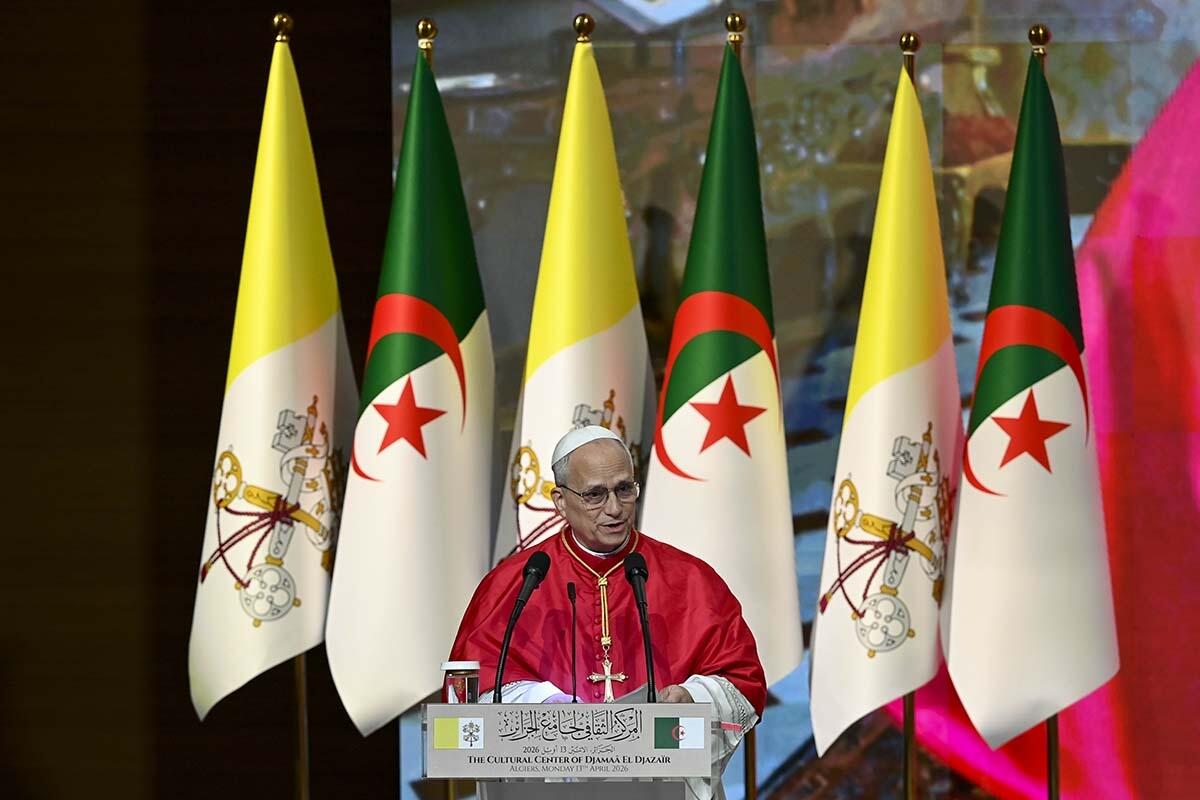
One cannot ignore the “dramatic hour in history” in which this visit takes place, with growing concern over what is happening in the Middle East and the threats of a further resurgence of conflict following the failure of the US-Iran negotiations in Pakistan. And it is significant that peace itself emerges as the main theme in Leo XIV’s first address in Algeria, during his visit to the Monument to the Martyrs of Independence, Maquam Echahid: “In this place we recall that God desires peace for every nation: a peace that is not merely the absence of conflict, but an expression of justice and dignity. And this peace, which allows us to face the future with a reconciled spirit, is possible only through forgiveness. The true struggle for liberation will be definitively won only when the peace of hearts has finally been achieved.”
He had reiterated the same message during the flight that took him to the North African country, when, in response to journalists’ questions about the criticism levelled at him by the US President, the Pope replied: “I continue to speak out strongly against war, seeking to promote peace, fostering dialogue and multilateralism with states to find solutions to problems. Too many people are suffering today, too many innocents have been killed, and I believe that someone must stand up and say that there is a better way.”
A message he then repated before the Algerian authorities, representatives of civil society and the diplomatic corps gathered at the Djamaa el Djazair conference centre, opening his address with these words: “I come to you as a witness to the peace and hope that the world so ardently desires and that your people have always sought.” That peace, to be genuine, must incorporate within it other, higher values – which the Pontiff acknowledged in the Algerian people – such as generosity and compassion, understood as the ripe fruits of true justice and true religiosity.
In the context of a country with an overwhelming Islamic majority, the Holy Father finally reflects on the opposing tendencies – fundamentalism and secularisation – which can be triggered by tensions between religious sentiment and modern life, and calls for the promotion of understanding and dialogue: “We must educate people in critical thinking and freedom, in listening and dialogue, in the trust that enables us to recognise in those who are different a fellow traveller, not a threat.”
Dialogue, respect, mutual understanding and brotherhood were themes touched upon again later by Pope Leo XIV in the early afternoon, in the pouring rain, when he visited the Great Mosque of the Algerian capital. After pausing in silent prayer beneath the great dome, in his conversation with the Rector, Mohamed Mamoun Al Qasimi, the Pope observed that “To seek God is also to recognise the image of God in every creature, a child of God, in every man and woman created in the image and likeness of God.” Therefore, it is important “to learn to live together with respect for the dignity of every human person.”
Pope Leo also praised the fact that a study centre has been established within the Mosque, because “it is important for human beings to develop the intellectual capacity that God has given to man”, in order to “discover the greatness of creation”, and because “through the search for truth”, “through study” and “with the ability to recognise the dignity of every human being”, we may “learn to respect one another, live in harmony and build a world of peace”.
On the first day of the Pope’s visit to Algeria there was still time for a private visit to Bab El Oued, at the Centre of Welcome and Friendship run by the Augustinian Missionary Sisters, to pay tribute to the Augustinians killed during the civil war.
And finally, the meeting with the small Algerian Christian community in the Basilica of Our Lady of Africa, a place of devotion also for Muslim faithful.
“You are also heirs to an even older tradition, dating back to the early centuries of Christianity,” the Holy Father recalled, before pointing out to those present three fundamental paths of Christian life: prayer, as a dialogue with God, following the example of Saint Charles de Foucauld; charity, as witnessed by the martyr of Tibhirine, Brother Luc; and once again the commitment to promoting peace and unity, for which Leo XIV finally used a meaningful simile: “A considerable part of this country’s territory is occupied by the desert, and in the desert one cannot survive alone. The harshness of nature puts any presumption of self-sufficiency into perspective and reminds us all that we need one another, and that we need God. It is the recognition of our fragility that opens the heart to mutual support and to invoking Him who can grant what no human power is capable of guaranteeing: the profound reconciliation of hearts and, with it, true peace”.