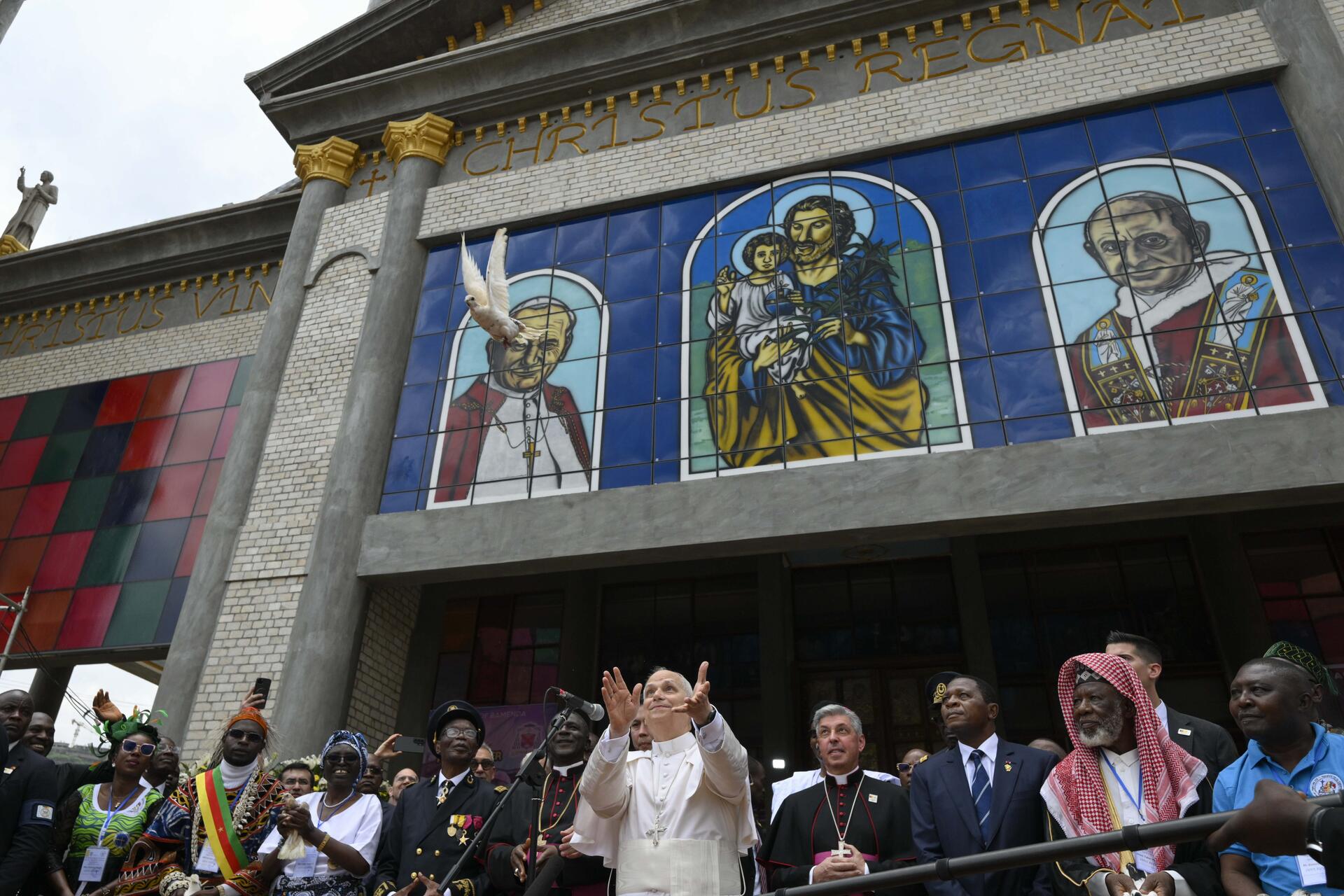
And it was of peace that the Pontiff spoke during the gathering in St Joseph’s Cathedral: a moment of great intensity punctuated by songs but above all by the enthusiasm of the faithful, perhaps still incredulous that Leo XIV could have chosen Bamenda as a stop on his journey through Cameroon. The turnout is overwhelming; amongst the pews, divided into brightly coloured sections, are all the components of this society marked by poverty and destruction. Representatives of Protestant churches, the Islamic faith, priests, religious, catechists and the faithful from various linguistic groups listen to the Pope’s words in an atmosphere of brotherhood, bolstered by the truce declared by separatist groups for the duration of his visit. A tangible sign of the need and desire to hear words of consolation and peace in a “tormented region”, as Leone describes it, a community overwhelmed “by pain” which, however, never abandoned by God, can start afresh.
Blessed are the peacemakers
Persecution and suffering make no distinction between faiths, races, languages and colours; everyone is traumatised, in need of psychological and spiritual healing. This is evident from the testimonies presented to the Pope, who praises the work of the Peace Movement led by Christian and Muslim communities in their attempt to “mediate between the opposing sides”. They are the ones who bring the message of peace to the whole world, despite attempts to exploit religions.
Blessed are the peacemakers! Woe, however, to those who bend religions and the very name of God to their own military, economic and political ends, dragging what is holy into the filthiest and darkest depths. Yes, dear brothers and sisters, you who hunger and thirst for justice, you who are poor, merciful, meek and pure of heart, you who have wept—you are the light of the world!
The warlords
The mandate to be “oil poured upon human wounds” is entrusted by Leo XIV precisely to the poor, with the instruction never to lose their identity, continuing to be “the salt that gives flavour to this earth”, treasuring what has been shared “in the hour of weeping”.
And then there is the “immense task” of supporting those who have been victims of violence. The Pope addresses the women, both lay and religious, who carry out this work of accompaniment, despite the risks involved in a land where “the lords of war pretend not to know that it takes but a moment to destroy, yet often a lifetime is not enough to rebuild”.
They pretend not to see that billions of dollars are needed to kill and devastate, yet the necessary resources cannot be found to heal, to educate, to rebuild. Those who rob your land of its resources generally invest a large part of the profits in weapons, in a spiral of destabilisation and endless death.
The call for unity
All of Bamenda, wounded, places its trust in the Pope, so that we may bring this conflict to an end and return to living in lasting peace. Leo therefore points to the need to change course, for this is the moment to make a ‘U-turn’; this is the opportunity for ‘every honest conscience’ to ‘denounce and repudiate’, taking the path of sustainability ‘and human fraternity’. The call is for the unity of a people urged to look one another in the eye, with the awareness of being “immense” in the face of a world “destroyed by a few rulers” and kept standing “by a myriad of brothers and sisters in solidarity”.
Peace is not to be invented: it is to be embraced, by accepting our neighbour as a brother and as a sister. No one chooses their brothers and sisters: we must simply accept one another! We are one family and we inhabit the same home, this wonderful planet which ancient cultures have cared for over millennia.
A silent revolution
Pope Leo XIV takes his leave of Bamenda, entrusting to its people the task of reconciling themselves and, united, serving peace, “each according to their own vocation”. The communities of Bamenda, who see in him an ambassador of reconciliation and a promoter of justice, and who over time have borne witness to a “silent revolution”, are invited to continue along that same path which, despite everything, has so far prevented the crisis from degenerating into war.
The flight of the doves
In the churchyard of St Joseph’s Cathedral, Pope Leo, at the end of the meeting for peace, reiterated that “the Lord has chosen us all as workers bringing peace to this land!”, and then invited everyone to pray: “As we release these white doves, symbols of peace – these are his words – may God’s peace descend upon us all, upon this land, and keep us all united in His peace.”
Source: Vatican News
wp-content/uploads/images/CAMERUN - Bamenda Papa 2026