Angola – Pope Leo urges the nation: follow Mary “to be, like her, workers for justice and peacemakers”
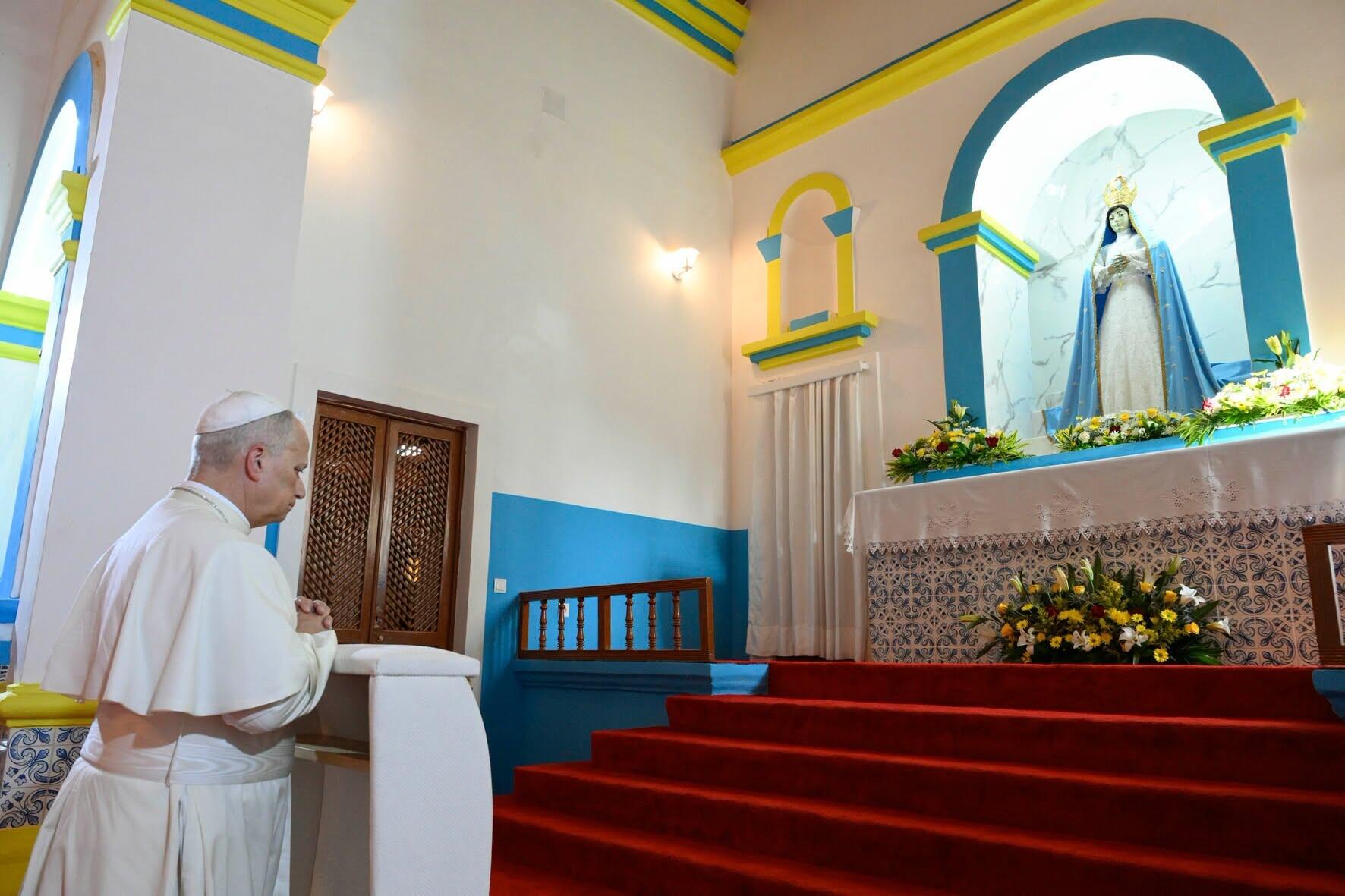
Following the very well-attended Masses presided over during the final stages of his visit to Cameroon – Friday’s Mass at the Japona Stadium in Douala, attended by 120,000 faithful; and the farewell Mass on Saturday at Yaoundé Military Airport, attended by some 200,000 people, during which he encouraged the people of Cameroon to remain steadfast in Christ so as to be “the salt and light of this land” – the Holy Father made his entry into Angola, the third stage of his apostolic journey.
The Pope has a packed schedule for this third phase of his African tour, under the motto “Pope Leo XIV, pilgrim of hope, reconciliation and peace, blesses Angola”.
It began on Saturday afternoon with a courtesy visit to the President of the Republic, João Manuel Gonçalves Lourenço, followed by a meeting in the Protocol Hall with some 400 political and religious leaders, business people, and representatives of civil society and the cultural sector.
On this occasion, the Pontiff first of all remembered the victims of the recent floods in Benguela, which caused around thirty deaths and left over 34,000 people displaced. He then highlighted the “scars” of the country’s exploitation caused by predatory “overbearing interests”: “We must break this chain of interests that reduces reality and life itself to a commodity (…) How much suffering, how many deaths, how many social and environmental disasters are brought about by this logic of extractivism!”
Instead, urging the building of a renewed country, which “can grow significantly” if its leaders are able to believe in the “multifaceted nature of its wealth”, Leone encouraged local leaders: “Do not be afraid of disagreement; do not suppress the ideas of the young or the dreams of the elderly; and know how to manage conflicts by transforming them into paths of renewal. Place the common good before every particular interest, never confusing your own part with the whole. History will then vindicate you, even if in the near term some may oppose you”.
There were two key events on Sunday: Mass for the Third Sunday of Easter in Kilamba; and in the afternoon, the Rosary on the esplanade in front of the Marian Mama Muxima Shrine.
At the first of these two events, before some 100,000 faithful, and commenting on the Gospel passage about the disciples of Emmaus, Leo XIV compared the nation’s journey to that of the two disciples, noting that in the face of setbacks one can lose hope and remain “paralysed by discouragement”.
The solution, for the people of Angola, as for the two disciples of Emmaus, does not stem from the implementation of a strategy of their own: it is a gift, which comes from on high. “The Lord walks alongside the two disappointed disciples, who are running out of hope, and, becoming their travelling companion, helps them to piece together the fragments of that story, to look beyond the pain (…). Here, too, for us, for you, dear Angolan brothers and sisters, is the path to a new beginning: on the one hand, the certainty that the Lord accompanies us and has compassion on us; on the other, the commitment he asks of us”.
At the same time, and precisely out of fidelity to the Lord, the Holy Father did not fail to address the local reality, urging people not to mix faith with “magical and superstitious elements that do not aid the spiritual journey”; and he prayed for the Angolans, in a country scarred by a long civil war, for a Church that would accompany them and heed “the cry of its children”.
In the afternoon, amidst the enthusiasm and devotion of 30,000 people, at the Mamã Muxima Shrine – an ancient place of worship dating back to the 17th century, situated where Portuguese colonisers used to sort goods and enslaved people for deportation to Brazil – the Pope led the recitation of the Rosary, with the various mysteries introduced by a young man, a child, a family, a religious sister and a seminarian.
The Pontiff then spoke and, in his address delivered in Portuguese, called for a commitment to “love every person with a mother’s heart, in a concrete and generous way” and to devote oneself “especially to the poorest”.
“It is love that must triumph, not war! This is what the heart of Mary, the heart of the Mother of us all, teaches us” was the central message of his address, in which he made a heartfelt appeal to young people, urging them “to build a better world”, where there is no longer any “injustice”.
For everyone, the example is Mary: “Our Lady asks us to let ourselves be moved by the sentiments of her heart, so that, like her, we may be workers for justice and bearers of peace.”