Upon arrival at Mengomeyén International Airport, near Mongomo, the Pontiff proceeded to the Cathedral of the Immaculate Conception and presided over Mass for the thousands of Christians gathered for the occasion.
Before entering the church, the Pontiff blessed the foundation stone for the construction of the future “City of Peace” cathedral. Then, in his homily, delivered in Spanish – the national language – the Holy Father explained that proclaiming the Gospel can sometimes come at the price of persecution, as recalled in the reading from the Acts of the Apostles. But the Gospel of John, he emphasised, reminds us that Christ “will not let us lack the signs of his presence”, satisfying our hunger with the bread of life.
In a country rich in oil and natural gas reserves, the Holy Father also encouraged the creation of “spaces of freedom” that safeguard human dignity, especially that of the most vulnerable: the poor, families in difficulty, and prisoners, “who are often forced to live in worrying hygienic and sanitary conditions”.
For this reason, at the end of his homily, the Pope invited the Christians of Equatorial Guinea to “continue the work that the missionaries began 170 years ago”, building a “future of hope, peace and reconciliation”.
And after the celebration, before leaving for Bata, the Pope also opened and visited the “Pope Francis” Technical School, an educational facility in Mongomo named after the Argentine Pontiff, just a few metres from the Basilica.
In the densely populated coastal city of Bata, considered the economic capital of Equatorial Guinea, Pope Francis first visited a place of suffering – the city prison – bringing, as always, his message of peace and hope.
Bata Prison is one of the largest in Guinea and has a capacity of 1,000 inmates. There are currently over 650, including both men and women. To all of them, the Holy Father delivered the most liberating message possible: “No one is excluded from God’s love! Each of us, with our own story, our own mistakes and our own sufferings, continues to be precious in the eyes of the Lord.”
His words touched the hearts of those present, who, despite the rain, danced and sang, repeatedly chanting: “Libertad! Libertad!”.
The Bishop of Rome also reflected on the concept of “true justice”, that which “seeks not so much to punish, but above all to help rebuild the lives of victims, of the guilty, and of communities wounded by evil”. And to those who think only of “imprisonment”, he pointed the way towards “inclusion” as well.
“You too are part of this country,” he said. “Your families, your communities and your faith are a great strength for this nation.”
Thus, after kindling in the prisoners the flame of courage, pride and hope, he urged them to seize the opportunity for a fresh start: “Life is not defined solely by the mistakes one has made, which are generally the result of difficult and complex circumstances: there is always the chance to get back on one’s feet, to learn and to become a new person.”
Later in the day, the Bishop of Rome paid tribute to the monument commemorating the suffering and sacrifice of the victims of the explosion at the Nkoantoma military base in 2021, which claimed at least 107 lives and left over 600 injured. Stepping out of the car, he paused in silent prayer, hands clasped and head bowed, for a brief moment of quiet reflection; he then imparted his blessing on this place, which bears witness to the unhealed scars of a tragedy whose true causes remain unknown.
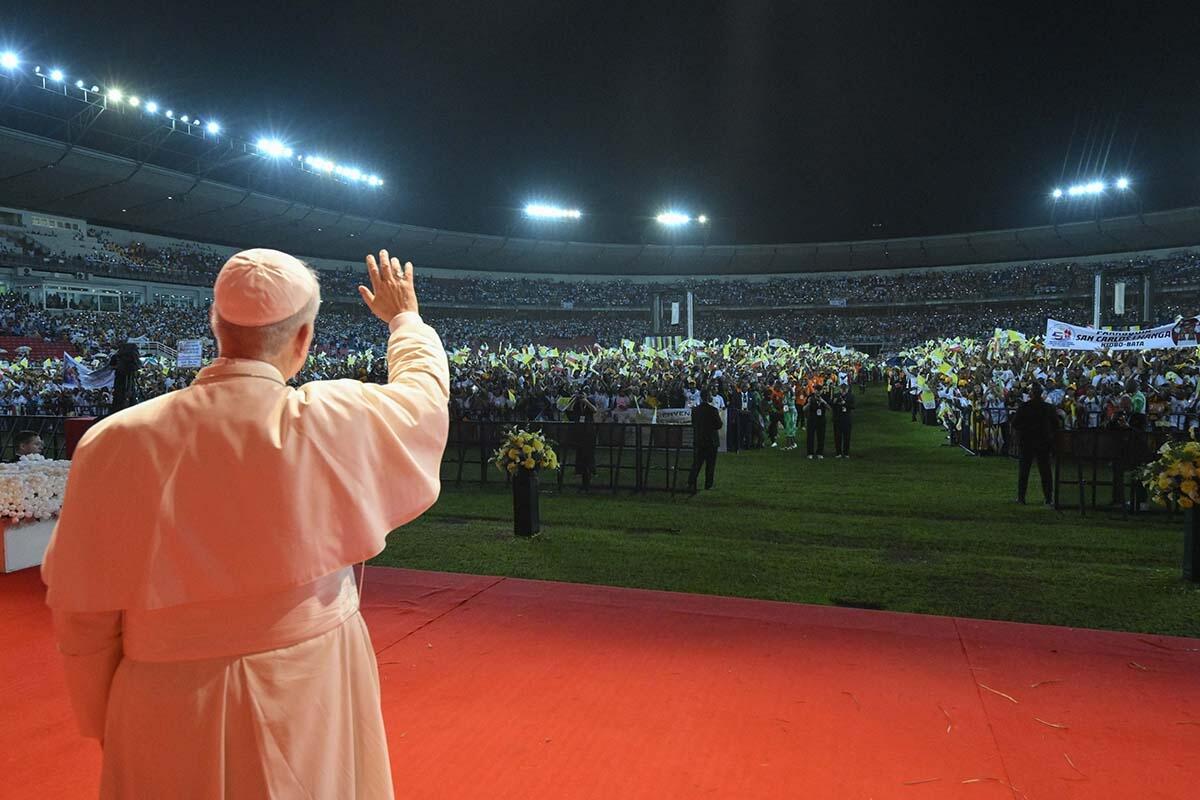
Finally, in the last engagement of the day before returning to Malabo in the evening, the Holy Father met with young people and families at the stadium in Bata. The Pope listened attentively to the testimonies of the local people, from the challenges faced by women in the workplace to those posed by married life.
Delivering his address with great emphasis to the thousands of young men and women present, Leo XIV traced the history and traditions of Equatorial Guinea, beginning with the customs and symbols through which each group expresses its identity: “It is this luminous and demanding heritage of which you, dear young people, are called to be, in faith, the foundation of your future and of this land. ‘The future is yours!’ he declared.
Then, the Pontiff addressed the many families present, ‘the fertile soil in which the fresh and fragile tree of your human and Christian growth sinks its roots’. Being spouses and parents, he told them, is an “exciting mission”, to be lived day by day in a covenant that is renewed, becoming “co-creators, together with God, of the miracle of life and builders of happiness (…) Prepare yourselves to live this calling as a journey of true love, which grows in freedom; a journey of hope born of the awareness that God does not abandon you; a journey of holiness that always seeks the good and happiness of the other.”