Italy – ‘The Gospel is a celebration’: lectio divina on the wedding at Cana at SFSD2026
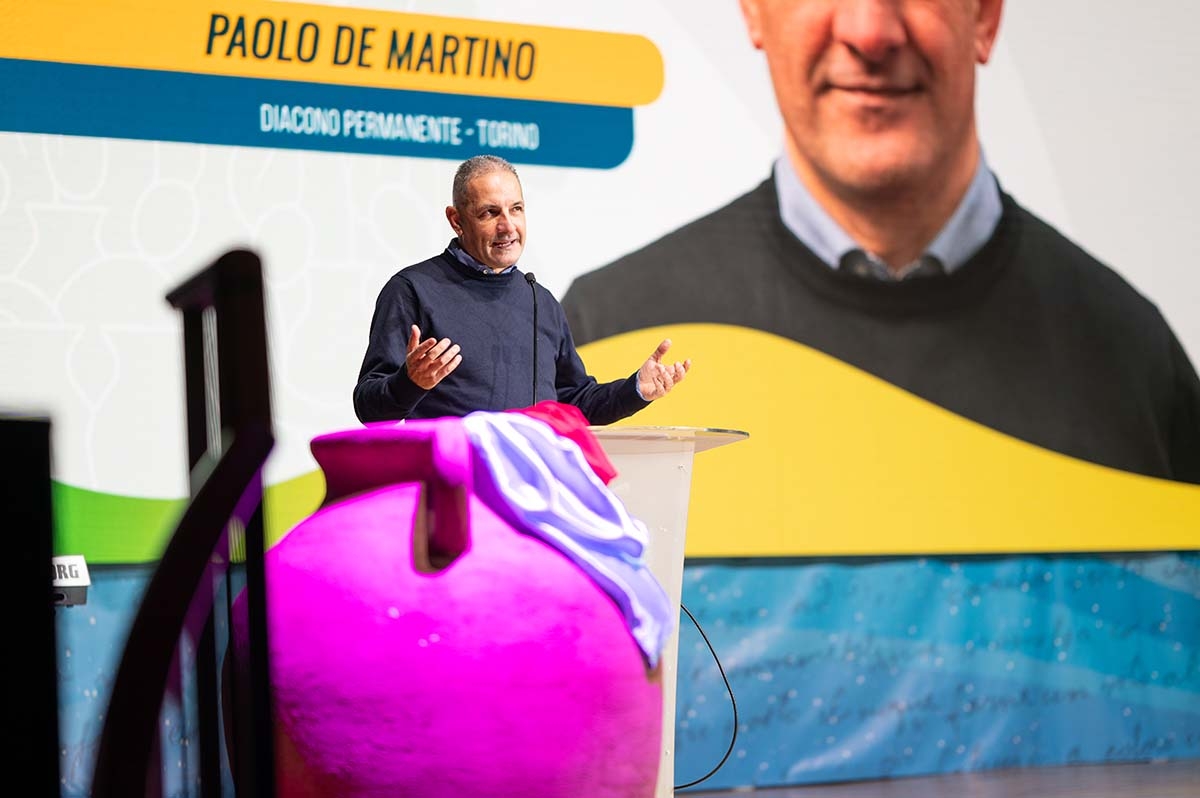
Proposed as a central moment of listening, prayer and internalisation on Friday morning, the meditation, significantly entitled ‘The Gospel is a celebration’, offered a profound and spiritually dense re-reading of one of the best-known texts of John’s Gospel, highlighting its symbolic power and its relevance for Christian and Salesian life.
The Gospel scene – the first of the miraculous signs reported by John – opens in a context of joy, relationships and shared celebration. For this reason alone, the speaker emphasised how the Gospel does not distance itself from concrete life, but enters fully into its human dynamics, and not only the hardest or most painful ones: ‘Slaves and lepers cried out their despair, and Jesus begins not with them but with a wedding feast. There must be something very important underneath: it is the new face of God, a God who comes as a feast.’
So if the feast is the context, the protagonist is wine, which runs out: ‘It is not bread that runs out, not what is necessary for life, but wine, which is not indispensable, but “something extra” that is useless, except at a feast or for the quality of life,’ De Martino noted. And the one who notices this is Mary, who ‘at Cana is the Help of Christians par excellence’. In fact, she ‘participates in the feast, converses, eats, laughs, tastes the wine, dances, but at the same time observes what is happening around her’ with an attention that ‘is already a form of prayer.’
Her invitation to the servants – ‘Do whatever he tells yout’ – are the first and only words spoken by Mary in the Gospel of John, and have been presented as a summary of the attitude of the believer capable of immediately uniting saying and doing, of opening up new spaces even when one does not fully understand what is happening.
The text proposed for meditation also highlighted how the sign performed by Jesus is not a spectacular gesture, but a silent, almost hidden action which takes place through the collaboration of others. The jars filled with water, the service of the servants, the simple obedience to the word received become an integral part of the miracle. In this sense, it was emphasised that Jesus does not create wine, but takes water – ‘the simplest and most mundane thing there isì – so that he can transform it into something precious and joyful. This is what God does with all human lives: whether small or great, God dwells in them in everyday life, and, if welcomed, can transform them into something beautiful.
‘How wonderful to know that God does not change our lives, but transforms them. It is water that is transformed into wine. God needs something that is already given, something that has already happened, in order to accomplish his work. That is why he will use my humanity, which is unclean to me but precious to him, so much so that it becomes the object of a miracle,’ the deacon observed towards the end.
For this reason, the speaker urged all those present with great emphasis: ‘When we continue to believe, to belong to the Church, to the Salesian Family, despite its obvious limitations, when we do not give up in our sad suburbs and gather to pray, to talk about Christ, to proclaim the Word, we are filling the jars.’
And, looking ahead to the new year that has just begun, he wished: ‘As at Cana, so begins this year of the Salesian Family, with simplicity and wonder. Whatever happens, this year is the year in which we want to give the Lord our imperfect fidelity, our petrified lives, to see them transformed into the new wine of the Kingdom.’
With such richness and depth of input, the lectio divina helped the participants to connect the Gospel to the concrete life of the Salesian Family, exhorting each of those present – and the thousands of people connected via live streaming – to be a sign of credible joy in today’s world.
At the end of this session, the participants were divided into groups by language to continue reflecting on these themes, aided by some questions proposed for meditation. Later in the morning, what was shared in the groups was summarised and concluded in the form of a prayer.
More photos from the day are available on ANSFlickr.