Portugal – ‘Yours is a welcoming province, where I felt at home’: interview with the General Councillor for the Mediterranean Region, Fr Juan Carlos Pérez Godoy
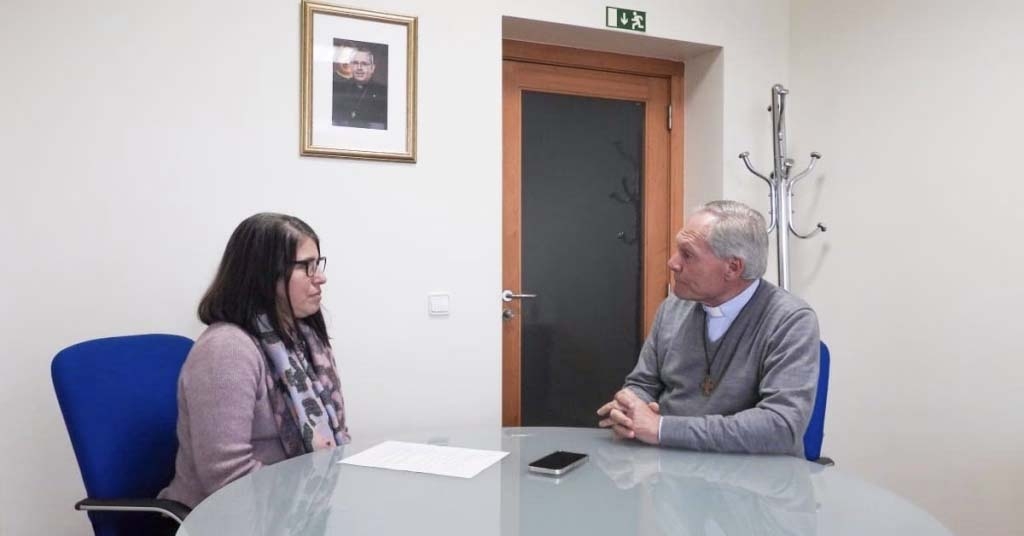
What is an Extraordinary Visitation? Who conducts it?
An Extraordinary Visitation is an important moment for all Salesian provinces. It is a visit that our Constitutions require the Rector Major to make every six years to all the provinces of the Congregation. The same article establishes that this can be carried out by a visitor, a delegate, since it is impossible for the Rector Major to make all the Extraordinary Visitations.
What is the importance of Extraordinary Visitations? What do they represent for the province that receives them?
They allow the Rector Major and the General Council to gain a deeper understanding of the reality of each province, each house and the religious. Therefore, after each Visitation a report is prepared and presented to the General Council and the Rector Major. After examining this report, the Rector Major writes a letter to the respective Provincial.
What were the main reasons for this visit to the Portuguese Province?
It is mainly the need to establish very close relations between each province and the Rector Major, so that he can encourage and guide them.
How do you see the current reality of the Portuguese province?
It is a beautiful, coherent reality with great Salesian vitality. When you arrive at the houses – 10 in all, including the one in Cape Verde – you breathe a typically Salesian atmosphere made up of closeness to young people and a family spirit.
What aspects of the Salesian mission in Portugal touch you most deeply?
I greatly appreciated the Feast of Youth Holiness, the first of its kind that I have encountered in a province. It was significant to see how the young people celebrated this reality! I was also touched by the serenity of life in the communities. I can say that yours is a welcoming province, where I felt at home.
How do you assess the role of the Salesian presence in the Portuguese educational context?
This is a province strongly characterised by its school system, which is very well managed and has a strong Salesian identity. Salesian schools in Portugal achieve a level of excellence, not only for their educational results, but also because they represent a favourable space for carrying out the Salesian mission: to educate and evangelise. If there is one place where the combination of evangelising-educating, educating-evangelising, can be realised most fully, it is in the school. And that is why I so much appreciate all the activities that this province has developed around the school environment.
In your opinion, what are the major challenges facing the Salesian Congregation today at a global level?
I would say that the first challenge for the Congregation is to reach young people. In a world characterised by great cultural, ethnic, religious and socio-cultural diversity among young people, reaching them all remains a great challenge. On the other hand, reaching the poorest young people through education is also a great challenge, whether in oratories, parishes or social works.
Caring for the poorest and most excluded is a priority in the Salesian charism. What are the new forms of poverty that challenge the Congregation today?
Today, there are many forms of poverty among young people. I think that saying ‘young people’ today, looking at the global world, often means saying ‘poverty’. It is true that we have many young people in welfare societies, but the Congregation is globally located in poor places where others do not go. And that is where we are.
There is much talk about the decline in vocations in Europe. How is the Congregation trying to respond to this challenge?
The Congregation is committed to helping every Salesian to be a good Salesian, to live their vocation with joy and happiness, because only in this way can we “infect” our reality and those around us. The question of vocations is complex and depends on several factors. For example, we do not have enough young people and the birth rate is steadily declining. But when I look at our reality, I am not one of those who constantly demonises our culture. We have many beautiful things, but I must acknowledge that our culture is not a vocational culture.
What role do lay people play in the Salesian mission today?
They play a very important role. It is true that we must continue to make progress, but since the Congregation addressed this issue in 1996, during the 24th General Chapter, it has never ceased to insist on this reality. The challenge now is also to accompany all these lay people, not only so that they share a job, but above all so that they share the spirit of Don Bosco and the Salesian mission.
In the year that marks the 150th anniversary of the First Missionary Expedition, what missionary horizons are opening up for the Salesians today?
The Congregation is not abandoning the missionary horizon! We have just founded a mission in Greece, we are waiting to enter Algeria, and we have many missionary fronts. In this province, for example, many young people from Cape Verde are waiting for Don Bosco to give them an answer.
The Congregation has begun a new phase with the election of the new Rector Major. What characteristics do you highlight in his personality and leadership?
Certainly his attention to the individual, to the lives of each person. Then his constant availability and his great intellectual capacity. He has a predisposition for languages, which allows him to connect with people. He obviously has an immense love for Don Bosco and strongly insists that we must get to know him.
In what aspects can the Congregation observe continuity and in what aspects can it observe novelty?
When a new Rector Major arrives, he is the Successor of Don Bosco, so it is Don Bosco himself who guarantees continuity. The Programmatic Guidelines, however, clearly introduce elements of novelty. Just think that we are called to reflect on topics such as Artificial Intelligence. In conclusion, if the first and second lines are in continuity with the previous General Chapter, the last two represent a novelty.
At the end of this Extraordinary Visitation, what message would you like to leave to the young people, the Salesians and the Salesian Family in Portugal?
For me, this is the message: ‘The Lord is with us, the Lord accompanies us, the Lord does not abandon us. The only thing we have to do is open our hearts to Him.’ It is therefore a message of hope! Yes, it is true, we have difficulties, but we can build a future of hope, especially for young people, who are not just simple recipients, but are entrusted to us by the Lord for a journey to be travelled together.
In the long interview, Fr Godoy goes on to recount his vocational journey, which began at the age of 10 when he met the Salesians in Utrera. During a retreat, a decisive phrase (‘the happiness of many depends on your yes or no’) led him to choose the Salesian life, with the support of his parents. He entered the Congregation at a very young age, studied, taught and held various positions of responsibility in youth ministry and in the government of the Salesian provinces in Spain. He became Superior first in Seville and then in Madrid, participating in the General Chapters, in which he was elected – and then confirmed – as Regional Councillor for the Mediterranean Region.
The full text, in Portuguese, is available here, on the website of the Salesians of Portugal.