Italy – Don Bosco’s dreams: Catechesis in the form of stories for children
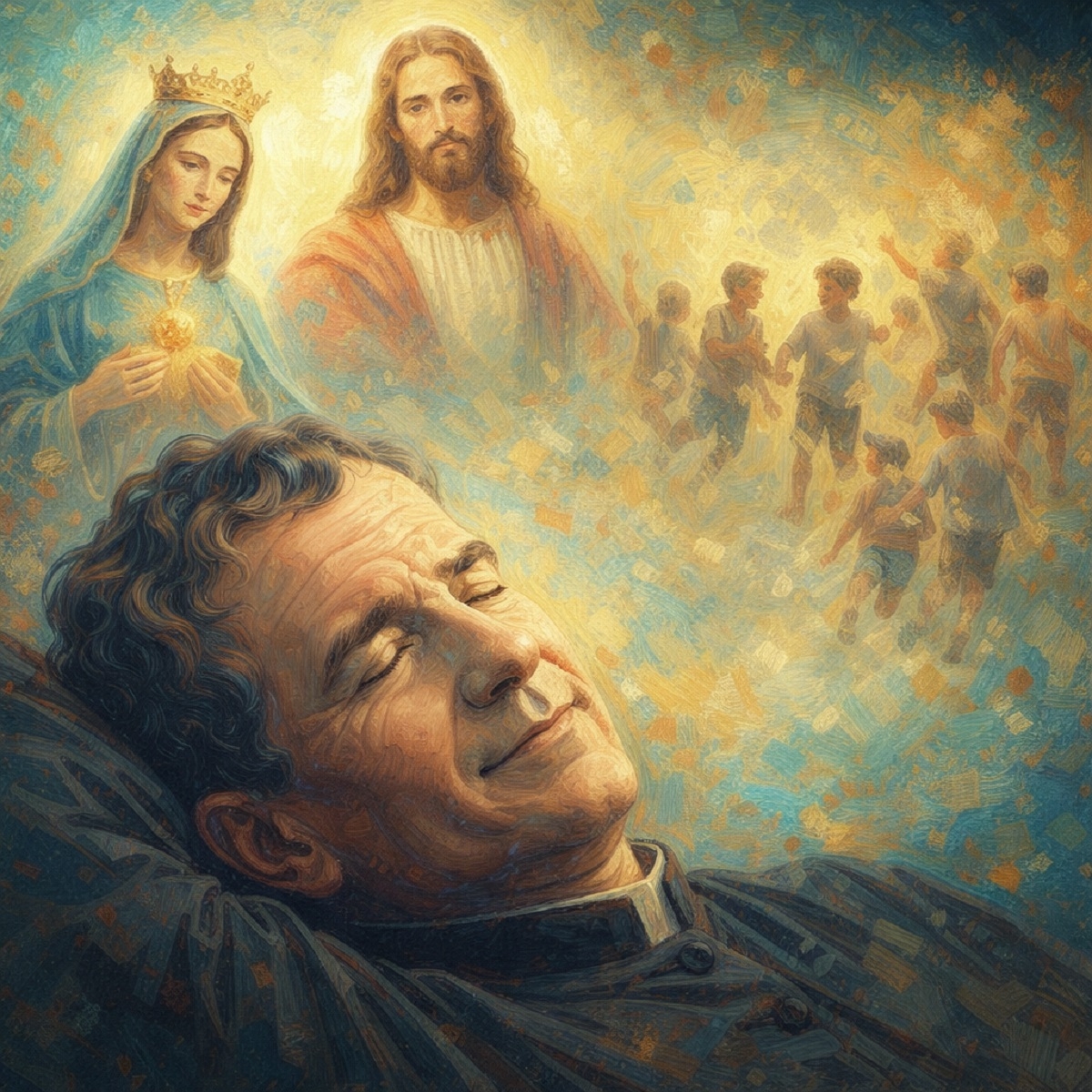
Although rich in symbols and sometimes strong with dramatic images, Don Bosco’s dreams are never oriented towards fear for its own sake. On the contrary, they always lead to salvation, mercy and hope. Even when they warn against evil or its consequences, they do so with a paternal gaze, offering young people the opportunity to choose good and change their ways.
The famous dream at the age of nine is only the first in a long series. This is followed by missionary dreams, in which Don Bosco contemplates distant lands and peoples awaiting the proclamation of the Gospel; vocational dreams, which help him to intuit the path of certain young people; and warning dreams, in which moral or spiritual dangers to be prevented emerge. An important introduction to the study of dreams emphasises how they ‘enabled Don Bosco to perceive hidden facts or future events’, without, however, replacing discernment and verification in reality. Don Bosco himself waited to see ‘how things would turn out’ before drawing definitive conclusions. This balance between openness to mystery and concrete prudence is in itself a lesson in intelligent faith for young people.
For the young people of the Oratory, dreams were indeed a true ‘catechesis in the form of a story’. Ananalysis of the nine-year-old’s dream, for example, highlights the presence of strongly educational elements: the courtyard full of children, the figure of Christ, Mary as Teacher, the transformation of animals into joyful young people. Through these images, Don Bosco manages to talk about sin and grace, vocation and Christian happiness, without resorting to abstract or moralistic explanations. The images remain impressed, stimulate the imagination and open the heart to the question of the meaning of life.
The same reflection highlights how Don Bosco, as he grew up, developed a true pedagogy of celebration linked to dreams. Theatre, games, music, liturgical celebrations and moments of shared joy became the concrete way to realise that vision of a lively courtyard, where the Lord passes by, meets and transforms. Catechesis is not limited to words, but takes shape in an environment that educates through beauty, relationship and participation.
Why do Don Bosco’s dreams still speak to young people today? Because they are stories with young protagonists, immersed in very real dynamics: friendships, conflicts, difficult choices, dangers, the desire for happiness. At the same time, they open our eyes to a God who accompanies, calls, corrects and protects. For an educator, these dreams can become little parables: opportunities to address sensitive issues – the use of time, companionship, vocation, purity of heart, mercy – starting from images and stories, not moralising speeches.
Thus, even today, Don Bosco’s dreams reveal themselves to be a very contemporary form of narrative catechesis: a Gospel told through images, capable of educating not only the mind, but also the hearts and imaginations of young people. A language that is both simple and profound, which continues to speak to new generations and show them a path of joy, faith and hope.