Italy – Young people, protagonism and witness: Fr Fabio Attard in dialogue with the SYM at the Sacred Heart Basilica
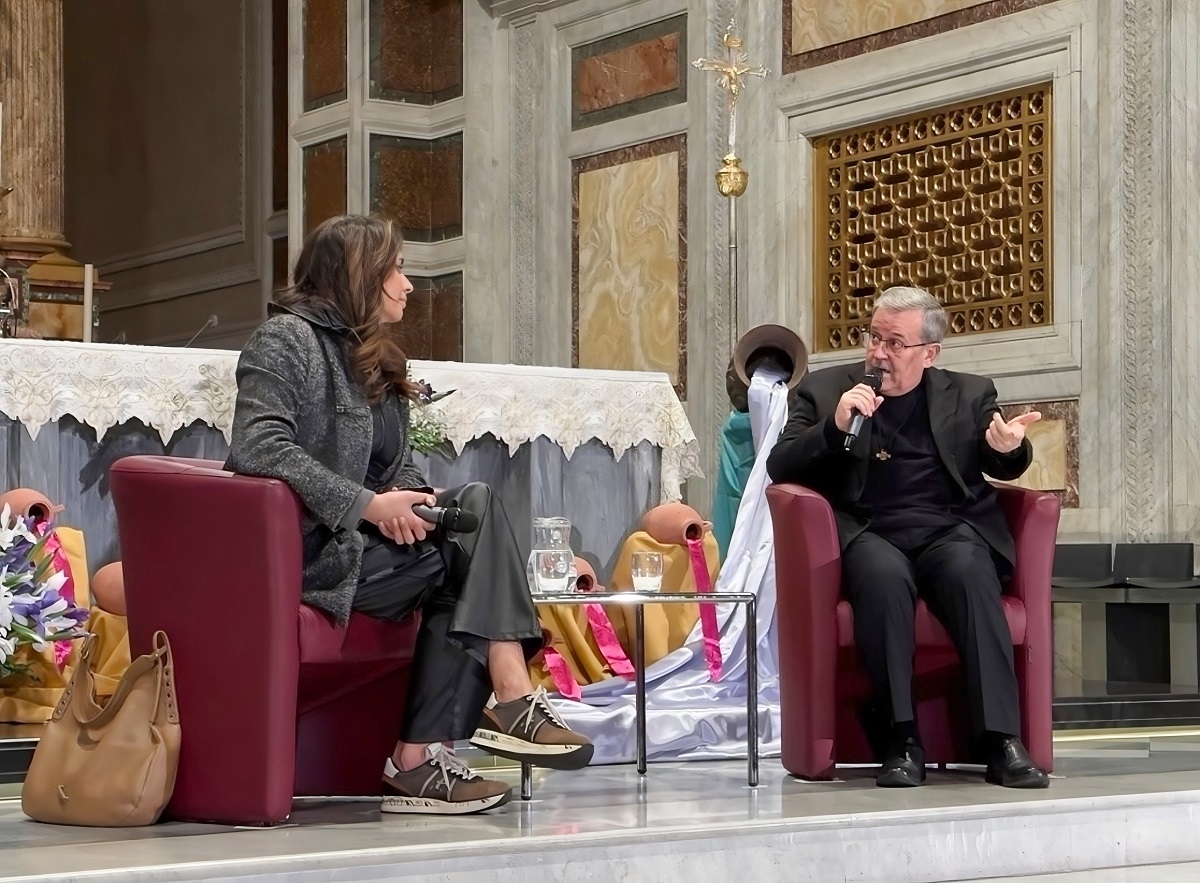
The evening was opened by Fr Francesco Marcoccio, Rector of the Basilica of the Sacred Heart, who greeted those present by recalling the value of the Salesian charism and its vital link with young people and with the educational journey of the Church.
In her introductory words, Benedetta Rinaldi shared a personal testimony, recalling her experience in the Salesian Youth Movement and acknowledging how the joy, smiles and accompaniment she received had profoundly marked her human and professional journey. This led to the first question addressed to the Rector Major: how can we live our Christian identity today in a world that often discourages confrontation and rewards popularity?
Fr Fabio Attard responded by placing the question in the current context, marked by fragility and fears but also by a strong desire for meaning. The world has changed, he said, but young people have not lost the ability to seek authentic happiness. In this scenario, the Salesian group is not a refuge from the world, but a ‘furnace’ that forms internally and prepares one to face reality with a solid backbone, capable of witnessing without aggression and without compromise.
Returning to the theme of the group, the moderator highlighted the risk that youth experiences may become exhausted or self-referential. Fr Attard responded clearly: an authentically Salesian group is by its very nature “outgoing”. It is not a place that holds back, but an environment that generates responsibility and restitution. The group, he emphasised, does not simply offer activities, but creates relationships and forms people capable of serving others.
In this regard, the Rector Major shared experiences gained in various international contexts – from Spain to Latin America – telling of young people who choose to “give” what they have received in oratories and youth centres. These are often silent gestures, but ones that are full of evangelical power, making the group a light and support for the most fragile.
The dialogue then entered its most intense moment with the second question: ‘How do we forgive, even when we don’t want to forgive?’ Fr Attard clarified that forgiveness does not come from a voluntary effort. Forgiving does not mean denying pain or justifying evil, but choosing not to remain prisoners of the wound. Often, he explained, forgiveness is a decision that precedes the feeling: entrusting to God what the heart cannot yet resolve. It is a journey that requires time, truth and accompaniment, but one that makes the future possible, even in the life of groups.
In this context, the Rector Major emphasised that the experience of the group does not belong to the past, but is a living heritage. It is not a phase to be archived, but an educational and spiritual legacy that continues to guide choices, relationships and responsibilities over time.
The third question, asked by Benedetta Rinaldi, concerned the theme of youth protagonism, often reduced to visibility and personal success. Fr Attard clarified that protagonism, in the Salesian charism, means taking on real responsibilities. Don Bosco entrusted real tasks to young people because he believed in their abilities: emblematic is the figure of Michele Rua, called to lead an oratory at only sixteen years of age. Being protagonists does not mean appearing, but serving and building.
The dialogue concluded with a question from the young people about how Fr Fabio Attard had experienced while accompanying young people in his ministry. With simplicity and gratitude, the Rector Major described accompaniment as one of the most demanding and fruitful experiences: walking alongside without replacing, respecting times and fragility. In relationships with young people, he added, it is often the educators who are transformed: young people educate adults in hope.
In the atmosphere of the Triduum and in preparation for the Feast of Don Bosco, the evening dialogue left a clear message: only young people capable of forgiveness, responsibility and joy can become credible signs of hope in today’s world.