Italy – The death of Saint Dominic Savio as told to today’s youth
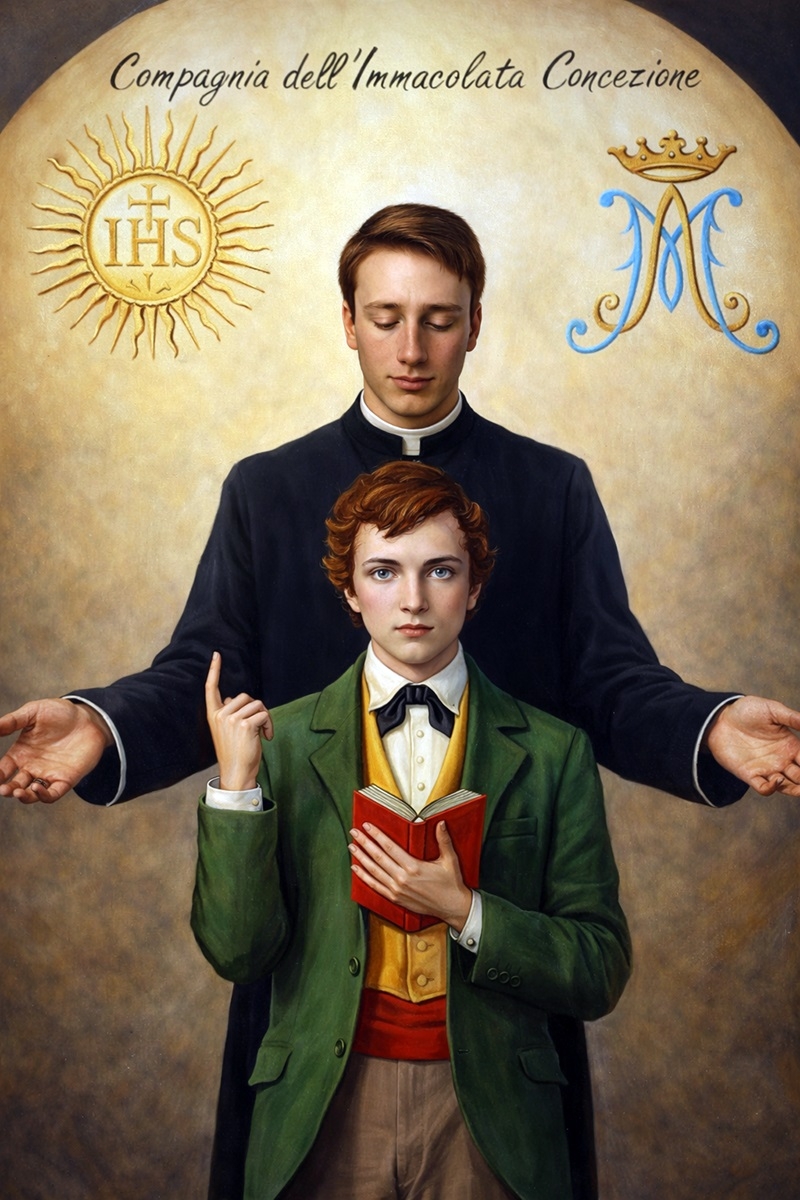
The ‘Life of Dominic Savio’ written by Don Bosco, which had been a fixed point for the previous 110 years, became a starting point in 1967. Everyone felt the need to compose a ‘Life’ rooted in tradition, but truly new, that is, truly post-conciliar, attentive to the saint to be admired and imitated, but equally attentive to the boy in flesh and blood, to be understood and welcomed.
The writing process, begun and carried out by Salesian historians and biographers, was recently completed by research and studies conducted by Ornella Ceruti on behalf of the Nebbiuno Immaculate Conception Sodality.
The project, which took fifteen years of work, achieved the desired result because it was inspired by the heart of Dominic Savio. The traditional ‘Life’ tells the story only from the point of view of Don Bosco’s heart as an educator. The new ‘Life’ tells the story from the point of view of Dominic Savio’s heart, who, like all young people, lived for friendship.
The life of St Dominic Savio reinterpreted by “La Compagnia dell’Immacolata Concezione” (The Immaculate Conception Sodality) Nebbiuno
For Dominic Savio (1842-1857), it was not only his friendship with Jesus and Mary that was vital, but also his friendship with Giovanni Massaglia of Marmorito (now Marmorito di Aramengo, 1838-1856), in whom, when they were 11 and 15 years old respectively, he found a providential older brother who had a positive influence on his future. Together they quickly reached the summit of holiness, together they founded the Immaculate Conception Sodality, the embryo of the emerging Salesian Congregation and a breeding ground for Salesian priestly vocations, including missionary ones.
Therefore, Dominic’s real secret is the treasure he finds by putting into practice the basic and ever-valid lesson of good friendships, thanks to which it is possible to maintain good intentions and achieve extraordinary goals, even when starting from a disadvantaged position.
Despite being hampered by his innate lung weakness, Dominic manages to go far and reach high, because his companion on the journey has the same aspirations to the priesthood and holiness (guaranteed by Don Bosco) and the same moral and mystical virtues (ascertained by Fr Caviglia and Fr Molineris), added to the good fortune of being healthy and robust and four years ahead in age and studies (the same age as Cagliero and Rua, a son of Don Bosco since 1853 and a cleric of Don Bosco since 1855).
The story of Dominic Savio is nothing more than the story of his friendship with Giovanni Massaglia, which began in Mondonio in 1853 and matured and flourished during the school year 1854/55 and the first half of the following year, a period in which both were members of Don Bosco’s Oratory. Bearing this bond in mind, all the scenarios of Dominic’s life, including the last ones, are revealed and understood in depth, because they take on the human depth of real life.
Coming to the epilogue, what Don Bosco had foreseen in a dream comes to pass. In fact, the holy friendship that makes them inseparable also leads them to share pulmonary tuberculosis. The disease, contracted from his frail companion, took Massaglia away in just three months, spent with his family († 20 May 1856, aged 18), and his end was the beginning of the end for Savio.
Don Bosco writes: ‘At the loss of this true friend, who had worked so hard for his good, Dominic was deeply saddened and, for the first time, I saw his face saddened and weeping with grief. He mourned him for several days and, throughout the time he survived him, he always kept him in mind and repeatedly expressed his desire to join him in Heaven. His only comfort was to remember him in the Lord, especially when he went to Holy Communion, which they used to receive together. This loss was a very hard blow to Dominic’s tender heart, and his already precarious health suffered considerably as a result.’
In the summer and autumn of 1856, Dominic spent long periods of illness with his family. During the first half of the 1856/57 school year, he was present at the Oratory but unable to attend school regularly and often unable to get out of bed. On 1 March 1857, he left Don Bosco’s house for good, knowing that he was a few steps away from the reward promised to him by the Lord.
He spent his last eight days at home. During the last five days, he received visits from the surgeon, who tried to cure him by performing bloodletting, and from the parish priest, who administered the Sacraments of the Sick. While going through these experiences, which exhausted his strength, Dominic was not alone, because the Savio family was large and loved by their neighbours and fellow villagers.
However, it is as if he were alone, because the only person he would like to have by his side is the friend who preceded him to Heaven and who can therefore only comfort him spiritually. This spiritual presence becomes almost palpable when he welcomes it into his heart by consuming Viaticum, the last Communion of his life. And, at this point, for ten months now, when he gathers himself in the Lord or takes courage, Dominic has been placing his hand on his chest, a gesture that encompasses a world, because the pocket of his shirt holds all that remains of Giovanni, namely his farewell letter, which ends as follows: ‘Dear Dominic, remember me with all your heart in the Lord, especially when you receive Holy Communion, and take courage. The holy and loving will of God is now about to separate us, but one day we will be friends forever in happy eternity.’
On 9 March, late in the evening, this prospect draws nearer and the boy awaits it with serenity, alternating between rest and wakefulness. At his bedside is not only his father Carlo, but also Giovanni Massaglia’s maternal grandfather (Giovanni Garesio di Mondonio, aged sixty), ready to relieve the poor parent of his two most painful tasks: fulfilling his son’s last wish by reading him the prayers for a good death, and then going to the parish to declare his death and sign the death certificate († 9 March 1857, almost fifteen years old).
To conclude, all that remains is to fill with meaning the last sentence uttered by Dominic, a broken sentence on which Don Bosco elaborates: ‘Oh! What a beautiful thing I see…’. Reflected in his clear eyes is a very specific scenario, the happy ending of the story, which unfolds as agreed by the two young men in their farewell correspondence. The snapshot is taken by Dominic Savio’s last words: ‘My dear Massaglia, let’s do this: the first of us to go to Heaven will prepare a place for his friend, and when he goes to visit him, he will offer him his hand to lead him into the dwelling place of Heaven.’
For more information and/or free teaching materials, visit the website: www.massagliaesavio.altervista.org, which outlines the entire project, or write to: compagniaimmacolataconcezione@gmail.com
Ornella Ceruti