Brazil – German filmmakers conclude their first visit to Brazil for a project on Salesian Servants of God
Documents that tell a story
Research in the provinces’ archives brought the crew into contact with documents of great emotional impact. Among these is a list of names handwritten by Fr Lunkenbein moments before his death. For Fr João Bosco Monteiro Maciel, vice-postulator of the cause of martyrdom, this is ‘the most important document’ in the archive. Anna Haupt, marketing manager, described the emotion of the moment: ‘We saw the document in which he almost signed his own death warrant. It is something impressive.’ After working on the archives, the group visited the ‘Dom Bosco Museum of Cultures’ in Campo Grande to learn about the cultural heritage of the Bororo people before travelling to the villages.
Meruri’s testimonies
During his stay in the village of Meruri, the director of Don Bosco Medien, Ferdinand Auhser, collected testimonies that offer new perspectives for the screenplay. Direct contact with the indigenous people allowed him to hear the account of an eyewitness to the crime, a personal friend of Simão Bororo. Auhser emphasised the accuracy of the account: ‘He described the events with great accuracy… based on this testimony, it will be exciting to reconstruct and stage what happened that day.’
The complexity of Salesian education
The same account brought to light the difficulties experienced by indigenous people in the Salesian school system of the past. Simão Bororo’s friend explained how the Boe-Bororo language and culture were often suppressed by the formal education of the time. Auhser pointed out that the project also aims to address these complex issues, offering ‘new perspectives’ on history, without avoiding the most sensitive issues of the past.
The journey to the Vatican
The Salesian Congregation’s former General Councillor for Social Communication, Fr Gildasio Mendes, proposed giving the project a broader political and spiritual dimension. He suggested that once the script is complete, the crew should request an audience with Pope Leo XIV in the Vatican, together with the Rector Major of the Salesians. According to Fr Gildasio Mendes, the Pope will show interest in the work both because of his missionary experience and because the project highlights the ecological value of the struggle for the demarcation of indigenous lands.
Environmental protection and demarcation of territories
The legacy of Fr Lunkenbein and Simão Bororo is closely linked to the conquest and official recognition of the lands of the Boe-Bororo people. The battle for demarcation protected these territories from external exploitation, producing positive and lasting effects for the environmental balance of the region. Fr Gildasio Mendes emphasised that the actions of the two must also be viewed from an ecological perspective: the permanence of indigenous peoples on their traditional lands is essential for environmental protection. The filmmakers intend to highlight this aspect to show how the cause of Fr Lunkenbein and Simão Bororo was also a concrete defence of Creation, in tune with current ecological sensibilities.
An artistic intervention
Artist Mika Springwald, a member of the crew, will create an artistic intervention in Brazil to honour the memory of the two martyrs. The work, conceived as a visual dialogue with the history of martyrdom and the legacy of the Servants of God, will be part of the documentary produced by the German group. This initiative will complement the feature film and podcasts, creating a multi-platform strategy designed to reach an international audience.
Funding and international co-production
The production will seek public funding in Germany and Austria and aims for an international co-production that also involves Brazil and Italy, reinforcing the global nature of the project. The director, Mirjam Unger, who lives in Vienna, emphasises that this collaboration between countries reflects the very essence of the story being told. Given the time needed to raise funds and write the screenplay, estimated at around two years, the project is expected to be released between 2030 and 2031.
A bridge between cultures
For Mirjam Unger, the friendship between Rodolfo and Simão represents a true ‘bridge between cultures’, namely indigenous, Brazilian and European. The director recalls the importance of revisiting this story, not least because ‘those responsible for the murder have never been brought to justice’, and invites us to look closely at what happened. The aim is to give equal prominence to both figures, highlighting the fundamental role of the Bororo people in history and in the struggle for their rights. The historical reconstruction will be based on direct testimonies in order to accurately represent the events of 1976, without avoiding the most difficult issues and offering indigenous points of view that have so far been little heard.
Welcome in the communities
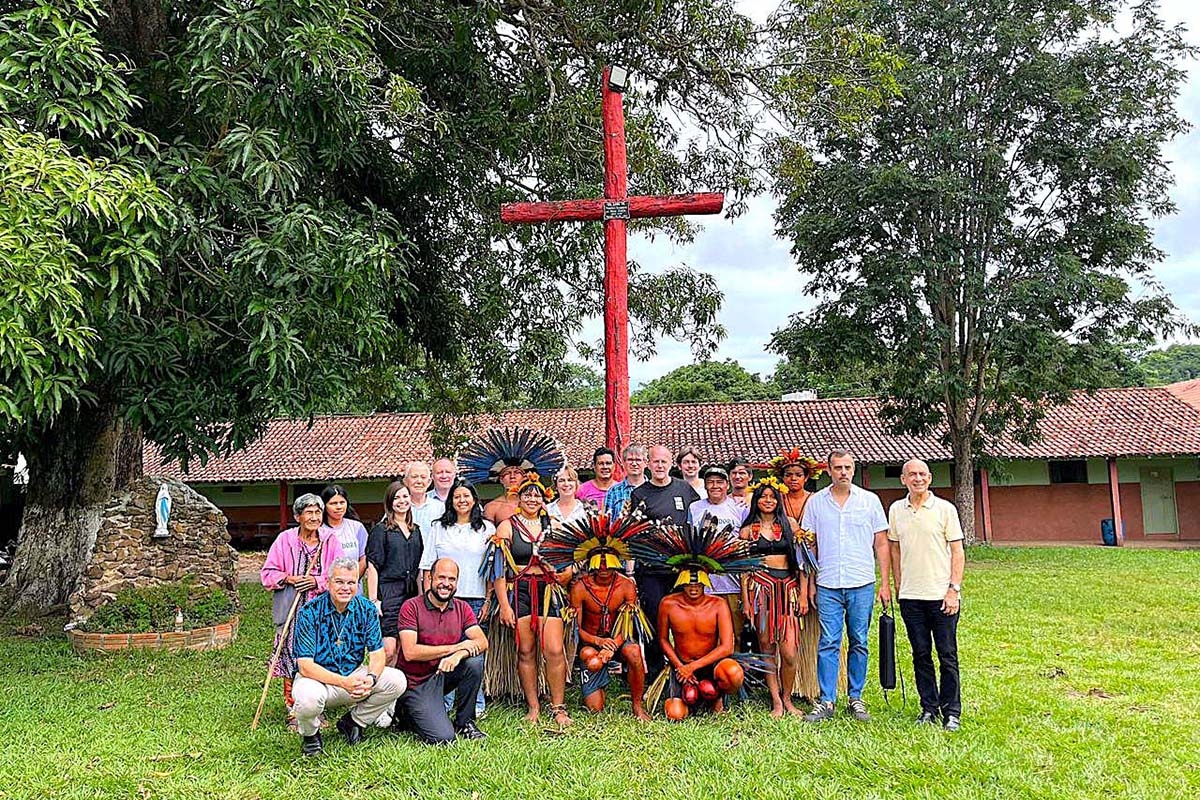
The welcome given to the crew in the indigenous and Salesian communities was characterised by great openness and collaboration. In Meruri, the group was hosted at the Salesian mission, welcomed by Fathers Ângelo Cenerino and João Vítor Ortiz, together with a team of women led by Bernadete. Ferdinand Auhser said he was struck by the willingness of the inhabitants to share information and stories. During the three and a half days spent in the village, the crew held meetings and interviews with indigenous people, priests and nuns, gathering personal accounts and details about the day of the martyrdom. The trip ended with a feeling of gratitude for the ‘many encounters’ experienced and with the conviction that they were leaving Brazil even more motivated than when they arrived.
The group plans to return to Brazil in July to document the celebrations of the 50th anniversary of the death of the Servants of God, continuing a project that is expected to last a total of about five years.
Euclides Fernandes Brites
{gallery}BCG – Visita cineasti 2026{/gallery}