Italy – Like a Ferrari without brakes: educating about emotions to stop young people going off the rails
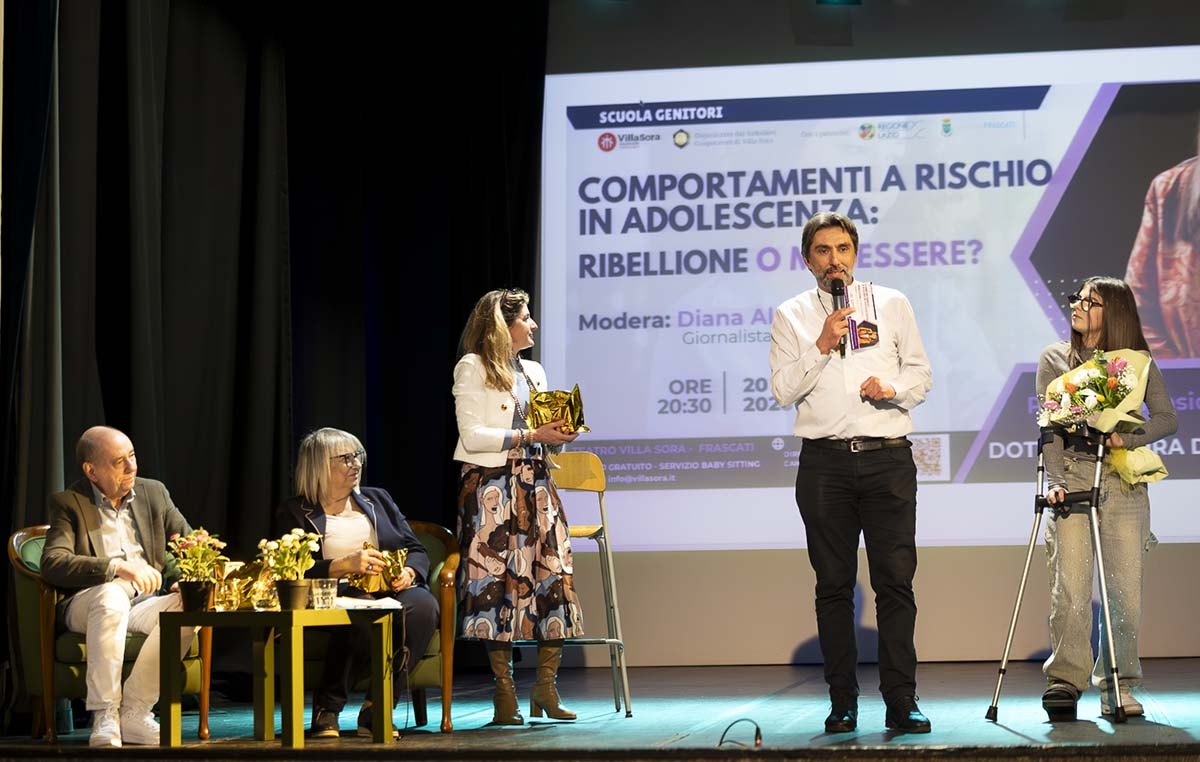
This is anything but an abstract question, and it was addressed on 23 January in a room packed with attentive and engaged parents during a meeting organised by the Salesians of Frascati to offer tools for reflection and educational support.
Moderated by Radio1 Rai journalist Diana Alessandrini, psychologists and formators Rosanna Schiralli and Ulisse Mariani proposed an educational model based on relationships, emotional competence and responsibility, interweaving data, neuroscience, clinical experience and concrete cases.
The meeting opened with reference to a news story that shook public opinion: the killing of a boy at school, which took place on the very days of the National Day of Respect, established in memory of Willy Monteiro Duarte. A dramatic paradox that, as Alessandrini pointed out, cannot be dismissed as an isolated event: according to CNR data, 90,000 young people between the ages of 15 and 19 say they have used a knife at least once to injure or threaten a peer. This is a rapidly growing phenomenon that directly affects families and schools.
In her speech Rosanna Schiralli clarified that emotional education is not simply ‘talking about emotions’, but represents a real process of building the emotional brain. She explained that ‘Today’s young people struggle to recognise what excites them, cannot tolerate frustration and seek immediate relief in impulsive behaviour.’ Hence the close link between emotional distress and increased addiction, from alcohol to substances, from digital technology to self-harm.
Using an effective metaphor – of a powerful Ferrari without brakes – Schiralli emphasised how children are born with enormous potential, but without the tools necessary to manage impulses and emotions. ‘Brakes are built,’ she said, ‘and their name is emotional education.’ An education that involves acceptance, attunement, mirroring, but also clear rules, boundaries and limits, elements that are increasingly difficult to exercise today.
Ulisse Mariani expanded on the topic by referring to neuroscience and developmental psychology: the human brain is fully developed around the age of 24, and its development depends decisively on the quality of educational relationships. ‘Parents, teachers and educators are the true architects of children’s brains,’ he said. Without adult guidance capable of combining affection and rules, there is a risk of raising young people who are dominated by their impulses and unable to transform them into emotions and conscious actions. It is necessary to train empathy, made possible by mirror neurons, from childhood through an education that involves not only the family but also the school, which is called upon to increasingly integrate emotional teaching alongside traditional learning.
The meeting concluded with the reading of a letter from a school headmaster who survived the Nazi concentration camps, inviting educators not to limit themselves to training competent students, but human beings. This powerful warning sums up the profound meaning of the initiative of the Salesians at Villa Sora: educating about emotions is not a luxury, but an urgent responsibility, in order to prevent violence and give young people the tools to live in the world in a humane way.
The Villa Sora Parents’ School thus confirms itself as a valuable forum for discussion, where parents and professionals meet to seek shared answers to one of the most decisive educational challenges of our time. At a time when violence seems to arise from an inability to feel and wait, educating about emotions is not only a pedagogical choice, but an urgent act of collective responsibility towards the future of our children.