RMG – “Signs of Providence”: Mary Help of Christians and the Miracles documented in the Works of Don Bosco (1866–1875) – Part 2
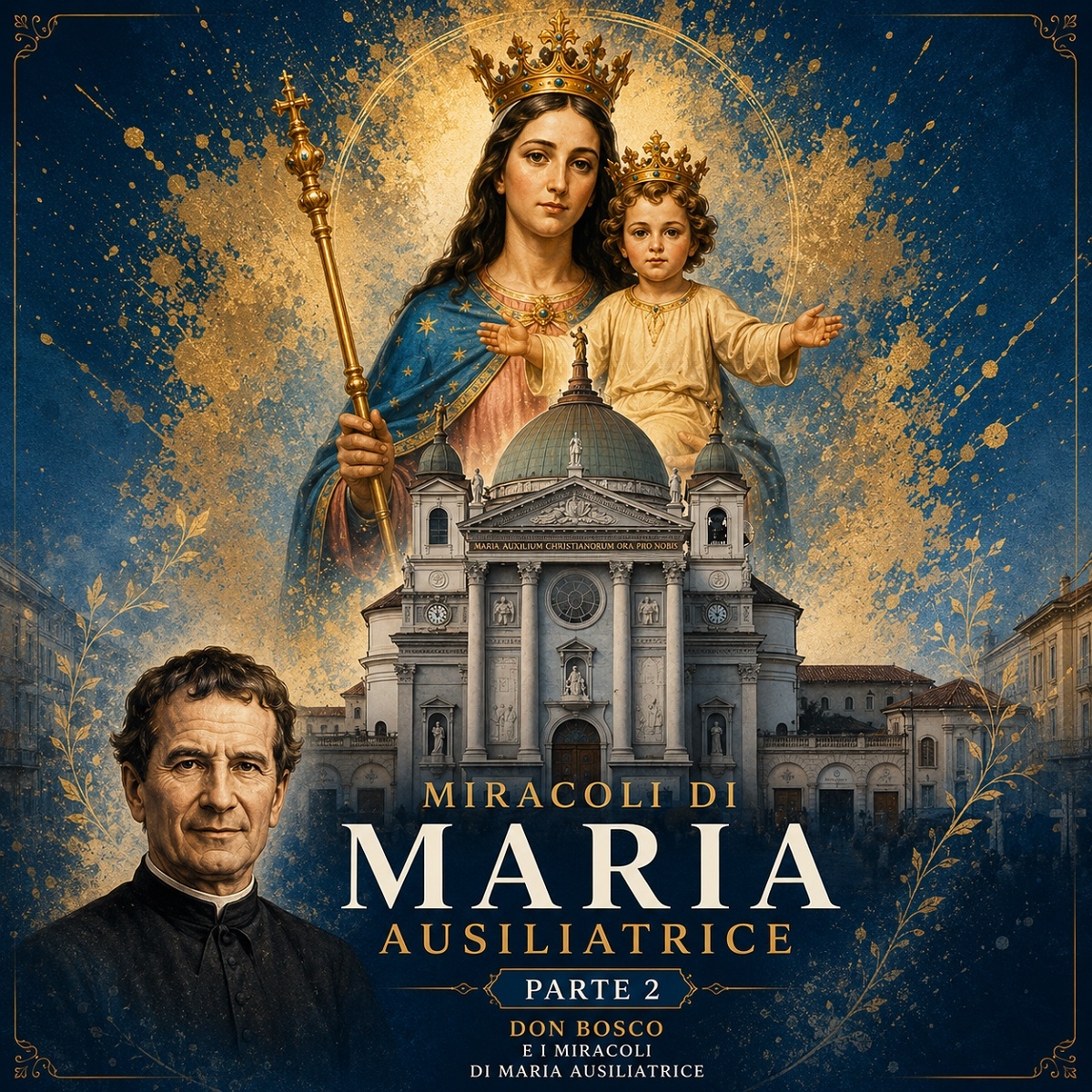
Between 1866 and 1875 – the early years of the Basilica of Mary Help of Christians in Valdocco – testimonies multiplied, all sharing a common thread: simple, concrete, active trust. A medal clutched between the fingers. A novena recited in the silence of the evening. A blessing given at dawn. A letter sent across the ocean.
Don Bosco did not propose magic formulas, but a filial entrustment. The medal was not superstition, but a visible sign of a living relationship. In these accounts, Mary Help of Christians appears as a Mother attentive not only to great tragedies, but also to material needs, inner doubts, financial anxieties, and the ‘small’ sorrows that are immense for those who experience them. These 12 episodes, drawn from the Biographical Memoirs and the Published Works, show how Marian devotion in the Salesian experience was not a form of spiritual escapism, but a transforming force in the concrete lives of people.
1. THE TRAIN STOPPED BEFORE THE TRAGEDY (Alessandria-Turin, March 1873)
Without anyone noticing, a night-time landslide had damaged the tracks along the route being travelled by the 7.15 am train from Alessandria to Turin. The train was heading for certain derailment. On board, Carlo Ferretti, a devotee of Mary Help of Christians, was seized by a sudden and seemingly inexplicable anxiety: he clutched the medal blessed by Don Bosco and began to pray aloud, inviting others to join him. Without any human intervention, the train slowed down until it came to a halt just before the damaged section. The driver described the event as “inexplicable”. Sixty passengers were saved. Many went to Valdocco to give thanks.
Published Works vol. XXVI
2. THE DRUNKARD TURNED APOSTLE (Turin, October 1869)
Matteo Rinaldi, a slave to alcohol, terrorised his family and squandered his wages. In desperation, his wife Elena turned to Don Bosco, who gave her three medals of Mary Help of Christians, urging her to pray with faith. One evening, looking into his glass, Matteo saw his own misery reflected and felt a sudden pang of remorse. From that day on, his desire to drink vanished. Not only did he remain sober for the rest of his life, but he helped others to free themselves from the vice, founding a mutual aid society. He died after 34 years of total abstinence.
Biographical Memoirs vol. XIII / Published Works vol. XXVI
3. THE BLASPHEMER WHO BECAME A PREACHER (Cuneo, January 1872)
Antonio Gamba, a blacksmith deeply grieved by the death of his son and wife, lived in hatred of God. Struck down by severe pneumonia, he rejected the priest and the sacraments. A medal of Mary Help of Christians was left on his bedside table. During a feverish night, he dreamt of a Mother who urged him to stop hating. Upon waking, his fever subsided and he asked for confession after twenty years of estrangement. Healed in body and soul, he transformed his workshop into a place of prayer and became an apostle among those who blasphemed, bearing witness to the mercy he had received.
Published Works vol. XXVI
4. THE IMPOSSIBLE RECONCILIATION (Asti, June 1873)
Luigi and Marco, brothers estranged for 25 years over a disputed inheritance, no longer spoke to one another. Their wives, in distress, went to Valdocco. Don Bosco entrusted them with two medals and a novena to Mary Help of Christians. During those days, both brothers were inwardly moved by memories and dreams of peace. On the tenth day, they met by chance before the altar of Mary. After a moment’s hesitation, Luigi took a step forward: the embrace melted away a quarter of a century of hatred. The families were reunited and lived from then on in fraternal harmony.
Published Works vol. XXVI
5. THE SEMINARIAN’S REDISCOVERED VOCATION (Turin, November 1874)
Giovanni Battista Francesia, a twenty-one-year-old seminarian, was determined to leave due to doubts and spiritual aridity. His spiritual director sent him to Don Bosco, who gave him a medal and a week’s stay at Valdocco. Among the boys of the oratory and through prayer before Mary Help of Christians, Giovanni rediscovered the joy of priestly service. He had no visions, but a profound peace. He stayed, was ordained, and became a distinguished Salesian collaborator, educator and founder of schools. Throughout his life, he attributed his fidelity to his vocation to that week and to the intercession of Mary.
Biographical Memoirs vol. XVII / Salesian Archives
6. THE INNOCENT MAN RELEASED FROM PRISON (Cuneo, April 1871)
Stefano Bartoli, an honest accountant, was sentenced to five years for a shortfall of 5,000 lire that he had not committed. His wife, certain of his innocence, implored Don Bosco, who gave her three medals of Mary Help of Christians and invited her to pray with confidence. Two weeks later, the new accountant discovered a hidden folder containing the confession of the real culprit. Stefano was released immediately. The family went to Valdocco to give thanks. “Mary has restored my freedom and honour,” he would repeat every year on the anniversary of his release.
Published Works vol. XXVI
7. PROVIDENTIAL ECONOMIC RELIEF (Turin, December 1870)
On Christmas Eve, the Colombo family had run out of both bread and money. Paolo had been ill for two months; Teresa, exhausted, prayed before the statue of Mary Help of Christians: “Help my children”. At dawn, an elderly stranger knocked on the door and handed over a parcel containing food and 100 lire, accompanied by a note: “From Mary Help of Christians, for your children”. The man vanished without a trace. With that help, they got through the winter. From then on, every Christmas, the Colombos helped other poor families, remembering the Providence they had received.
Biographical Memoirs vol. XVI / Published Works vol. XXVI
8. THE MIRACULOUS HARVEST AFTER THE DROUGHT (Monferrato, summer 1874)
After months without rain, Giuseppe Merlo’s fields were lost. On the advice of the parish priest, he went to Valdocco and returned with holy water and medals of Mary Help of Christians. At dawn he blessed the fields, planting the medals at the boundaries. That night a gentle, steady rain fell. In the weeks that followed, whilst neighbouring crops remained meagre, his fields flourished in a surprising way. The harvest was extremely abundant. Giuseppe offered a tithe to Don Bosco: “Mary has saved my land”. From then on, he renewed that gesture of trust every year.
Published Works vol. XXVI
9. THE DEAL SAVED AT THE LAST MOMENT (Genoa, March 1873)
Carlo Bianchi was facing bankruptcy: a costly consignment of silk remained unsold and his debts were due in nine days. On his wife’s suggestion, he began a novena to Mary Help of Christians. On the eighth day, an unknown French merchant entered the shop and purchased the entire consignment at the asking price, paying half in cash. The deal saved his home and honour. Carlo went to Valdocco to give thanks and promised to help the poor. From then on, he attributed the salvation of his business to Mary’s maternal intercession.
Published Works vol. XXVI
10. THE FIVE SEMINARIANS EXEMPTED FROM MILITARY SERVICE (Turin, September 1869)
Five clerics from the Oratory received their call-up papers. Their exemption had been rejected and their vocation seemed compromised. Don Bosco gave each of them a medal of Mary Help of Christians: “Take this with you and come back.” At the barracks, one after the other, they were declared exempt due to an “administrative error”. All five of them. They returned to Valdocco astonished, holding up their medals. They completed their studies and became Salesian priests, convinced that this unexpected exemption had saved their vocation and their mission.
Biographical Memoirs vol. IX, 337
11. THE VINEYARD IN AMERICA THAT TOOK ROOT (United States, 1870)
After three failed attempts to plant a vineyard in California, Margaret O’Connor wrote to Don Bosco from America. She received twelve medals of Mary Help of Christians to be planted at the head of the rows. With persevering faith, she and her husband tried a fourth time. The vines all took root and thrived extraordinarily, producing abundant grapes of superior quality, never before seen in the area. The vineyard became a living testimony of gratitude. Every 24 May, the family prayed amongst the rows, remembering that Providence knows no bounds.
Biographical Memoirs vol. IX, 337
12. THE INSTANTANEOUS HEALING OF A TOOTHACHE (Turin, August 1868)
Rosa Ferrero had been suffering from a terrible toothache for three days. The only possible remedy was extraction without anaesthetic, which she feared more than the pain itself. Exhausted, she placed a medal of Mary Help of Christians on her cheek and prayed with simplicity. The pain ceased instantly and never returned. She slept peacefully that night and was able to chew without pain. She went to Valdocco to give thanks, amazed that such a ‘minor’ pain had received so much attention. She kept the medal for the rest of her life, a sign of filial trust.
Biographical Memoirs vol. IX, 337
The events recounted here represent only a fraction of the graces documented during the first seven years of the Basilica of Valdocco. A constant theme emerges in every episode: faith translated into action, prayer becoming active trust, and the grace received transforming into charity towards others. The miracle, in Don Bosco’s view, is never an individual point of arrival: it is the beginning of responsibility. He never sought personal prominence. He would simply repeat: “Mary did it all.” And again: “Whoever trusts in Mary will never be disappointed.”
The Basilica of Valdocco remains a tangible sign of this conviction:
a sanctuary born of faith, built amidst economic hardship and opposition, and sustained by the gratitude of thousands of people who felt they had been heard. For Don Bosco, miracles were not ends in themselves. They were pedagogical signs. They taught trust in Providence, perseverance in trials, filial devotion to Mary, and concrete solidarity with the poorest.