Poland – The rich symbolism of the painting depicting the beatification of Fr Jan Świerc and his eight Salesian martyr companions
The painting
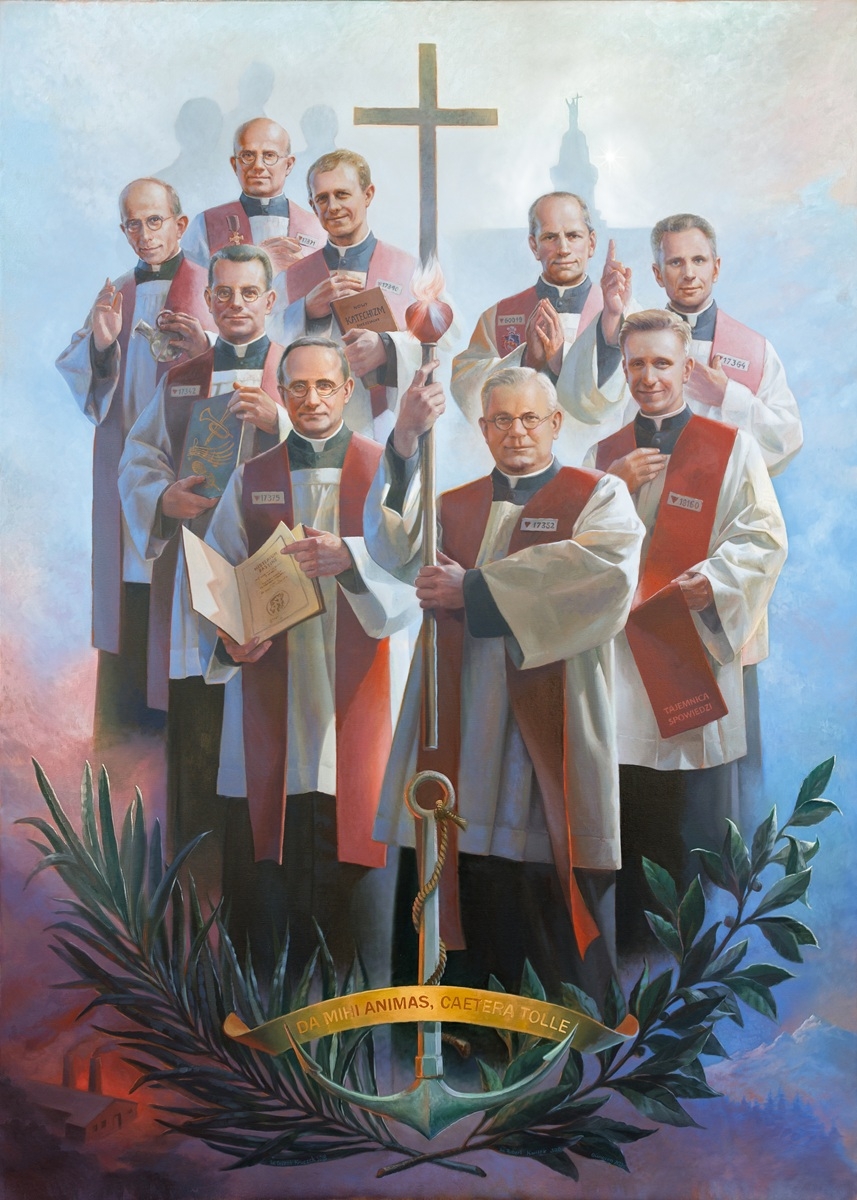
The painting was created in oil on linen canvas and measures 195 x 270 cm. The figures of the blessed, depicted in the painting, are portrayed during the final years of their lives. This choice was made to show how they looked at the time of their martyrdom.
At the bottom of the painting are elements of the Salesian Congregation’s coat of arms: a palm branch – signifying martyrdom – and a laurel leaf – symbolising wisdom. These elements are intended to become a reward for those who faithfully follow the path of the Salesian vocation.
The anchor, the star and the heart symbolise the three theological virtues: hope, faith and charity, which are also present in the Salesian coat of arms. For the Salesian, hope must be the driving force behind generous and joyful work on behalf of young people. Apostolic love must embody the essence of the Salesian spirit and become the key to understanding Don Bosco’s pastoral and educational experience. Finally, faith, which is indispensable in educational work, must lead young people to the fullness of humanity and to evangelical holiness. The star, which in the image is placed above the Blessed, is also the oldest symbol of Our Lady. For the Salesian Congregation, it is the symbol of Mary Help of Christians, who is depicted in images with a crown of twelve stars.
Next to the star, one can make out the outline of the Salesian Institute in Oświęcim, and in particular its tower crowned by the statue of Christ the Saviour with the cross. This reminds us that each of the nine Blesseds was linked to the Salesian Mother House in Poland, whether as a pupil, aspirant or assistant, or as a teacher or superior of that house.
At the bottom right, a ‘wood’ is depicted, intended to evoke the figure of the founder of the Salesian Congregation, St John Bosco, and specifically his surname; behind it are mountains, symbolising the peaks of excellence to which the Salesians must aspire. A cross held by Fr Jan Świerc runs across the entire image.
The banner bears the inscription: “Da mihi animas caetera tolle” (Give me souls, take away the rest). This motto accompanied Don Bosco at the dawn of his work with young people in need.
In the lower left-hand corner of the painting is depicted the Auschwitz crematorium, a symbol of the end of the martyrdom and the beginning of the eternal reward of the martyrs depicted above.
Father Ignacy Antonowicz died at the age of 51. In the painting, he is depicted wearing the Cross of Military Valour, which he received in his capacity as a military chaplain.
Father Franciszek Miśka, murdered at the age of 43, is depicted holding a baptismal font, as he baptised the son of a Wehrmacht soldier.
Father Ludwik Mroczek is holding a catechism, as he zealously taught the catechism for almost his entire priestly life. He died at the age of 36.
Father Kazimierz Wojciechowski was a very energetic, athletic man with a talent for music. Among other things, he conducted an orchestra; for this reason, the book he is holding features drawings depicting various aspects of his work. He was murdered at the age of 37.
Father Franciszek Harazim, murdered at the age of 56, is depicted in the painting holding an open copy of *The Paschal Mystery*, which he authored – a play that was performed in Salesian houses for decades.
Father Włodzimierz Szembek was regarded by the local population as a virtuous and deeply devout man, as symbolised by his clasped hands. As he came from a family of counts, the statue bears the Szembek family coat of arms. He died at the age of 59.
Father Ignacy Dobiasz, amongst his many priestly activities, distinguished himself in particular as an excellent confessor, reconciling people with God; hence his raised hand and index finger pointing towards heaven, the direction of our aspirations. He was murdered at the age of 61.
Father Karol Golda. As a polyglot, he was also fluent in German, which is why he heard the confessions of German soldiers – something that was forbidden at the time. When arrested, despite cruel torture, he did not betray the seal of the confessional, for which he was murdered. In the painting, on the edge of his stole, is the inscription: ‘secret of the confessional’. The youngest of the nine, he was just 27 years old when he died.
And finally, Father Jan Świerc, aged 64, as the first to shed his blood as a martyr, leads the entire group. In the painting, he holds a cross in his hands – an element of the Salesian coat of arms – and points with one finger to his heart, from which two rays emanate; these, so to speak, colour the image in two shades, red and blue, much like the rays emanating from the Heart of the Merciful Jesus in the vision of Saint Faustina Kowalska.
All the priests are depicted wearing a red stole, a symbol of martyrdom, on which the registration numbers from the concentration camps are inscribed.
Behind the Blesseds, the silhouettes of several other figures can be glimpsed, symbolising those Salesians who also suffered a martyr’s death during the Second World War, but whose beatification processes, for various reasons, were never initiated.
Flowers
The symbolism of the basket of flowers is also significant; indeed, a basket of flowers was carried during the beatification ceremony. The creator of this arrangement is Michał Zdanowski, a Salesian Past Pupil from Nowa Huta Krakow, who describes his composition as follows: “Drawing on a wealth of meanings and symbolism, the arrangement features red flowers and leaves (gerberas and cordilines) to emphasise the martyred deaths of the priests. The symbol of martyrdom, but also of victory, is represented by the robelini palm fronds.”
These nine different flowers, in various colours, symbolise the nine new Blesseds. Nine different flowers, because ‘each of them was different’. They were: white garlic, blue delphinium, green anthurium, yellow cymbidium orchid, pink protea, orange strelitzia, burgundy hydrangea, lemon-coloured astromeria and red gerbera.
“The solemnity of the beatification of the Martyr Priests requires, in addition to martyrdom, an emphasis on the priesthood, which is so closely linked to the Eucharist. This symbolic meaning is represented by the wheat arranged within the composition. It can therefore be said that this basket of flowers embodies the symbolism of both martyrdom and the priesthood. The slender blooms of the blue delphinium symbolise the heavens, whilst in liturgical floristry the colour pink represents joy.”