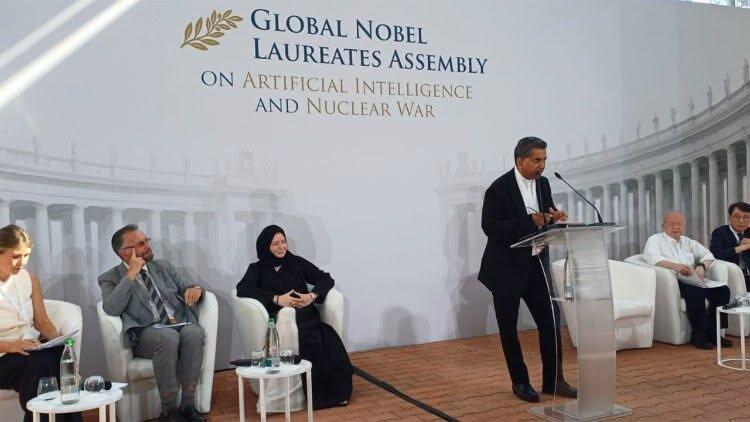
(ANS – Castel Gandolfo) – From 14 to 16 July 2026, Castel Gandolfo hosted a discussion between Nobel laureates, experts and representatives of Big Tech on the development of Artificial Intelligence and its implications for the human condition. As a result of this work, at the end of the three days, the Declaration is being signed today at the Campidoglio in Rome; it aims to promote a vision of international security based on cooperation, human dignity and integral development.
The symposium, held on the Holy See’s extraterritorial estates in the small town of Castel Gandolfo – on the outskirts of Rome, home to the Pope’s summer residence – was attended by 30 Nobel laureates and 20 leading experts in artificial intelligence, including representatives from major technology companies such as OpenAI, Google DeepMind, AarU and Anthropic. Also in attendance were 30 former heads of state and government, and 30 representatives from some of the world’s most important and influential universities and research institutions, such as Harvard University, the University of Oxford and Columbia University… to name but a few.
A constructive dialogue
The stated aim was to foster a constructive dialogue on “the future of international security, the governance of emerging technologies, disarmament and the building of an economy of peace” – with peace understood, as Cardinal Fabio Baggio, Pro-Prefect of the Dicastery for Integral Human Development, as “an order founded on justice, mutual trust, respect for the law and the inviolable dignity of every human being”.
In the service of the common good
Artificial intelligence, therefore, becomes a tool that must be genuinely geared towards serving the person and peace, “an extraordinary opportunity for progress in medicine, research, education, the economy and cooperation between peoples. Precisely for this reason, it requires ethical reflection commensurate with the scale of its consequences”.
A broad vision
The event draws inspiration and its lifeblood from Leo XIV’s encyclical Magnifica Humanitas and, as the organisers maintain, “forms part of the Pontiff’s vision of a peace that is both unarmed and disarming. At the heart of the debate over the coming days is the search for a new global paradigm capable of combining innovation, responsibility and ethics”.
Geopolitical shift
“Artificial intelligence, autonomous systems, quantum technologies, computing capabilities and advanced computational infrastructures are redefining the very concept of security,” observed Cardinal Silvano Maria Tomasi, President of the Communis Foundation. These technical developments, the cardinal explained, are shaping a global geopolitical landscape in which “the language of deterrence has once again come to dominate international relations, nuclear threats are once more being openly invoked, and the current arms control frameworks have progressively weakened”.
The danger of Babel
Cardinal Tomasi argued with concern that regional conflicts are increasingly drawing in global powers, whilst the possibility of a nuclear escalation is no longer perceived as an abstract scenario. Quoting Magnifica humanitas, the cardinal sought to remind his audience that humanity today faces a choice, just as every generation has ultimately done: “Building a new Babel where technological power becomes an idol promising salvation, whilst at the same time reducing the human person to data, efficiency and control; or of rebuilding Jerusalem in which diversity becomes communion, technology is at the service of fraternity, and every innovation is measured against the dignity of the human person rather than the expansion of power. The Holy Father reminds us that technology is never morally neutral.”
Fundamental rights
Cardinal Ángel Fernández Artime, pro-prefect of the Dicastery for Institutes of Consecrated Life and Societies of Apostolic Life, also holds the conviction that an algorithm – capable of profoundly changing the way people live and work – cannot replace human discernment. In his address to the speakers and international guests, he emphasised that “the problem is not technology but the direction we choose to give it. If fundamental rights are not taken into account, there is a risk of creating systems that encourage control, manipulation and even new forms of inequality.”
Towards the Rome Declaration
Over the course of the event, there were numerous presentations by the various expert speakers in attendance, as well as closed-door sessions dedicated to listening and sharing.
At the end of the three-day proceedings, the “Rome Declaration for an unarmed and disarming peace in the age of artificial intelligence, nuclear and autonomous weapons, new digital protocols and emerging models of digital development” will be drafted and presented at a formal ceremony at the Campidoglio. The organisers have stated that this document “aims to define principles and guidelines for the governance of artificial intelligence, promoting a vision of international security based on cooperation, human dignity, integral development and peace among peoples”.
Source: Vatican News