What emerges is a complex picture, highlighting how this transition is a delicate period, including from an emotional perspective, and how teamwork between families, schools, businesses, public services and institutions can be the right way to accompany and support young people on this journey.
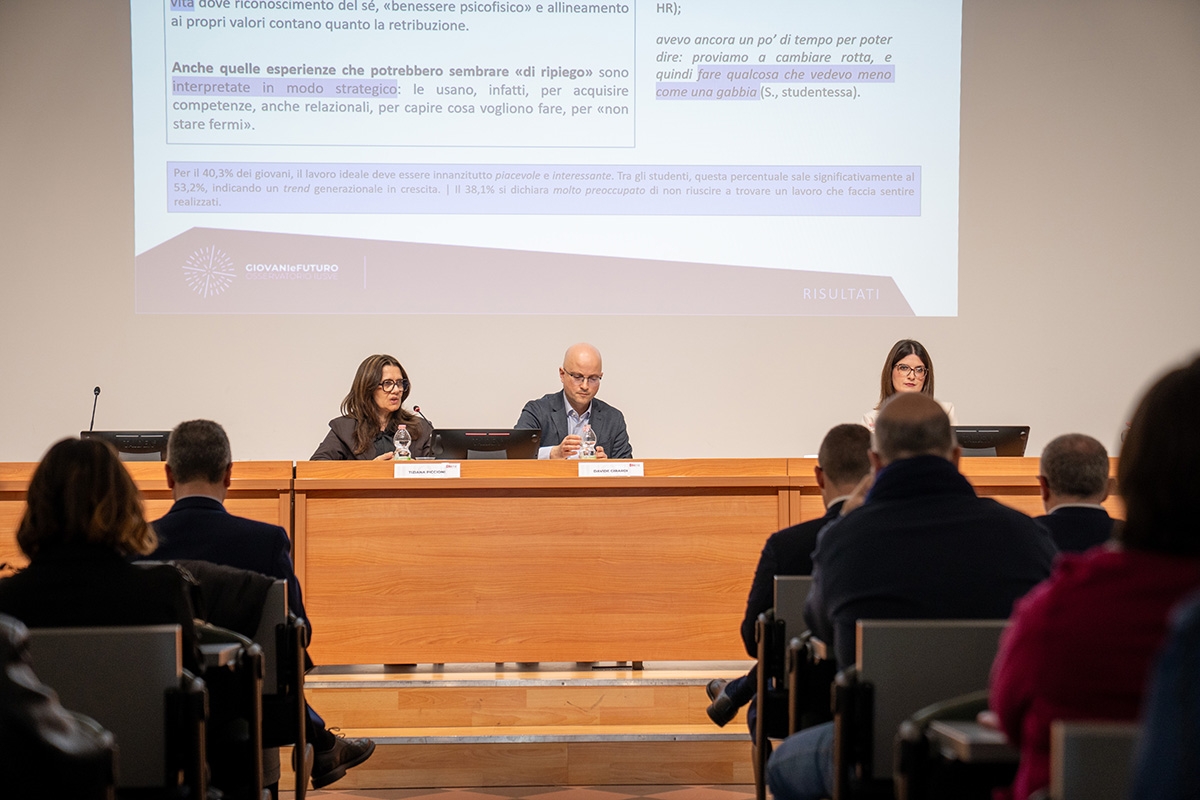
The conference explored the theme of young adults’ transition into work, drawing on data from a survey of 18–34-year-olds in the Veneto region conducted by the IUSVE “Youth and Future” Observatory. The research involved a representative sample of over 900 young adults, including managers, HR professionals, mentors, teachers and students, who provided useful insights into the subjective aspects of the transition through interviews; in addition to thirty key informants who offered valuable contextual insights through in-depth interviews. The data highlight, on the one hand, the maturing of a now well-established proactivity among young people in the world of work, but also limitations clearly highlighted by the respondents, such as the issue of pay and prospects for professional growth.
The data
Regarding the data presented during the conference, there are many interesting findings: if one were in a workplace that did not make them feel comfortable, for example, almost one in two respondents (47.5%) “would actively look for another job, even at the cost of a period of instability”. “Awareness of one’s own abilities” (28.4% of responses) and “specific skills” (26.8%) are then cited by young adults in Veneto as the two priority areas for personal improvement. At the same time, these findings do not necessarily translate into an individualistic approach in the workplace: the two main characteristics that the relationship between colleagues should have are, in fact, “collaboration and mutual support” (67.5%) and “open and honest communication” (62.1%); almost one in three respondents also mentions “respect for everyone’s ideas” (28.4%), whilst “competition that drives improvement” and “strong goal orientation” together account for no more than 10.0% of all mentions.
To a young person starting their first job, 63.9% of respondents would advise “seeking constructive dialogue, whilst accepting the final decision of a more senior colleague or manager in all cases.”
Salary concerns top the list
There are strong concerns regarding salary, which ranks at the top (with 65.0% of responses) of the two main issues cited by respondents.
In line with this, the idea of an ideal job certainly involves “enjoyable, interesting work” (40.3%) and “career progression” (37.5%), but even more so for the “continuity of professional activity/job stability” (51.1%) and, above all, for the importance of “income/good earnings” (68.9%). A range of issues – those discussed during the conference and explored in depth by the survey – which will certainly pose a challenge for the policies to be implemented in the coming years in order to effectively address the weaknesses that still plague the transitions to work for young adults in the Veneto region; with direct repercussions on their specific circumstances, but also on the wider social context.
Methodology
The survey’s target population comprised young people aged between 18 and 34 residing in Veneto. All interviews were conducted using the CAWI (Computer Assisted Web Interviewing) method. The main data collection was carried out via a commercial online panel. In addition, a survey was conducted using social media sampling, employing targeted ads on Facebook. The sample was controlled ex ante by gender, age group and geographical area, and subsequently weighted ex post according to educational attainment. The survey was conducted in October 2025 by Demetra Opinioni.net, under the supervision of Alice Cappello. The data were analysed by Beatrice Bartoli, with the collaboration of Davide Girardi.
Statements
Lucas Pavanetto, Vice-President and Councillor for Employment of the Veneto Region, stated that “The research presented today has a particular merit: it combines analysis of labour market data with direct engagement with young people, gathering their voices and exploring the emotions and expectations that accompany the transition from school to work. As a Region, we are convinced that supporting young people during this phase is a fundamental task because young people are a resource; they are our present and our future.”
Davide Girardi, Researcher at the IUSVE ‘Youth and Future’ Observatory, highlighted that: “The key word emerging from the data analysis and testimonies is recognition, which is not merely an economic aspect, but also concerns the ability of work environments to assign young people the appropriate role. Building a solid pathway to adulthood brings wider benefits to the whole of society, not just to young workers”.
Finally, Tiziano Barone, Director of Veneto Lavoro, emphasised that: “Today, young people entering the labour market face complex dynamics.
Our priority must be to focus policies on the issue of support, especially during these delicate transition phases from school to work. It is not just a matter of matching supply and demand, but of empowering people, in a process that involves the individual’s freedom to take the initiative and invest in their own future, and the freedom of the practitioner to create the conditions for this to happen.”