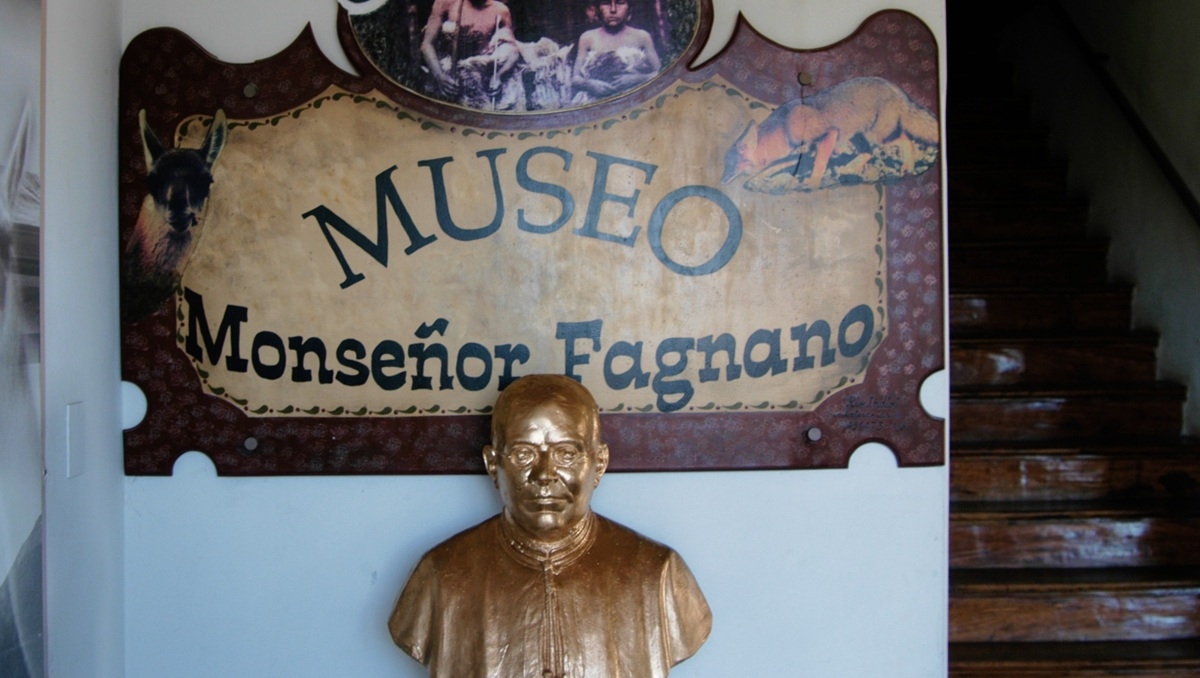
Born in 1844 in Rocchetta Tanaro to a farming family, he moved to Asti to study, before entering the seminary and leaving behind a certain degree of comfort to continue his journey at the Valdocco Oratory. He qualified as a teacher for lower secondary schools and was ordained a priest in Casale Monferrato shortly afterwards: it was the year 1864 and he was 20 years old. Don Bosco appointed him as a teacher at the college in Lanzo Torinese; seven years later, he entrusted him with the stewardship of the House in Varazze, in Liguria. Finally, he was chosen to form the group of the first ten Salesian missionaries.
While the first missionary post had been the port of Buenos Aires, the exploration of Argentine territory followed the course of the Paraná River. Some 500 kilometres from the capital, the small town of San Nicolás de los Arroyos requested the opening of a school for the children of cattle ranchers in an area inhabited by indigenous peoples: a dual challenge – education and evangelisation – which Fr Fagnano, by then known as ‘Father José’, embraced with enthusiasm. The typhoid fever that struck him in 1879 forced him to return to base to recover and to reconsider the spirit and method of the mission.
On the borders of Patagonia
The following year he was sent to Carmen de Patagones, the southernmost town in the Province of Buenos Aires, 900 km away: the gateway to Patagonia. Here he devoted himself to the construction of school buildings and places of worship. The population consisted of ‘Indians’, descendants of African slaves and European immigrants, a diverse society facing no small number of difficulties. The Salesian founded a mutual aid society, a sort of charter that powerfully articulated the missionaries’ spirit of collaboration.
On the other side of the Río Negro lay Viedma, the capital of Patagonia.
Once the new missionary settlement was established, Father Fagnano was able to devote himself to exploring the new region until 1887. He was then transferred to Chile, as if he were seeking another route to reach the Fin del mundo.
He made his home in Punta Arenas. A frontier town much like the Wild West, the city attracted traders from every nation, sailors, geographical and geological explorers, with a clear division between ‘dreamers’ and ‘adventurers’, between revolutionaries and reactionaries. Managing to strike a delicate political balance, Father José joined forces with groups of scientific researchers as well as soldiers: his aim was to test the possibilities of encountering the inhabitants of Isla Grande in Tierra del Fuego. The great lake known as ‘the rest of the horizon’ by the Selkman people, unknown to cartographers, was named Fagnano by the Rear Admiral commanding one of those expeditions.
Fr José had a reputation as an extremely pragmatic missionary: he built churches, oratories, schools and colleges. Within three years, he managed to gain the trust of the authorities: the President of Chile entrusted Dawson Island to him for twenty years with the aim of establishing there a ‘reserve’ for the Onas, Alacalufes, Yahganes and Tehuelches peoples. He reached his destination on the schooner renamed ‘Maria Auxiliadora’, with which he had previously reached the outermost points of the archipelago. This was the long-awaited opportunity to build the ‘happy island’, a model of a peaceful and flourishing society. It was, in fact, a sort of social experiment. However, typhus, scarlet fever, tuberculosis and smallpox spread.
Prefect Apostolic
Although Dawson’s utopia ended with the abandonment of the project, the philosophy that inspired it proved effective in laying solid foundations and securing a future for another mission, this time in the Argentine part of Tierra del Fuego overlooking the Atlantic Ocean. In 1883, Fr Fagnano was granted the use of a vast area at the mouth of the Rio Grande, again with the aim of establishing a model farm capable of providing food and shelter to the populations that General Roca had decimated with his ‘war of the desert’. The mission, entrusted to Fr Giuseppe Maria Beauvoir, was dedicated to Our Lady of Candlemas.
This was the year of the final turning point: on 2 December 1883, Father Fagnano was appointed Prefect Apostolic of Chilean Patagonia, the Chilean territory of Magallanes-Punta Arenas, the Argentine territory of Santa Cruz, the Falkland Islands and the unspecified islands extending as far as the Strait of Magellan. This was recognition of the vast work of the Salesian who, despite his surname – which in Piedmontese means ‘slacker’ – worked feverishly to establish the Catholic Church at the farthest reaches of South America.
He died in Santiago, Chile, on 18 September 1916, but his body was buried, at the request of the community of Punta Arenas, in the cathedral he had helped to build, in the town where he had spent much of his adult life.