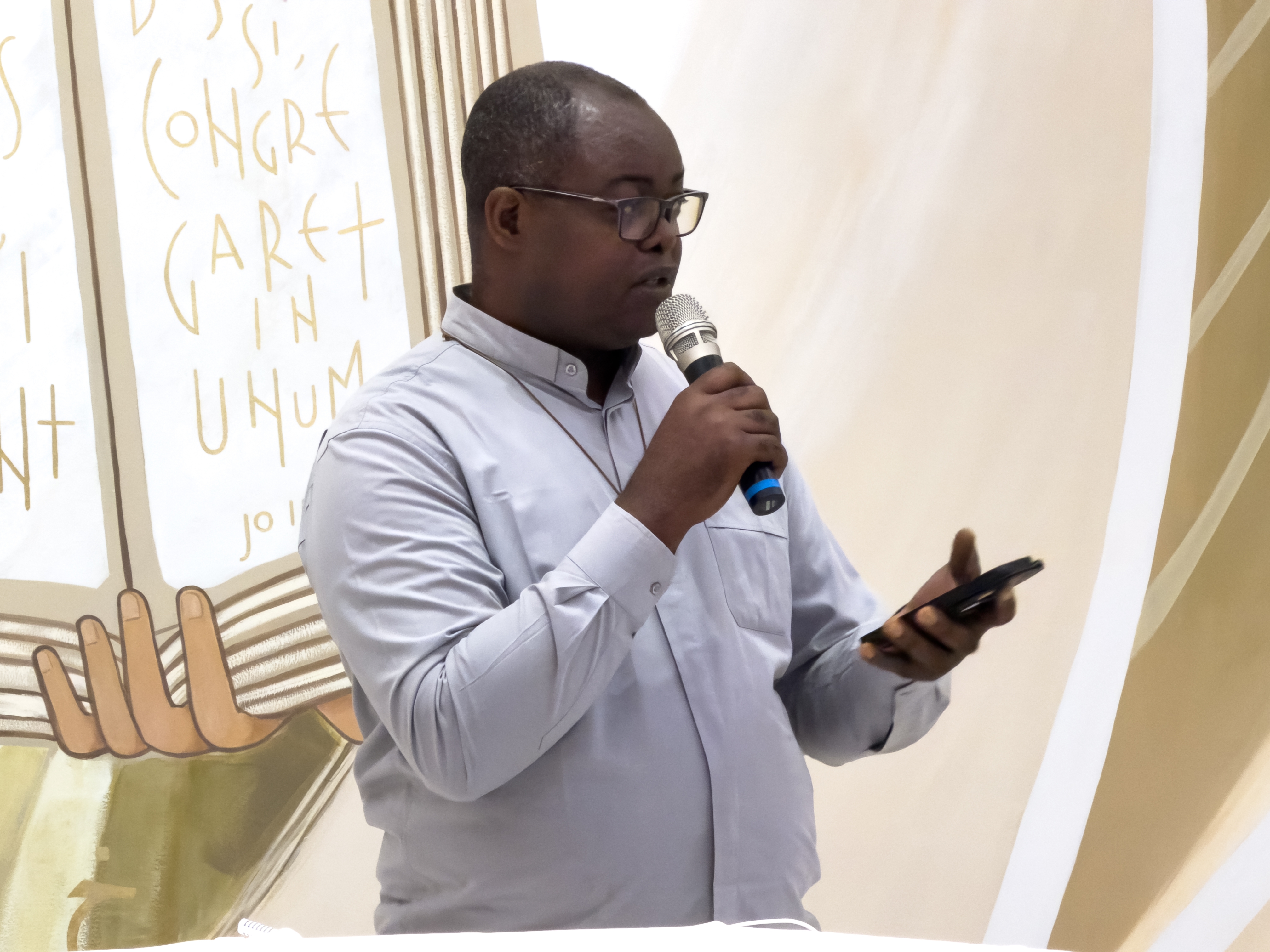
The first ‘goodnight’ was delivered by Fr Alphonse Owoudou, Regional Councillor for Central and West Africa, who shared a reflection inspired by a series of experiences he had had in recent months in various parts of Central and West Africa – experiences which, despite their geographical and cultural diversity, all centre on a single fundamental question: how to accompany, today, with fidelity and creativity, the formative and prophetic journey of the Church and the Congregation.
Formation is not a straight line
Father Owoudou began by recalling the curatorium in Yaoundé, within his province, a strategic hub for formation in the region, home to the centre for coadjutors – the only one of its kind in Africa – and the French-speaking theological college, which is currently undergoing renovation. This year, a group of fifteen first-year theology students are attending the Catholic University, whilst those who had already begun their studies are continuing at St Cyprian’s School of Theology: a new development, the councillor emphasised, which requires further consideration to harmonise the two pathways and adapt the house’s programme accordingly.
This was followed by the curatorium in Lomé, enriched by the presence of numerous Provincial Superiors and the collaboration with Fr Silvio. The work on the statutes, in the light of the recent General Chapter and the fifth edition of the Ratio, highlighted how structures cannot be mere organisational frameworks, but must embody a theological and pedagogical vision consistent with contemporary challenges.
Fr Owoudou then recalled his visit to the novitiate in Ghana, a special opportunity to listen through meetings with formators, novices and trainees, which allowed him to grasp both the vitality and the fragility of the formation journeys experienced on the ground: ‘as in a living laboratory,’ he explained, ‘formation is not a straight line, but a dynamic process, made up of tensions, expectations and discoveries’.
The situation in Haiti
Special mention was made of the situation in Haiti, marked by severe instability, which has necessitated a different approach to accompaniment through online meetings with confreres, young people in formation and formators. Despite the difficulties, these meetings have revealed a surprising capacity for resilience, touching on themes such as trust, fear, ambitions and discernment.
Fr Owoudou wished to highlight the courage of the Haitian confreres, who are constantly supported by the leadership of Fr Morachel, the Provincial, and his Council. He shared his joy at having recently been joined, via video link, by the Rector Major himself, and on no fewer than three occasions by the Regional Councillor for Africa: a concrete sign of closeness to the rest of the Congregation, even amidst the distance imposed by circumstances.
In this context, the lectio divina inspired by the story of Emmaus (Lk 24), entitled “Do not be afraid of the truth”, arose precisely from the need to address an issue that had clearly emerged in some houses of formation: fear – fear of judgement, fear of not being accepted, fear that resurfaces at delicate moments such as examinations and admissions. Hence the risk, the councillor warned, of slipping into two parallel and conflicting pedagogical approaches: one that is strictly preventive, founded on the pillars of reason, religion and kindness; and another, less preventive and at times openly repressive, which creates distance rather than trust. The story of Emmaus thus offers an alternative interpretative key: Jesus appears there as the companion who catches up with the traveller on the road, who listens before speaking, and who only then utters a powerful word – but a word that neither threatens nor humiliates. ‘The formator, like Christ,’ explained Fr Owoudou, ‘is called to become a travelling companion, capable of listening, enlightening and sending forth’: a model of formator, superior and travelling companion, to put it in synodal terms.
A new province and a new bishop
Fr Owoudou also mentioned the establishment of the new Province of Equatorial Tropical Africa on 24 June, describing it as a change that is not only administrative but also symbolic, marking the transition to greater ecclesial maturity. He emphasised, however, that the complexity of the context (five nations, three languages, considerable distances and socio-political fragility) requires careful and ongoing accompaniment.
Finally, the Councillor devoted considerable attention to the story of Bishop Miguel Ángel Nguema Bee Etete, a Salesian who, despite having been a bishop since 2017, has undergone a significant change in recent months: not an episcopal ordination, but a transfer from the Diocese of Ebebiyín to that of Bata, in Equatorial Guinea, which he had already been administering as Apostolic Administrator since December 2024 and to which the Holy Father appointed him as residential bishop on 14 May 2026.
Born in Bata on 13 July 1969 and ordained a priest in 2000, Bishop Nguema served as Provincial of the ATE for two years (2015–2017), following two three-year terms as Vice-Provincial alongside Fr Manolo Jiménez. Bishop of Ebebiyín since 1 April 2017 (episcopal consecration on 20 May of the same year), he led the Diocese of Bata as Apostolic Administrator before being appointed its Ordinary: a journey which saw him play a leading role, in this capacity, in Pope Leo XIV’s meeting with young people at the Bata stadium in April 2026.
His transfer to Bata holds special significance for him: it is the city where he was born and where he was ordained a priest. In his homily during the celebration, Bishop Nguema expressed his joy at ‘returning home’, welcomed by the evident emotion of the faithful, and emphasised his identity as a son of Don Bosco, always supported by his religious family throughout nine years of service to the local Church.
Father Owoudou noted that the two central messages of the homily were particularly powerful: the first concerned the communal life of priests, emphasising that it is not enough simply to share a space but that it is necessary to build authentic relationships capable of bearing witness to ecclesial communion; the second, of strong prophetic significance, concerned freedom from all political affiliations. ‘Being a bishop for everyone’, the councillor reiterated, is not a slogan but a demanding choice, which entails the courage to renounce privileges and protection in order to safeguard the freedom of the Gospel.
Like Christ and like the prophets
Concluding his goodnight, Fr Owoudou stated that all these experiences converge towards the same conviction: the prophetic dimension is not an accessory but a constitutive element of Christian and religious life. Like Christ and like the prophets, he said, we are called to a witness that does not fear the cost of the truth: even when this entails the loss of security or recognition, it is precisely in this freedom that the Gospel reveals all its transforming power.
{gallery}RMG – Buonanotte don Alphonse 2026{/gallery}