Living memory: the treasure of the Historical Archive
The day’s activities began in the morning with a visit to the Salesian Historical Archive of Chile. The team, comprising Salesian Fr Leonardo Santibañez, librarians Paulina Salazar and Andrea Aguayo, and architect Gina Scharager, presented to the Councillor the progress made by this centre, established in 2023.
Fr Orendain was able to learn about the specialised management work that today safeguards over 420,000 documents. Key milestones were highlighted during the visit, such as the preventive conservation of over 61,500 documents and 9,270 photographs, as well as the digitisation of 1,540 images – work which the Councillor described as essential for projecting the Salesian identity right back to its roots.
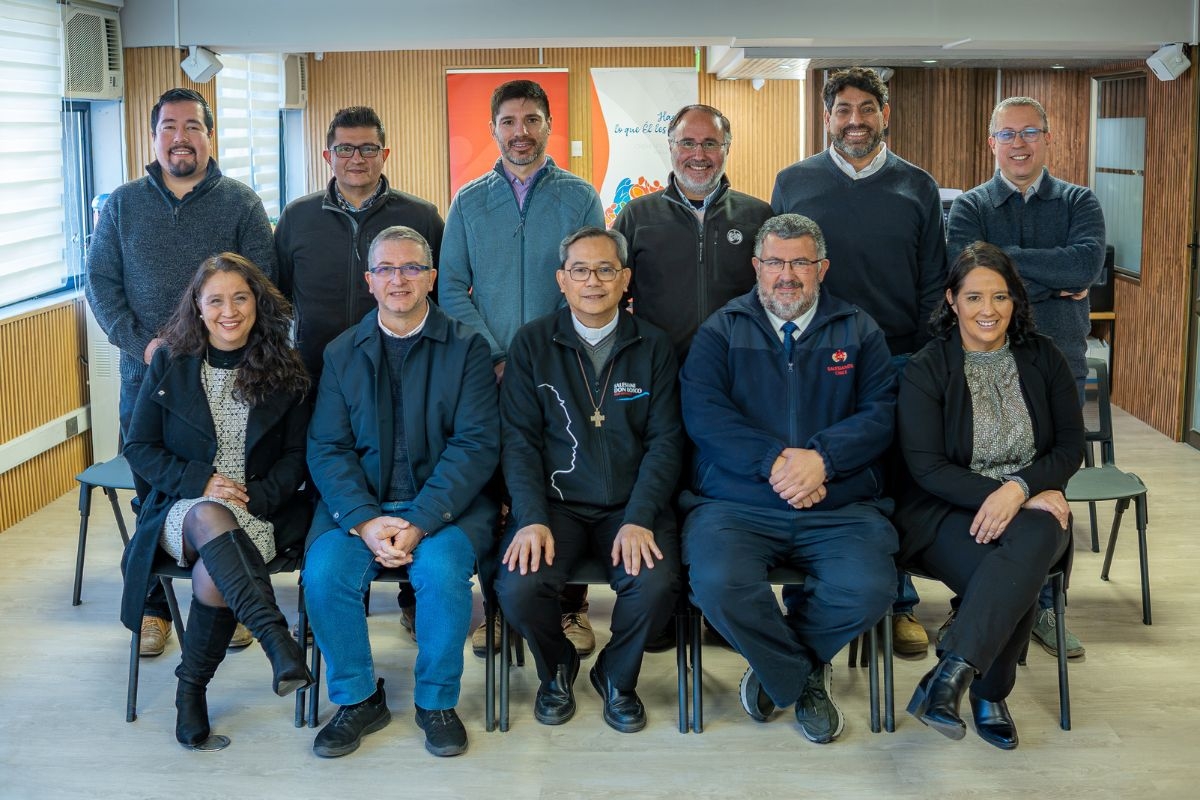
Meeting with the Youth Ministry Team
He then met with the Youth Ministry team. During this meeting, the Councillor expressed his satisfaction with the coordination of the Province’s 22 schools, describing the Chilean system as a model he wishes to present to the world.
During the discussion, he emphasised the importance of data analysis in understanding the reality of young people, particularly in the face of challenges such as mental health, aggression and digital addiction. “If we do not do our job properly, we may harm young people”, he warned, urging those present to act as professionals in the field of “care and prevention”.
He also shared a metaphor of hope: “If you chase butterflies, they will fly away; but if you build a garden, they will come to you”.
Communication: 100% evangelisation
The highlight of the day was the live interview from the studios of the “Caetera Tolle” multimedia centre, conducted by journalist Karina Velarde. During the interview, Fr Fidel Orendain explored Pope Leo XIV’s new encyclical, “Magnifica Humanitas”, emphasising how, in the face of the advance of Artificial Intelligence, the role of the educator is more vital than ever: “Only real people can educate, accompany and understand consciences”.
The Councillor proposed a model of communication based on three pillars: Encounter, Commitment and Empowerment. He also praised the animated series Salesian Missions in America, assuring that he would share it with the General Council in Rome as an example of creativity to inspire vocations.
Fr Fidel emphasised that Salesian communication goes beyond the mere production of content or meeting editorial deadlines; it is a ministry that has a real impact on people’s lives. According to the Councillor, every Salesian and member of the Salesian Family is, by nature, a communicator – not necessarily through the management of groups, but through the witness of their own lives – an approach that aims to build a “theology of communion”, where communication serves to establish deep and lasting relationships, following the example of Don Bosco.
With regard to challenges, he explained that one of the main ones is to support young people so that technology does not dictate their identity or their purpose in life, always reminding them of their human dignity.
Finally, he emphasised the fundamental role of lay professionals, insisting that they should not be seen as an “emergency button” in the event of a shortage of religious staff, but as “strategic partners who contribute a worldview necessary for the shared planning and execution of the mission”.
The full interview is available at this link.