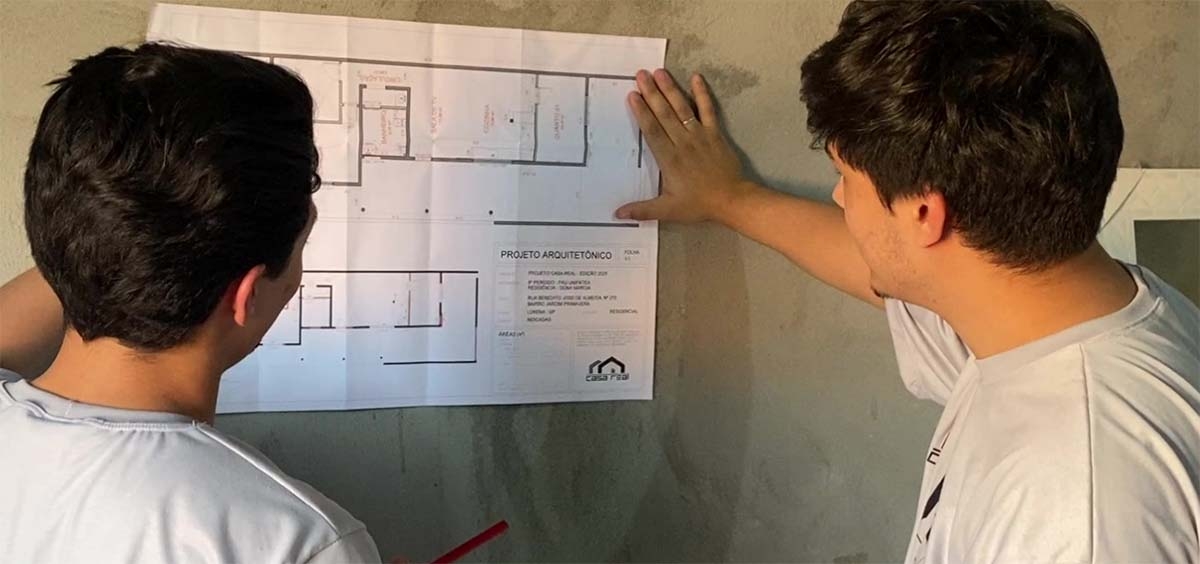
How can we offer university students a comprehensive education that prepares them for the real challenges of their professional careers and lives? For 15 years, the Architecture and Urban Planning course at the Teresa D’Ávila University Centre (UNIFATEA) in Lorena, São Paulo, has been responding to this challenge with the Casa Real Project, which combines excellence in professional training with encouragement for transformative social action.
A success story
The project was born practically alongside the Architecture and Urbanism course, which began in 2010, as the course coordinator, Professor José Ricardo Flores Faria, recalls: ‘In 2011, we held the first edition, still as an architecture and urbanism exhibition, which was set up and then dismantled. In 2013, it became a real project, with a social aspect, a Salesian social action project. We looked for an institution that needed renovations, and the first was the Maria de Nazareth Elderly Shelter. We renovated all areas of the shelter, except for the elderly residents’ rooms.’
It was a great success, and, driven by the Daughters of Mary Help of Christians, who support UNIFATEA, the Casa Real Project continued to be carried out every two years, with renovations in 2015 of the spaces of the Lorena Centre for the Visually Impaired and, in 2017, of the Vila Vicentina da Sagrada Família Long-Term Care Home.
Starting in 2019, the initial proposal was reformulated. In addition to becoming an annual event, Casa Real began to serve needy families in the outlying neighbourhoods of Lorena. ‘Starting in 2019, we adopted the theme of decent housing and began renovating the homes of people in socially vulnerable situations,’ says José Ricardo. Currently, these families are referred by Lorena’s Diocesan Caritas, which has become a partner in the project. ‘Families need to have a very specific profile, owning the property and at the same time being vulnerable in terms of housing.’
‘When professional training meets solidarity, knowledge leaves the classroom and transforms lives.’
How does the Casa Real Project work?
Each year, fourth-year students in the Architecture and Urbanism Course are responsible for the Casa Real Project. They choose the family that will benefit from the project from among those referred by Caritas; they conduct interviews to determine the family’s housing needs; they photograph and measure the house; they survey the costs and materials needed; develop the entire renovation project, which is discussed and adjusted with the family; launch a campaign to raise funds and materials; and, finally, monitor the execution of the work, solving any problems and unforeseen events that may arise.
‘The cool thing is that when we meet graduates of the Architecture and Urbanism course, their fond memories are tied to this project. Because it’s something that touches them, both because it does so much good for others and because it’s something really practical, a real project in which they are truly responsible for working as a team, overcoming difficulties and unforeseen events, and meeting the client’s deadline,’ says the coordinator, pointing out that these students, when they move on to the fifth and final year of the course, find it easier to obtain and adapt to internships in architecture and engineering firms, as they already have concrete work experience in the field.
Social impact
José Ricardo believes that the project’s significant social impact is another distinguishing feature in the students’ education, as they clearly understand how they can transform other people’s lives through their professional qualifications. ‘What we have seen over the years is that Casa Real’s intervention goes far beyond aesthetics and improving the physical space. It involves drainage and sewage systems, renovations to prevent leaks and mould, and sanitation issues.’
He recalls the case, for example, of a house that had a toilet but not a complete bathroom. The only tap was outside and was used by the family for everything: to get water for bathing, washing dishes and doing laundry. ‘So when the renovation is done, the impact on these people’s quality of life is very noticeable, opening up new horizons for that family, and that is very rewarding,’ he adds.
Solidarity and unity
Also noteworthy is the mobilisation of the educational community, with students carrying out fundraising campaigns at school events and educators contributing volunteer work to the project; in addition to the strong contribution from society, with partner companies donating building materials, equipment, furniture… In the latest edition of the project, in 2025, there was even a bakery that joined as a partner, offering coffee and snacks to those who worked on the project!
‘I see that the essence of this project is to combine the practical aspect, the “hands-on” approach, with this focus on others, this attentive listening, with the aim of providing the family being served not with a luxury, but with decent housing, appropriate to what those people want and need,’ concludes Professor José Ricardo.
Ana Cosenza,
with information from André Brazil – UNIFATEA Communications
Source: Salesian Bulletin of Brazil