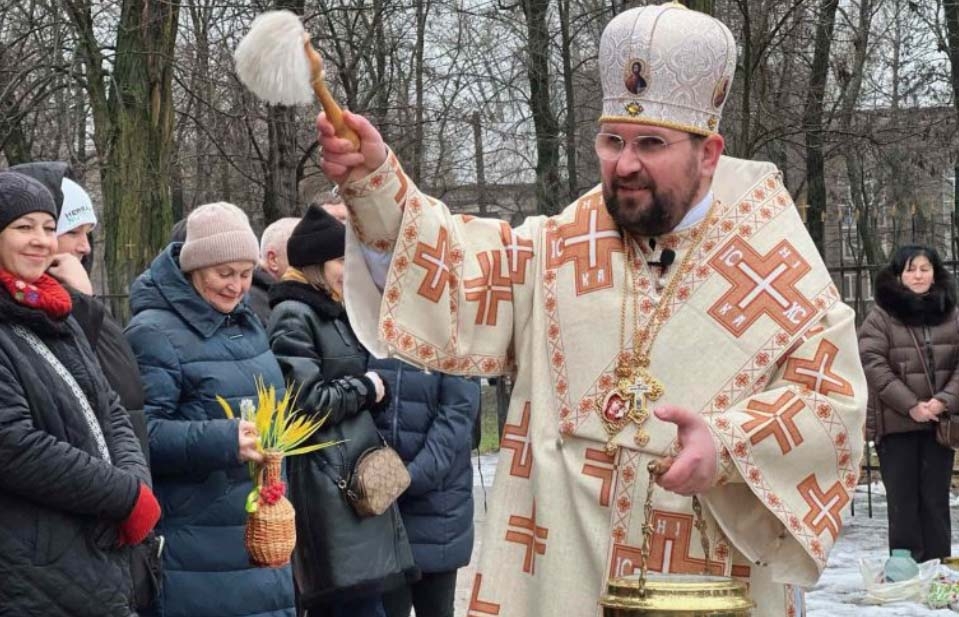
The ‘story’ features a soldier who was defending his homeland and who, at a certain point, became a prisoner of war. ‘After months of torture and after experiencing all the drama that this experience entails,’ says the Greek Catholic bishop of Donetsk, ‘it is inevitable that a person begins to reflect on the meaning of life, on the meaning of sacrifice and suffering. All this often leads to a search for a higher power, a search for God, someone who is beyond and above the human drama of existence.’ The search for God becomes particularly intense when one is experiencing great suffering. ‘I believe,’ Bishop Ryabukha notes, ‘that his interest in God was born precisely during his period of captivity.’
‘After the grace of being freed following a prisoner exchange between Russia and Ukraine, he returned home, but that deep search for God remained in his heart,’ the prelate continued.
At that moment, something in his life had changed. He began to seek out other people who had experienced imprisonment, those who had the courage to speak about that drama and the strength to promote a rediscovery of God. His search is intertwined with another story, that of Father Bohdan Heleta, a Redemptorist religious who, together with another confrere, Father Ivan Levytskyi, was imprisoned in Russian jails for a year and eight months, sharing that tragedy with many others, military and non-military. In short, ‘a prisoner among prisoners.’ After that experience, Father Heleta became the promoter of an initiative: a programme of help and support, including spiritual support, for those who had lived through the same experience.
The soldier found the announcement and decided to participate. And, upon returning home, he contacted the parish priest of one of the Greek Catholic churches in Zaporizhzhia and asked to be baptised, as he had never been baptised. He had grown up in an atheist family of Soviet tradition and had never asked himself the question of seeking God. For two months, Father Oleksandr Bohomaz prepared him to receive the sacrament. It was a journey of light and inner liberation. ‘Through reading the Holy Scriptures,’ says the bishop, ‘he discovered the wonderful plan that God has for humanity and the paternal love with which he accompanies every step of man throughout millennia of history. All this made him fall even more in love with God and gave him the courage to say “yes” to becoming a Christian, to recognising himself as a child of God and to the desire to follow in the footsteps of Jesus from now on.’
His baptism becomes a message of hope for the whole community. Bishop Ryabukha therefore describes it as ‘a small sign of victory: God’s victory over the evil we experience in our daily lives. A victory that brings strong hope which gives meaning to life and even to suffering. I believe that Jesus has never abandoned any of us. What we sang and experienced a few days ago at Christmas, proclaiming that God is with us, Emmanuel, has become alive and present in the life of this man. And for all of us, this is also one more reason to feel and express gratitude to God.’
Source: SIR