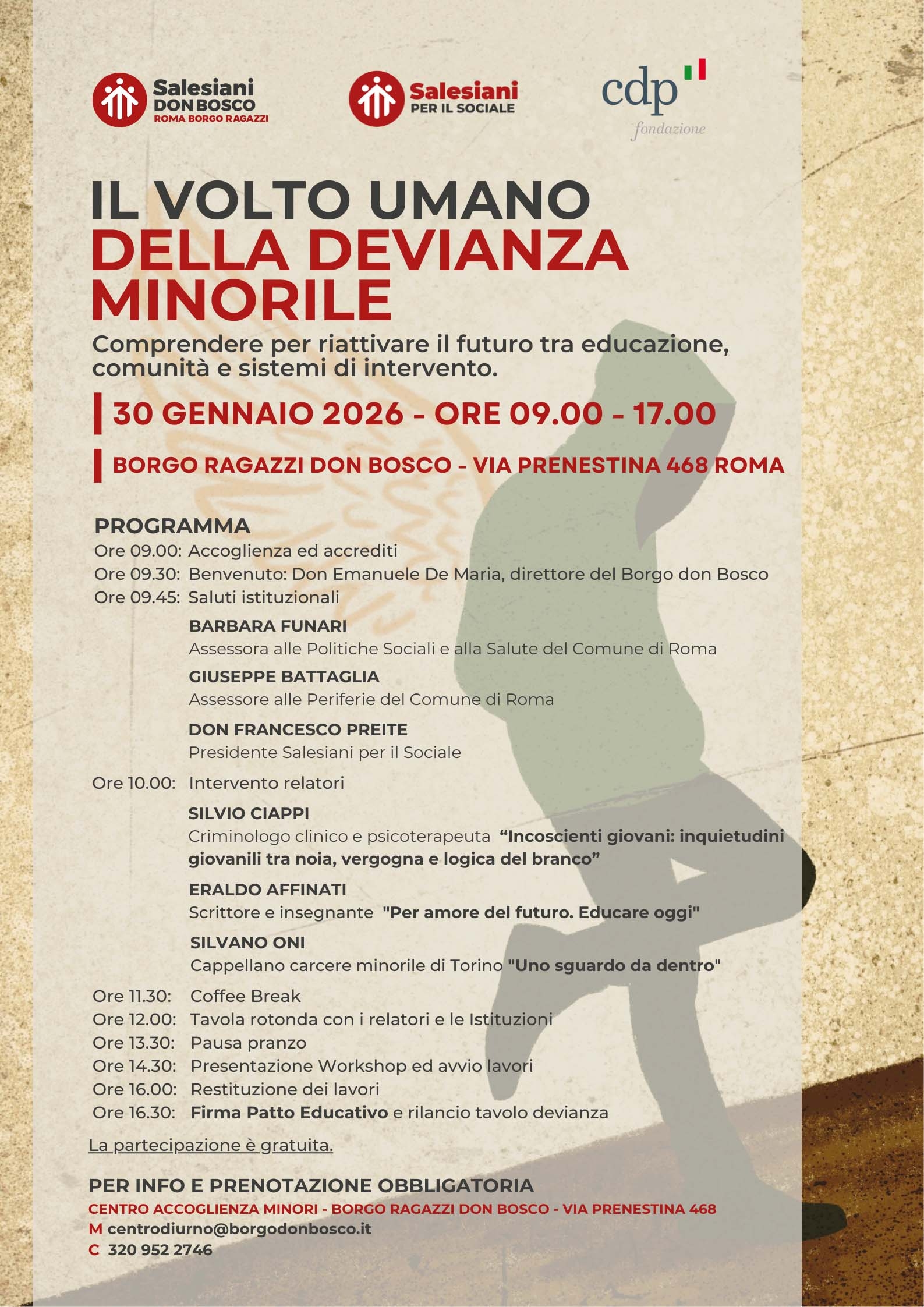
The initiative aims to shift the focus from the crime alone to the person, promoting a deeper and more responsible view of the juvenile offender. A paradigm shift that puts social mediation back at the centre as an educational strategy, capable of combining prevention, empowerment and social reintegration.
Borgo Ragazzi Don Bosco, together with its Round Table on Juvenile Delinquency, emphasises the urgent need to move beyond exclusively punitive responses, which are often ineffective in preventing recidivism and promoting real growth. The aim is to build models of intervention that are not limited to punishing behaviour, but which address the root causes of the problem, giving minors the chance to regain their well-being and their life plans.
From this perspective, the proposed model is a concrete alternative to recent emergency security policies, focusing on prevention, educational support and social reintegration. Understanding the reasons that lead a minor to commit a crime is essential to prevent identification with crime from becoming a destiny.
‘Only a deep understanding of the reality surrounding minors allows us to take truly preventive action,’ says Cecilia Corrias, head of the Borgo Ragazzi Don Bosco Minors Reception Centre. ‘It is essential to develop balanced strategies through dialogue between all the actors involved: families, schools, juvenile justice institutions, law enforcement agencies and prison officers. Only real cohesion between these worlds can generate effective educational projects that respond to the real needs of young people.’
The conference represents the culmination of a process that began in 2022 with the meeting “I ragazzi sono di chi arriva prima” (Children belong to whoever gets there first), organised by the Borgo Ragazzi Don Bosco Juvenile Reception Centre, in agreement with the Juvenile Justice Centre, with the aim of promoting a culture of prevention and social mediation. This commitment also aims to counter sensationalist narratives of juvenile delinquency, favouring instead communication based on knowledge and social responsibility.
In light of recent events in La Spezia and Naples which have seen minors involved in episodes of extreme violence, there is a risk that collective dismay and indignation will fuel a simplified and repressive interpretation of the phenomenon, steering public opinion and political choices towards exclusively punitive responses.
‘We understand the pain and fear that these events generate,’ says Fr Emanuele De Maria, Salesian and Director of Borgo Ragazzi Don Bosco, ‘but we believe it is essential not to lose sight of the human aspect of the minor and the personal, family and social circumstances that led them to commit the crime. To give up this perspective means giving up the very possibility of prevention.‘ It is with this conviction that Borgo Ragazzi Don Bosco continues to focus on the power of education, the same power that guided Don Bosco when he said, ’If these children had had a friend ready to take care of them, they would not have ended up here.’
In the afternoon, the proceedings will culminate with the signing of a Territorial Educational Agreement which will be signed by the stakeholders involved in the thematic groups, confirming a concrete and shared commitment to the territory. The ultimate goal is to create a Permanent Institutional Table, capable of transforming the reflections that have emerged into structural educational and training policies.
Source: borgodonbosco.it