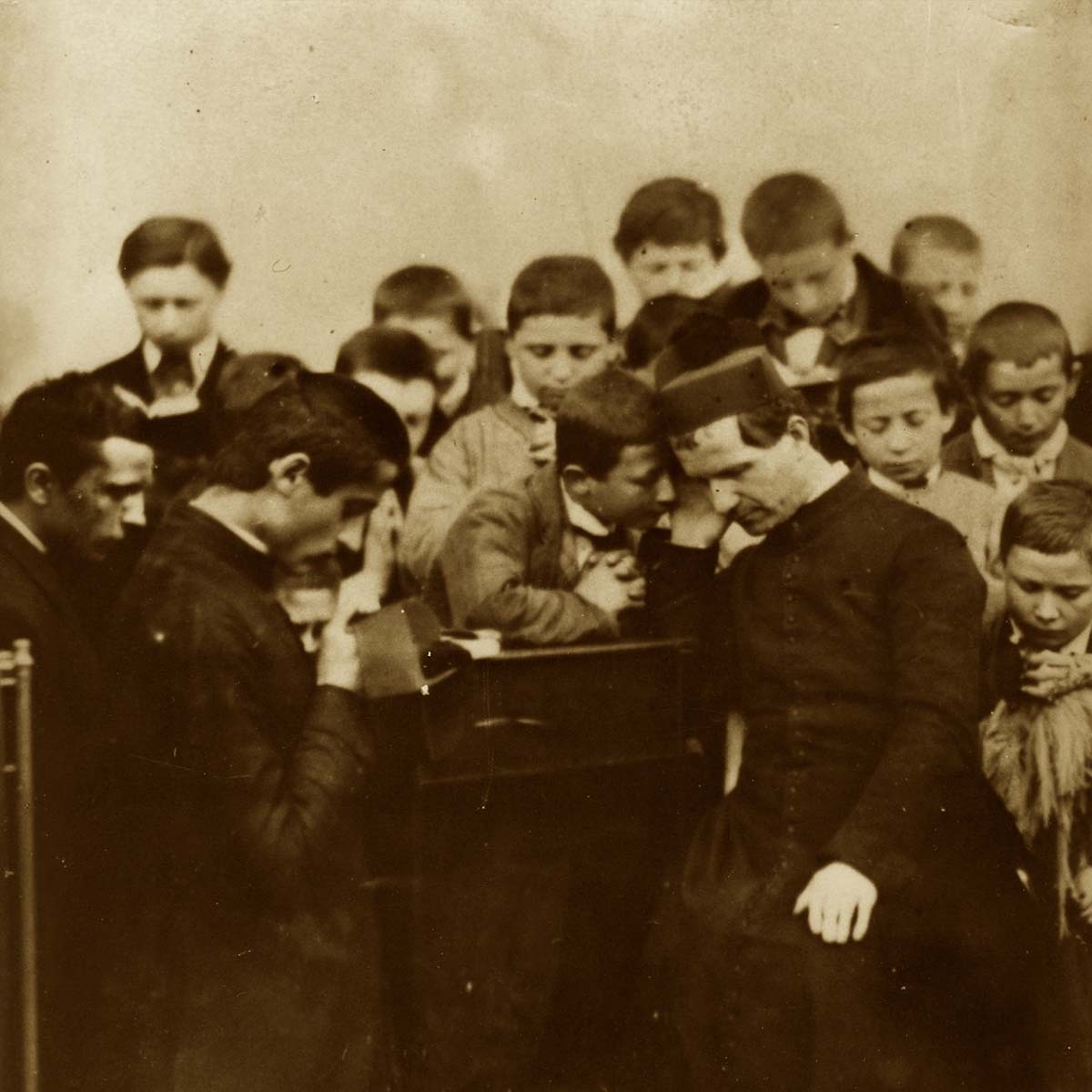
Often, two or three sentences were enough to change the atmosphere of an entire house, to ease tensions or to open a window in the heart of a young person who might never have found the courage to speak to the Director alone. The last word of the day was not that of noise or tiredness, but that of a father who guides the heart.
The Salesian Bulletin recalls how Don Bosco considered the “goodnight” a “powerful means of persuasion” and “the key to morality and the success of the educational enterprise”. The secret lay in three essential elements: brevity (a few minutes), concreteness (a single, clear central point) and an affectionate atmosphere (words addressed to children who know they are loved). In this way, Don Bosco was able to make the boys reflect without tiring them. It is not surprising that many witnesses remember how, after the goodnight, the boys continued to talk in whispers in the dormitory about that phrase or image: the catechesis continued spontaneously, in the form of shared friendship.
In many goodnights, the Preventive System is clearly at work. Don Bosco does not wait for problems to explode before intervening; rather, he starts from a small fact—a lack of respect, a quarrel, a generous gesture—and comments on it in a positive way, preventing evil and valuing good. The same attitude emerges in his dealings with his confreres: in a goodnight message in 1877, he invites them to watch over the boys affectionately, helping them to avoid the dangers associated with bad reading or bad company. Prevent, do not repress: educate the conscience before error takes root, and help each person to recognise the consequences of their choices. In this sense, the goodnight becomes a small daily school of discernment, where the Gospel illuminates concrete life.
Studies on the Preventive System emphasise how presence among young people—assistance—is an essential element. The educator lives the day with the young people and, in the evening, offers them an interpretation of what has been experienced. The goodnight thus becomes the moment when daily life is clarified: what happened in the playground, in the classroom or in the workshop is interpreted in the light of human and Christian values. The young person does not feel judged from the outside, but accompanied from within; he or she perceives that someone has seen, understood and taken to heart his or her struggles and joys, now returned in the form of a kind word.
It is no coincidence that the Salesian Constitutions and the main documents of the Institute have preserved this tradition as one of the most typical practices, to be adapted to the times but never neglected. Even today, an educator who finds two minutes every evening to say a kind word—in an oratory, a family home, a school or a parish community—continues Don Bosco’s style. In a world marked by noise, notifications and constant messages, that brief moment of listening and shared words can become a small daily sanctuary of the heart. This is also how the Preventive System works: through an evening word, spoken with affection, capable of guiding freedom and awakening in young people the desire for a slightly better tomorrow.