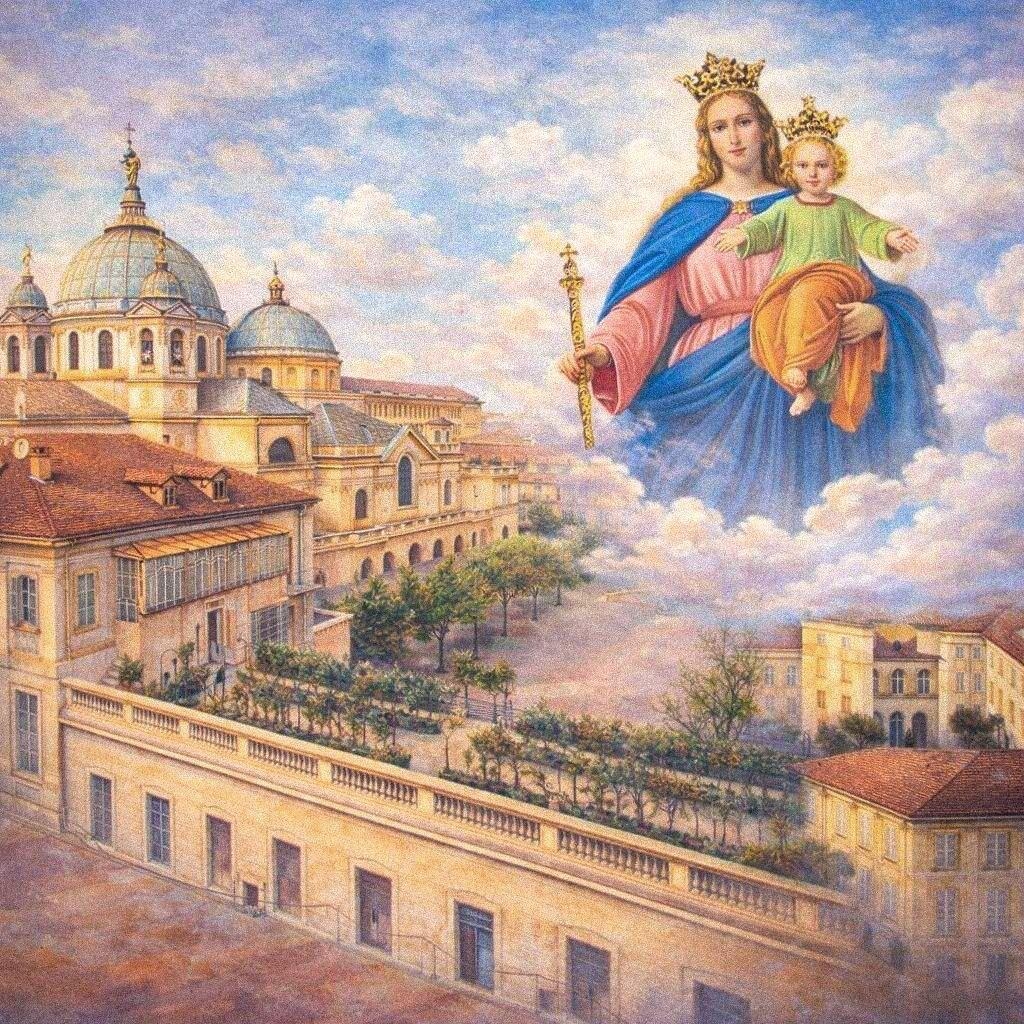
In biographies, in the fioretti and in the testimonies of his contemporaries, this familiar and audacious image often recurs: Don Bosco entrusts to Mary the expenses of the house, the instalments for the works, the daily bread for the young people, as if she were the heavenly treasurer of his works. This is not a poetic formula, but a concrete interpretation of his experience: the total confidence that, when the work is for young people and for God, Mary will not fail to provide the essentials.
The Basilica of Mary Help of Christians, built in just three years under humanly impossible conditions, is the most evident sign of this active faith. Official documents recall that Don Bosco chose the title Help of Christians precisely to express his gratitude for the many ‘helps’ he had received and to entrust the protection of the nascent Congregation to Our Lady. The history of the construction appears as a succession of bold choices and providential interventions: the land purchased without having the necessary money, the excavations started while the economer is already in serious apprehension, the lotteries organised to cover the debts, the offerings that arrived at the last moment to pay the workers. Don Bosco’s response to the economer who invited him to stop remains famous: ‘When have we ever started a project with the money ready? We must leave something to Providence and Our Lady.’
As the debts grew and the workers demanded payment, Don Bosco invited everyone to pray and reassured them that Our Lady would not fail to provide what was necessary. Numerous episodes tell of unexpected donations, unexpected benefactors, and sudden solutions to serious difficulties. Don Bosco never interpreted these events as mere coincidences: for him, they were ‘miracles of Providence’, obtained through Mary’s intercession. At particularly critical moments, when he had to choose between continuing the work or guaranteeing bread for the boys, he did not hesitate: the young people came first, always. The building sites were halted, while Our Lady was entrusted with the task of restarting the work when the necessary funds arrived.
This vision is well summarised in some expressions attributed to him: ‘Divine Providence will help us; it has never abandoned us,’ and above all in the conviction that Mary was truly the ‘economer’ of his works: ready to provide everything necessary for the good of the boys, but never anything superfluous. A document recalls his clear criterion: the Lord promises what is necessary for the mission, not what serves vanity. This is the source of Don Bosco’s typical balance: boldness and sobriety. He dares to do great things for young people because he knows he is not building them alone, but he rejects waste and useless decorations, certain that Our Lady does not finance what is not necessary for the salvation of souls.
Alongside the Basilica, the daily life of Valdocco also bears the “signature” of Mary Help of Christians. Dreams – such as the one about bread, in which Don Bosco sees the boys divided according to the type of bread they receive – become for him a key to understanding their condition in both spiritual and practical terms. They reinforce his decision to never let the table lack the necessities and to take the same care in nourishing the soul. In the Biographical Memoirs, small signs of Providence continually emerge: sacks of flour arriving at the last moment, benefactors touched by a simple visit to the house, boys sharing the little they have. For Don Bosco, these are not random episodes, but appointments with Mary, who “saw” and provided.
For Don Bosco’s followers, speaking today of Mary Help of Christians as the “true steward of Valdocco” means learning to read their own works with the same eyes of faith. Where the mission in favour of young people is lived with poverty, courage and fidelity, there Providence continues to act: not always with sensational signs, but through people, encounters and opportunities that arrive “at the right moment”.
And as Don Bosco taught, it is precisely in economic difficulties that authentic trust is measured: continuing to serve young people without fear, while Mary, silently, continues to take care of the needs of everyone.