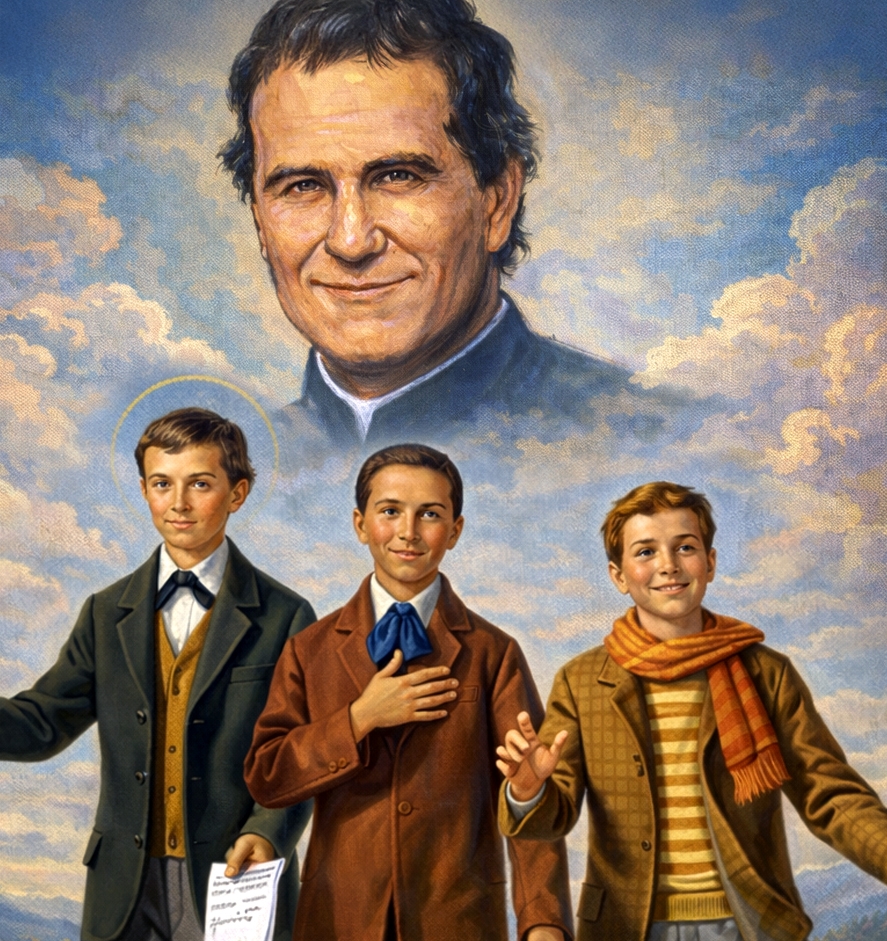
Valdocco, a workshop of youthful holiness
Valdocco is not just a boarding school or an orphanage: it is a home where one feels loved, a school that prepares one for life, a courtyard where one runs and laughs, a church where the Gospel becomes a daily experience. In this lively environment, Don Bosco exercises his educational art: a constant presence among the boys, a kind word at the right moment, trust that lifts up those who fall, a clear proposal of Christian life. Holiness is not presented as a cold or unattainable ideal, but as a path open to all, made up of joy, friendship with Jesus, love for Mary, and commitment to daily duties.
In this climate, the three boys find the ideal place for God’s grace to flourish. Don Bosco does not isolate them or place them on a pedestal: he integrates them into the ordinary rhythm of the oratory, where prayer coexists with play, silence with singing, sacrifice with smiles. Holiness has the scent of shared bread, the sweat of labour, the joy of celebrations, the forgiveness received in confession. It is here that the “tailor” begins his work: not by changing the boys from the outside, but by gently bringing out the best that God has already sown in them.
Dominic Savio: fine fabric that seeks guidance
Dominic Savio arrived in Valdocco with extraordinary fabric: a heart already in love with God, a great desire for holiness, a delicate and sensitive conscience. His famous phrase, addressed to Don Bosco – ‘I am the fabric, you be the tailor’ – is like the official handing over of this boy into the hands of his spiritual father. Don Bosco immediately saw the quality of this fabric, but he also understood that it risked tearing if it was not treated with wisdom. Dominic easily tended towards excesses: harsh penances, sacrifices that exceeded his strength, inner scruples that could weigh him down.
Here the tailor’s hand becomes both gentle and strong. Don Bosco corrects, purifies and lightens. He teaches Dominic that holiness does not consist in doing extraordinary things, but in living his duties as a student well, in being cheerful, in doing good to his companions. Instead of excessive mortification, he proposes to him the “programme” of youthful holiness: cheerfulness, study and piety. He helps him to nurture his friendship with Jesus in the Eucharist and with Mary Immaculate, but always in a smiling and fraternal manner.
Thus is born a habit of luminous holiness, made up of purity of heart, intense love for the sacraments, and apostolic zeal towards his companions. Dominic became a promoter of groups, supporting the weakest and quietly leading them to goodness. His early death was not a defeat, but the fulfilment of a rapid and intense journey: his habit was ready, carefully tailored, and the Lord welcomed him as a precious gift.
Michael Magone: rough fabric transformed into joy
If Dominic is fine fabric, Michael Magone is rough fabric, almost torn from life on the streets. We meet him as a gang leader, lively, noisy, already touched by the risk of delinquency. Don Bosco, seeing him, does not stop at appearances: he senses in that disorderly boy a good heart, thirsty for affection and meaning. He invites him to Valdocco, offering him not only a place, but a father. The first step is an encounter of mercy: Michael confides that he feels ‘full of demons’, crushed by a heavy past; Don Bosco accompanies him to a sincere, profound confession, where grace mends the lacerations of the soul.
From there, the tailor began to work on a fabric that needed to be cleaned, ironed and finished with patience. Don Bosco did not extinguish Michael’s liveliness, but guided it: he educated him in study, obedience and inner discipline, without depriving him of play, music and socialising. He teaches him to transform his explosive strength into energy for good, his theatricality into the ability to animate others, his impetuosity into Christian courage. Michael discovers the joy of prayer, of frequent confession, of communion experienced as a force for changing his life.
In a few years, the turbulent boy becomes a young man with a serene face, a lover of the oratory, attentive to his companions, sincere in his faith. Illness and death came early to him too, but they found him clothed in a new garment: that of a teenager who had experienced the power of forgiveness and had turned his fragility into a way of encountering God. Don Bosco, a patient tailor, succeeded in showing that no fabric is too damaged to be transformed into a garment of holiness.
Francis Besucco: simple fabric made luminous
Francis Besucco comes from the mountains, from a poor and laborious life, from a family and a parish that have already given him a solid, simple, concrete faith. He is a humble fabric, without flashy embroidery, but resistant, clean, faithful. Reading the lives of Savio and Magone, he too wanted to belong to Don Bosco; so he arrived at Valdocco with the fear of the little ones and the courage of the poor. He brought with him an intense piety, a love of Mass, and sensitivity towards the smallest and most needy.
Don Bosco, faced with this fabric, does not want to “redo” what God and his family have already done well. His work here is one of harmonisation and expansion. He helps Francis to fit into college life, to combine piety with study, prayer with play, shyness with the ability to open up to his companions. He frees him from any rigidity, making his devotion more serene, more Easter-like. He supports his generosity towards the sick, the poorest, the most neglected, transforming his shepherd’s heart into a truly pastoral heart.
Francis’ holiness has the profile of his mountains: clear, essential, solid. It makes no noise, it does not amaze with sensational gestures, but it convinces with daily consistency, with goodness, with a willingness to sacrifice oneself in silence. For him too, illness becomes the final canvas on which God and Don Bosco sew, together, the final stitches of a garment of poor and shining holiness.
Three garments, one hand… and our today
Dominic, Michael and Francis are three garments of holiness made by the same tailor, but with different cuts, colours and lines. In Dominic we see lofty desires, purity of heart, openness to mission; in Michael, redeemed strength, grace that enters the most tangled knots of life; in Francis, the luminous simplicity of a faith that smells of family, of earth, of the Gospel lived without fanfare. Don Bosco does not standardise or flatten: he preserves the originality of each person and brings it to fulfilment.
For us today, these three young men are a clear message. For educators, they remind us that every young person is a unique fabric: it is not a question of imposing rigid models, but of accompanying them with patience and love, so that God’s will can be expressed in ever new forms. For young people, they show that holiness is not reserved for the perfect, but is a path open to those who dream big like Dominic, those who have had a difficult past like Michael, and those who live a simple life like Francis. Don Bosco’s hand, after all, continues to work through all those who, in his spirit, allow themselves to be used by God as humble instruments to “sew” garments of youthful holiness in the new generations.