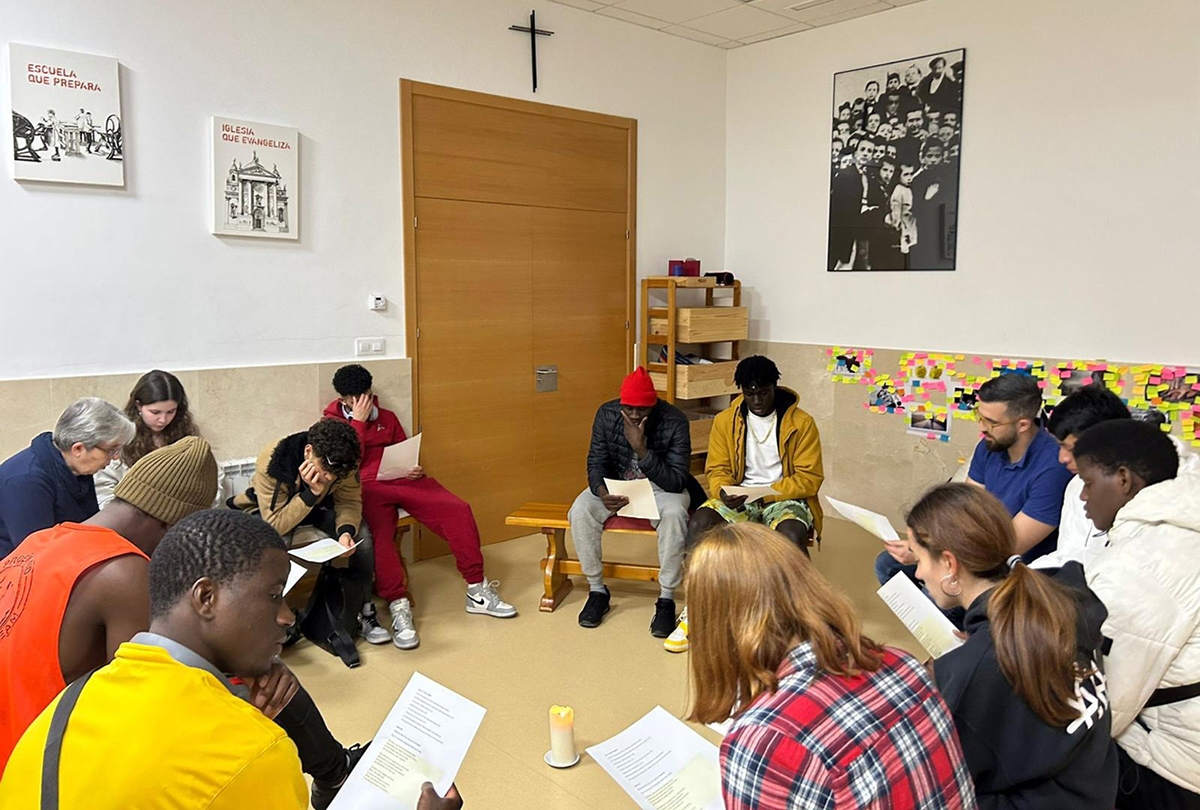
This interreligious shared living has always been and continues to be positive, edifying and challenging: Positive, since the creation of mixed spaces where the transcendent dimension has been understood as a necessity for all people, even though we may have different ways of seeing and experiencing it. Uplifting, because it bears witness to each other’s commitment to their beliefs, liturgies and traditions. Challenging, because we discover that it is possible to give ourselves spaces to share a faith that gives meaning to our lives and without which we are unable to live.
In daily coexistence it has a positive impact on relationships and the ways in which we treat each other, making us more sensitive and attentive, taking care of the most routine gestures and language in attention and care among all those living together.
Common spaces (dining room, free time, social gatherings, etc.) sometimes become rich moments for sharing personal experiences that reveal the religious influence and predominant values of individuals, as well as for responding to any curiosity that may arise.
This is even more pronounced in residential projects, as sharing daily life in the same home brings people closer together. This diversity is an opportunity to learn and grow through mutual respect.
A welcome that knows no boundaries
When we talk about interfaith dialogue, we are talking about a process that involves a change in mentality, sensitivity and behaviour. It goes far beyond carrying out a series of specific activities in which people of different religions participate, although this is usually the first step on a path that should take us much further. We try to achieve a real openness of minds, hearts and behaviours, overcoming prejudices, ignorance, ethnic and cultural barriers, and embracing the differences that enrich and humanise us.
From our experience over the years, in which we have continued to work towards a vision of respect and celebration of religions, we highlight elements such as:
An unconditional welcome to everyone who comes to our projects, based on a global vision of the person, where we try to make them feel comfortable and valued from the very first moment, including for the religion they profess, and to make them feel that we will support them in any way we can so that they can live it properly. Educating and raising awareness among teams, participants and society about interculturalism and interreligious dialogue. Promoting informal spaces for dialogue, emphasising the elements that unite us and explaining, with respect, the differences without judging them. Specific experiences and celebrations of interfaith dialogue, well organised and motivated, taking into account the most important festivities of different religions: Ramadan celebrations where people who do not profess the Muslim religion discovered what Ramadan consists of and what it means, all through testimonies and real shared experiences. Christmas celebrations, a space where people of different religions come together to celebrate life. We always look for the common elements that different religions and cultures share, such as music or food, always reserving a space for giving thanks. In May, on the occasion of Mary Help of Christians, we celebrate Mother’s Month, once again returning to common elements and focusing on celebration and gathering. Workshops and activities that highlight the value of different cultures and religions: explanation of the practices of Islam; the social and spiritual work of evangelical Christian communities and their strong sense of community; Christian tradition and Catholic culture: a space dedicated to the majority religious heritage in the area, explaining the meaning of festivities such as Holy Week or Christmas, and how Christian values of charity and hospitality underpin the work of organisations such as ours, activities with a spiritual focus in which people of different religions participate…
How is diversity experienced in the day-to-day life of the homes?
It is in the residential projects that the word ‘family’ has taken on a new and expansive meaning. Far from being just a residence, this space has become a real home for young migrants who arrived at our door with little more than hope in their backpacks: a new country, another city, without their neighbourhood, without a home, without their people, and struggling with legal procedures.
The dining room table is the centre of our universe, a vibrant meeting place where different beliefs and stories mix naturally. Differences dissolve over a hot meal or a simple cup of tea and a sincere smile.
Those of us who live here feel that this family atmosphere is the clear answer to the question: What would Don Bosco do today? He would be out on the streets, welcoming those most in need, offering a home where unconditional acceptance reigns.
This shared living is in no way apologetic; it is done with total honesty, respect and openness, with the conviction that this helps in the personal project that each person is developing and that we accompany educationally.
Aware that not everything is the same, recognising that our choice is neither eclecticism nor relativism, we value interreligious shared living within the framework of respect for the person and in the educational process that accompanies all dimensions of the human being.
Source: Salesianos.info