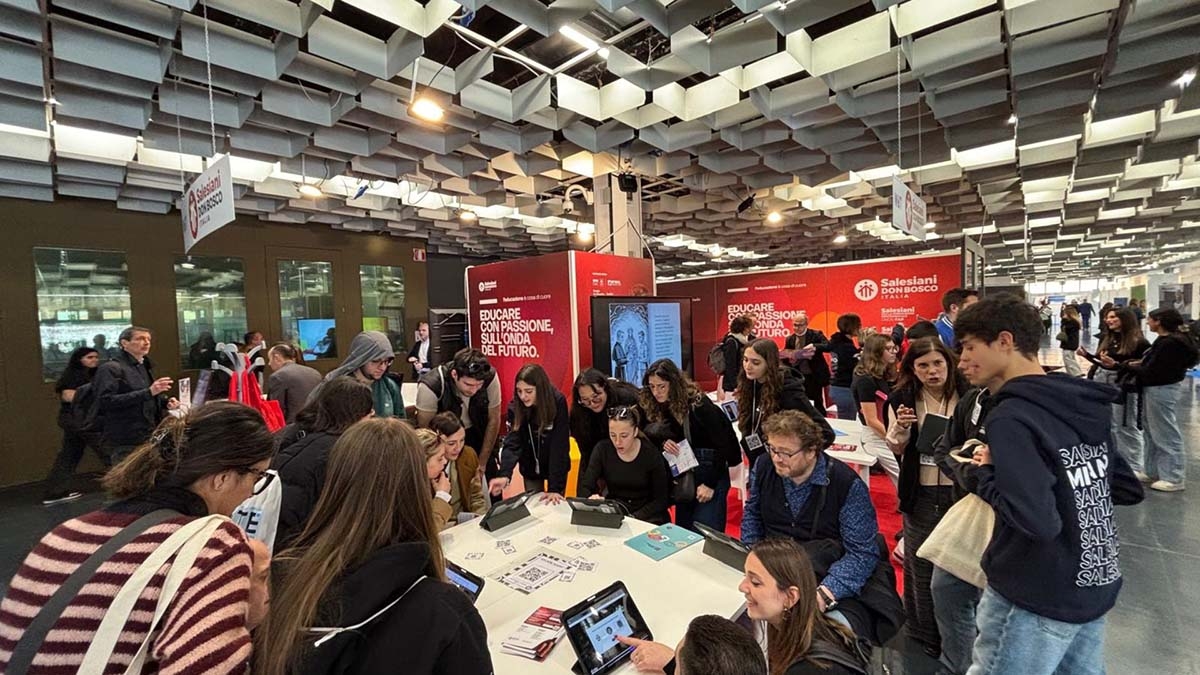
The link between the charism of a 19th-century saint and modern AI linguistic models is not simply a rhetorical device. ‘Don Bosco always wanted to be at the forefront of progress,’ was reiterated during the meeting. Today, that drive translates into the ‘GO Beyond’ project, a network that brings together about 80 schools and 1,600 teachers throughout Italy, coordinated at the national level to govern the digital revolution rather than suffer it.
Fr Elio Cesari, President of the National Centre for Salesian Works (CNOS), framed the issue: ‘The latest Censis report speaks of a savage age of predators and prey. AI is not just a technological issue, but an epoch-making upheaval that questions our destiny. Schools must analyse its full power, remaining within it intelligently and with full awareness.’ He added: “The Salesian personalist tradition sees technology as an enhancement of the human, not as a replacement: the centrality of the person and the encounter between teacher and student remains the ultimate criterion for evaluating innovation. AI is configured as a “pedagogical assistant” under the mediation of adults, capable of freeing teachers from repetitive tasks to give them back precious time to devote to listening and accompanying.”
Strategic collaboration: Google and MR Digital
The project boasts the collaboration of “Google Education Italia” and “MR Digital”. Marco Berardinelli (Google) highlighted how the goal is to personalise learning for each student, moving away from the “copy and paste” logic to encourage the inclusion of those with special educational needs. Andrea Russo (MR Digital), on the other hand, revealed that Google is following this project as a priority global case study for its ethical and research approach, conducted in collaboration with the Salesian University (UPS).
Experiences from the field: when AI becomes a tutor
Two teachers brought tangible proof to Didacta of how AI is changing lessons. Professor Carlo Spironello, who works at the Salesian centre in Mestre, illustrated how AI can simulate a historical trial of Louis XVI. By having the software generate sometimes incorrect accusations and defences, he encouraged students to verify the sources, turning the machine’s error into a lesson in critical thinking. Professor Francesco Fraccaro, also from Mestre, presented the “augmented laboratory”. Through “Google AI Studio”, students frame real plants and instantly receive technical data sheets: “AI frees students from the role of passive spectators and makes them active explorers”.
The perspective of institutions and research: INDIRE and the Salesian University
The event closed with two fundamental contributions to the scientific validation of the project. The representative of the National Institute of Documentation, Innovation and Educational Research (INDIRE), Samuele Borri, emphasised the global educational dimension, underlining the importance of constant support for young people in the use of AI. According to the institute, this guidance should not be strictly limited to classroom teaching but should extend to the everyday use of these technologies by young people, in order to make them aware digital citizens.
Fr Michal Vojtas, SDB, from the Salesian University, illustrated the scientific rigour behind the initiative. He spoke about the rigorous methodological research that the university is conducting on the impact of AI on education and learning processes. The aim is to monitor results in order to correct the course in real time, ensuring that technology always remains a means to empower humans and never an end in itself.
The event closed with a warning that will remain the manifesto of this edition of Didacta: “Artificial Intelligence will not replace humans, but those who use it will replace those who do not”.
Source: Don Bosco Italia