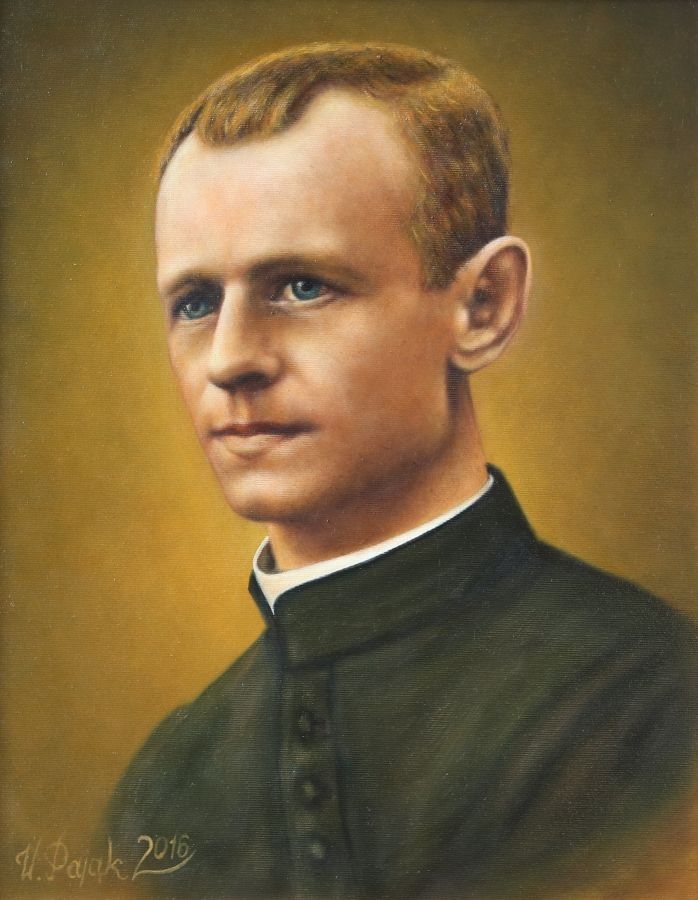
Salesian Path
Four years later, he was admitted to the novitiate of the Salesian Congregation in Klecza Dolna, and after completing it, on 7 August 1922, he made his first religious profession. He completed his philosophical studies in Kraków, after which he undertook practical pedagogical training (the so-called assistantship) in Kielce and, in the following year, in Oświęcim. He made his perpetual vows on 14 July 1928 in Oświęcim. In the years 1928–1933, he studied theology at the Higher Diocesan Seminary in Przemyśl, where he was ordained a priest on 29 June 1933 by Bishop Franciszek Barda.
After his first Mass, which was celebrated very solemnly by the people of his hometown, who loved him dearly, he devoted himself with great zeal to work among the youth in Salesian institutions. After ordination, he worked in Oświęcim, Lviv, Przemyśl, Skawa, and again in Przemyśl.
The youth especially loved their guardian, who was devoted to them with his whole heart and tireless in fostering their wholesome activities; he knew in a particular way how to draw them to the confessional and to the Table of the Lord.
During the war, the orphanage in Przemyśl was seriously damaged, and the youth were dispersed. Fr. Mroczek was transferred to pastoral work in Częstochowa, where a parish dedicated to the Sacred Heart of Jesus in Stradom had been entrusted to the Salesians. After a year, he came to Kraków, to the so-called “Łosiówka,” that is, to the Salesian seminary. His task was catechesis in nearby schools.
Arrest
On 22 May 1941, on the Solemnity of the Ascension of the Lord, while Fr. Mroczek was celebrating Holy Mass in the seminary chapel, the Gestapo arrived at the seminary to arrest him. When the Gestapo officers entered the chapel and saw him celebrating, they withdrew to the sacristy and waited for him there, searching his room in the meantime.
The reason given for his arrest was that he belonged to a military organization and supported the activities of the Polish Army in the territory of the General Government. This reason was fabricated, since Fr. Mroczek, apart from his work among the youth and in the confessional, was engaged in nothing else.
Some sources state that in the years 1939–1940 Fr. Ludwik was involved in the activities of the Polish underground Union of Armed Struggle as a courier of underground press on the route Przemyśl—Lviv and as a troop leader of the underground scouting movement—the Grey Ranks—in the area of Przemyśl-Zasanie. A month later, together with eleven other confreres, he was transported from the Montelupich prison to the concentration camp in Auschwitz, where, among other things, on 27 June 1941 he was an eyewitness to the martyrdom of four of his confreres.
Martyrdom and Death
Fr. Ludwik survived that day of severe camp trial and remained alive; however, having been brutally beaten, he suffered terrible pain, and the wounds caused by the beating did not heal—they swelled and gradually filled his entire body with infection.
Because of his heroic endurance of camp suffering, he was given the name “the titan of suffering.”
Here are fragments from the testimony of one eyewitness:
“In the evenings I visited Fr. Mroczek. Conversations with him were strengthening. He did not philosophize. With his simple faith, expressed in simple words, he won over and calmed the listener. In everything he was able to point to God’s purpose. His simplicity and goodness brought relief to people, in this sea of anger, hatred, bitterness, and suffering that afflicted this venerable priest. We came to love him.”
“One evening Fr. Mroczek admitted that the wound was not healing and, what is worse, that his right thigh was swelling and causing him pain. I went to Dr. Turschmid. He promised to examine the matter. The next day he found pus in the right thigh. Again anaesthesia and a surgical procedure. The suffering intensified. One day the surgeon found pus in his right arm. Again anaesthesia and surgery. And after a few days, pus in the left arm… The whole of his body was filled with infection.”
“Dr. Turschmid and Dr. Zabłocki, with great care, though without hope, cleaned the deep wounds, washed them with hydrogen peroxide, poured some kind of substitute over them, and carefully bandaged them—unfortunately, only with paper. After the procedure, Fr. Mroczek looked like an Egyptian mummy, bandaged from his ankles up to his neck…”
“And how long will he still suffer?” I asked, not expecting an answer. He thought for a moment and replied: “The infection has already reached the lower abdomen. I think—from three hours to three days…”
“After lights out that day, many shadows of prisoners gathered around Fr. Mroczek’s bunk. Groans could be heard from all sides of the ward. Many prisoners died that night.”
“In the morning, when the rays of winter light tried to break through the frozen window of that dreadful hospital room—the eyes of Fr. Mroczek no longer opened. His face was full of brightness and peace.”
Thus the eyewitness.
Fr. Ludwik Mroczek died on 5 January 1942, at the age of 36, in the 19th year of his religious vows and the 8th year of his priesthood.
He bore the camp number 17340.
Beatification Process
Fr. Ludwik Mroczek is one of the 122 Servants of God for whom the second beatification process of the second group of Polish martyrs of the Second World War began on 17 September 2003.
On 24 May 2011, the diocesan phase concluded in Pelplin, and all documentation was forwarded to the Congregation for the Causes of Saints in Rome.
The Positio was submitted on 21 July 2022, and its relator was Fr. Szczepan Tadeusz Praśkiewicz, OCD.
The postulator of the cause is Fr. Pierluigi Cameroni, General Postulator for the Causes of the Salesian Family, who collaborates with Dr. Mariafrancesca Oggianu.
On Tuesday, 28 March 2023, the historical consultors of the Dicastery for the Causes of Saints issued a positive opinion regarding the Positio suppletiva super martyrio of Fr. Jan Świerc and eight companions, priests of the Society of St. Francis de Sales, murdered in odium fidei in German extermination camps in the years 1941–1942.
On 24 October 2025, Pope Leo XIV ordered the promulgation of the Decree on Martyrdom and its inclusion in the acts of the Dicastery for the Causes of Saints.
Don Mroczek – Video:
I video:
PL
https://youtube.com/shorts/8JJ1t4ysCuk
IT
https://youtube.com/shorts/PMaSiurjaBY
EN
https://youtube.com/shorts/JSTI2FewX0A
II video:
PL
IT
EN
{gallery}PLS – 9 martire 2026{/gallery}