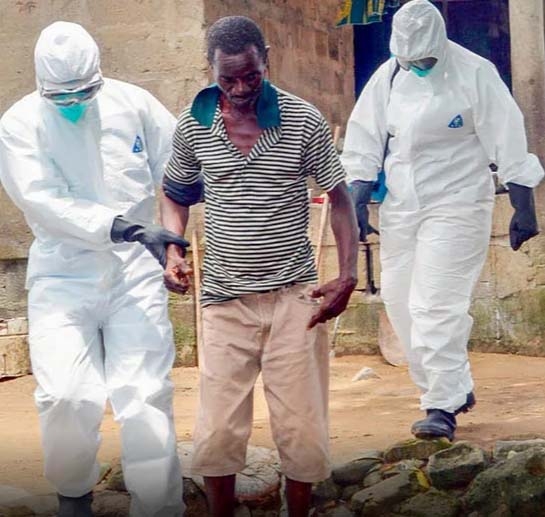
Concern over the spread of Ebola is growing daily. The WHO maintains an international alert for an outbreak that has already seen more than 750 suspected cases and over 170 deaths, figures that are rising daily due to health and security challenges in the eastern part of the country.
Most of the infections are concentrated in the Congolese province of Ituri, in the north-east of the country. However, there is also concern regarding North Kivu, due to the constant movement of people and the commercial and human links with the affected areas.
In Goma, where the Salesian community is present, the city is marked by violence, forced displacement and extreme poverty, and the situation remains under health surveillance. For the time being, the authorities have reported only a few isolated cases, involving people from the affected areas, with no widespread outbreak recorded in the city.
Nevertheless, fear and uncertainty are very much present among the population. “Thousands of families are surviving in very precarious conditions, and a health emergency such as this represents an additional threat to those who have already lost almost everything,” explain the Sons of Don Bosco working in Goma.
Furthermore, the epidemic is already having significant economic and social consequences. The borders with neighbouring countries, Rwanda and Uganda, remain closed, and this has severely affected thousands of people who used to cross them every day to work, study or stock up on supplies. The health threat has also disrupted trade and transport routes to Uganda, which are vital for the supply of food and essential goods to the eastern part of the country.
“The most important thing now is to keep people well informed and avoid panic”
In this context, the Salesians have stepped up preventive measures in their social and educational works. Every day, thousands of children, girls, young people and families pass through centres such as Don Bosco Ngangi, Bosco Lac or the Goma Technical and Industrial Institute (ITIG) to receive education, food, support and basic medical care. In addition, awareness-raising initiatives are being carefully carried out to ensure the population knows how to prevent infection and how to react if symptoms appear.
“The most important thing now is to keep people well informed and avoid panic,” explain the Salesians in Goma. In recent weeks, new handwashing stations have been installed, hygiene campaigns have been stepped up, and children, girls, young people and their families are being made particularly aware of basic preventive measures.
But the Salesian presence extends far beyond Goma: the Salesians also work in other parts of the country, where they support vulnerable communities and run educational, social and health projects.
In cities such as Lubumbashi, Kinshasa, Mbuji-Mayi and Tshikapa, they run schools, youth centres and child support programmes. In more isolated and impoverished areas such as Kasenga, Mokambo, Sakania and Kipushya, they carry out educational and social projects.
Furthermore, they are also present in Uvira, Bukavu, Nyakadaka and Kalemie, in the eastern part of the country, one of the regions most affected by armed violence and mass displacement. There, in addition to education, the Salesians provide humanitarian aid, protection for displaced children and support for families who have been living for years amidst conflict and a constant succession of new emergencies.
The Salesians stand by those most in need
“The population is tired of constantly living with emergencies: war, displacement, hunger… and now also the fear of Ebola,” explains Salesian Domingo de la Hera, who has been working for decades in the Democratic Republic of Congo.
The WHO has reiterated that the risk remains “very high” in the Democratic Republic of Congo, due to the fragility of the healthcare system, insecurity and the constant movement of the population. Furthermore, there is still no approved specific vaccine for the strain identified.
The Salesians continue once again to stand by those most in need: amidst the uncertainty, their centres continue to be a refuge and a source of hope for thousands of children and families trying to get by in one of the most challenging regions of the world to live in.
Source: Misiones Salesianas