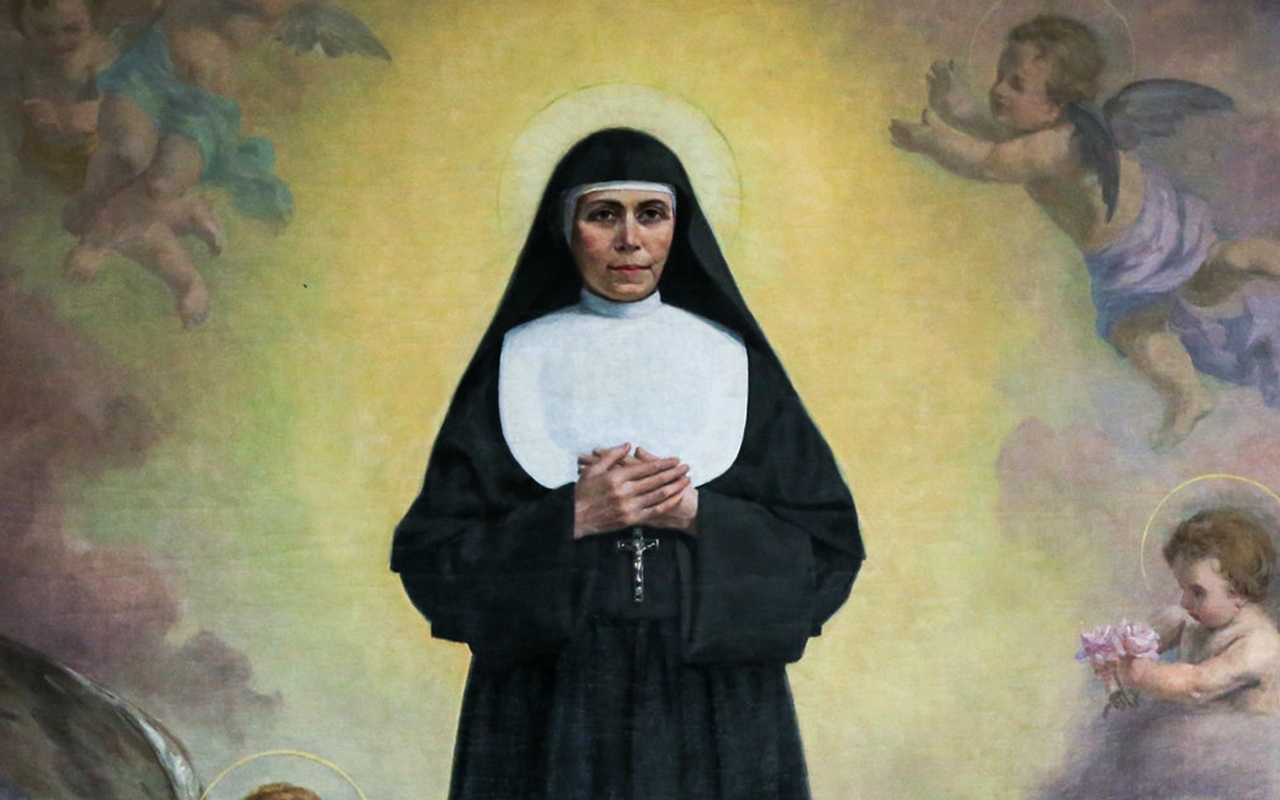
In the Apostolic Exhortation Gaudete et Exsultate, Pope Francis speaks of a “call to holiness that the Lord addresses to each one of us” and which is expressed through various forms of witness in our lives: “Within these various forms, I would stress too that the ‘genius of woman’ is seen in feminine styles of holiness, which are an essential means of reflecting God’s holiness in this world” (no. 12).
Sister Eliane Anschau Petri, coordinator of the Spirituality Course at the FMA Institute, in her detailed study of the testimonies from the canonical process of Saint Maria Domenica Mazzarello, contained in La santità di Maria Domenica Mazzarello. Ermeneutica teologica delle testimonianze nei processi di beatificazione e canonizzazione [The Holiness of Maria Domenica Mazzarello. A Theological Hermeneutics of the Testimonies in the Processes of Beatification and Canonisation] (Rome, LAS, 2018), explores Mother Mazzarello’s “form of holiness”, highlighting various nuances which, as well as facilitating a personal understanding of the Saint from Mornese, help us to grasp the significance of her spiritual legacy so that we may follow in her footsteps:
“Through the canonisation of the saints, the Church seeks to present models of holiness to the faithful. In this sense, the Church also presents canonised saints as teachers of the spiritual life. But not all saints are spiritual teachers in the same way. Maria Domenica presents herself as a teacher of the spiritual life through her very life and the simplicity of her way of living.”
One of the distinctive features of her holiness, explored in depth by Sister Anschau Petri in Chapter 6 of this volume, is precisely her strong feminine-Marian character:
Mary Domenica, like so many other holy women, enriches the holiness of the Church with her particular feminine holiness. One of the nuances of her holiness derives from her very nature as a woman: a woman is ontologically a mother. Her holiness, as we have seen previously, has a maternal quality, characterised by gentleness and firmness, understanding, the capacity for forgiveness, tenderness and affection, and a commitment to ‘caring for’ life.
The accounts of her witnesses clearly convey this aspect of Maria Domenica’s holiness: she made herself ‘all to all’; she loved everyone with a truly maternal love. The specific charism of women is procreation. By living out this charism to the full, as a consecrated woman in her educational mission, Mary Domenica Mazzarello was a mother, a sister amongst sisters, a wise and prudent educator, leading the sisters and young women to God. She was a source of life through her own life.
Female holiness finds its prototype in the figure of Our Lady, the Immaculate, ‘full of grace’, the ‘Holy One’ par excellence, a model for every Christian and in a special way for women. The holiness of Mary Domenica Mazzarello is closely linked to her filial love for Our Lady. Her whole life was a journey of ever-deepening likeness to Mary, mother and educator of the saints.
From a young age, Mary Domenica Mazzarello found in Mary an inspiration, a help, a teacher and a model on her journey of heroic witness to faith, hope and charity. She is the ‘daughter’ of Mary Immaculate, the ‘daughter’ of Mary Help of Christians, the ‘mother’ of the Institute, a sister amongst sisters; and this being a ‘daughter’, ‘mother’ and ‘sister’ draws its strength, meaning and vigour from her Marian journey – that is, from her journey of growing ever more like Mary, the mother of Jesus, the mother of the Church and of every believer.
Our Lady was the formator, the educator and the guide of Mary Domenica Mazzarello. Through her ‘chiragogia’ (moral guidance)—that is, by taking her by the hand and walking alongside her—Mary guided the saint from Mornese to the fulfilment of her feminine vocation within the Church and in the world.
Mary Domenica placed herself as an intelligent and docile disciple at her school in order to become a ‘mother’ to all those entrusted to her care and to become, for everyone, a credible witness to holiness, bearing witness with courage and radical commitment to following Jesus.
At the hour of her death, Mary was a source of consolation and comfort. Maria Domenica ended her earthly life singing a hymn of praise to the one who had been her mother and guide on the path to holiness: ‘I want to love Mary, I want to give her my heart. Whoever loves Mary will be happy.’ She ended her life entrusting herself once more to Mary, in the knowledge that whoever belongs entirely to Mary belongs entirely to Jesus.
The Bull of Canonisation of Mother Mazzarello concludes with an exhortation addressed to everyone, particularly to the Daughters of Mary Help of Christians, encouraging them on the path to a ‘possible’ holiness, attainable through ordinary daily tasks, in imitation of the Holy Foundress: ‘May they learn from her the one true science, which – as she wrote – consists in making ourselves holy’.
Source: cgfma.net.org