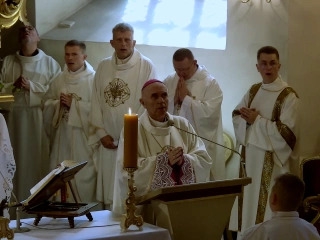
The homily during the Eucharist was delivered by Fr Paweł Figura SDB, a Salesian from the Wrocław Province (PLO), who had previously led a three-day retreat in the parish as a sign of thanksgiving.
‘During one of the informal conversations over the last few days, I heard an elderly parishioner recount this anecdote dating back to the day of the beatification: “My grandmother used to say that there was a very gifted young man from Ciochowice who had set off to study in faraway Italy and of whom all trace was subsequently lost”. ‘Dear friends, he did not disappear, and today we bear witness to this,’ he said.
He then quoted the words of Blessed Ignacy from a sermon delivered in 1916, in which he maintained that ‘we can all become saints, if only we wish to, because God grants us grace. Holiness does not require us to do extraordinary things. It is not necessary to shed one’s blood for the faith’. “These words were written by Father Ignacy after several years of a gruelling battle with ill health. When, in recent days, we retraced his life story during our spiritual retreats, I emphasised several times that here, in Toszek, he was regaining his health; here he was learning to endure suffering; and he certainly could not have imagined that one day those words he had spoken would take on a completely different meaning,” he observed.
The preacher spoke of the many fine qualities of the Blessed’s rich personality, citing, amongst others, the typical Silesian steadfastness, combined with incredible kindness and a great sense of humour.
‘Our Salesian sources strongly emphasise that he had eyes that smiled, eyes that won people over. And it was he who, in the Dębniki district of Kraków, became an almost legendary confessor,’ he emphasised.
‘Take note: Father Ignatius’s life began right here, on this very floor, at this very baptismal font.
And here, by contemplating the Sacred Heart of Jesus, the Good Shepherd. This is the concrete reality. And Father Ignatius today poses a question to each of us: how often do you come to this church? How often do you pick up the Bible to get to know Jesus? Is this something that forms part of my daily life? This foundation cannot be built on pious wishes alone. Holiness that arises from desire must be transformed into a journey,’ he stated.
‘Father Dobiasz spent his final years before being imprisoned in Montelupich Prison in Krakow and in the concentration camp in the Dębniki district of Kraków, where he was a close collaborator of the Servant of God Jan Tyranowski, who led a men’s rosary group, of which the young Karol Wojtyła was also a member.
“He spent just one day in the concentration camp. First he witnessed the death of his confrere, Father Jan Świerc, then he himself died. It is significant that those who witnessed this agree on one point: as he was dying, the last words on his lips were words of forgiveness, an invocation to the Merciful Jesus, asking for forgiveness for his tormentors. Who is capable of doing such a thing? Just like Christ on the cross, who said: “Father, forgive them, for they know not what they do”? Only one who shares the same vision as the Good Shepherd,” he emphasised.
Father Dobiasz was brutally murdered the day after his arrival at the camp, on 27 June 1941, whilst carrying out gruelling and exhausting labour. He was 61 years old.
During Holy Mass, the Prayer of the Faithful was read by the descendants of Fr Dobiasz’s relatives, whilst the offerings were brought to the altar by the inhabitants of Ciochowice.
The Eucharist was concelebrated by numerous priests present, including many Salesians, with the Superior of the Wrocław Province (PLO), Fr Bartłomiej Polański SDB; the Vicar of the Krakow Province (PLS), Fr Andrzej Gołębiowski SDB; Fr Mateusz Koziołek SDB, Rector of the Salesian Seminary in Krakow, where Blessed Ignacy Dobiasz taught; and Fr Leszek Król SDB, Director of the Salesian School and Educational Centre in Tarnowskie Góry.
The highlight of the ceremony was Bishop Iwanecki’s blessing of the painting depicting a portrait of Fr Dobiasz, against a background showing the church in Toszek and the gate of the concentration camp. The painting will be placed above the entrance to the sacristy.
Source: https://gliwice.gosc.pl