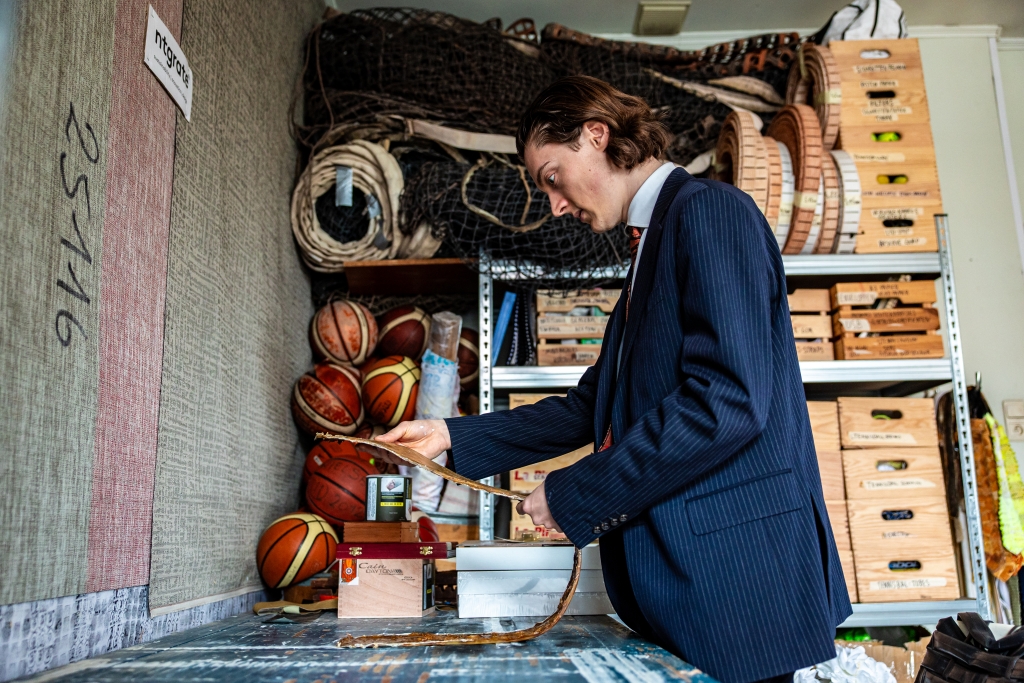
In his studio, located in the centre of Kortrijk, every shelf is crammed with objects that many would call rubbish: basketballs, fishing nets, plastic cable ties, cigar boxes and, above all, thousands of used tennis balls. For Nollet, however, these are precious raw materials. He prefers to describe himself as an ‘experimental researcher’ rather than simply an artist.
His method involves dismantling the materials without completely destroying them, extracting filaments that can be woven, embroidered or crocheted. In this way, he manages to create new structures without using glue or other binders: each piece is held together solely by the craftsmanship employed.
The aim, he explains, is not merely to create aesthetically original works, but above all to change the way people view waste. According to Nollet, many materials end up being disposed of unnecessarily, when they could instead be reused creatively or even industrially. Among the examples he cites are tennis balls, which in Belgium are not recycled locally but sent abroad for highly polluting treatment. By recovering them before they reach this stage, he gives them a new lease of life.
Every new material he experiments with gives rise, as his first creation, to a tie. This accessory is, in fact, a distinctive feature of his personal identity: he has habitually worn a suit and tie ever since his art school days and considers this combination perfectly consistent with his philosophy. For him, there is no contradiction between the elegance of a suit and the hidden value in waste materials.
Nollet’s journey has not been a straightforward one. After a classical education in Latin, he initially chose to pursue competitive cycling, even going so far as to move to Italy. His sporting career, however, did not go as hoped and prompted him to rediscover his passion for creativity. From that moment on, he embarked on studies in textile design, gradually developing the technique that now characterises his work.
His rapid rise to prominence has been driven largely by social media. By showcasing his work through short videos on TikTok and Instagram, he has amassed millions of views and built a vast community of followers. This visibility has led to collaborations with companies and figures from the entertainment world, but the artist emphasises that fame is not his true goal.
His ambition is to use art as a tool for raising awareness, inspiring citizens, businesses and institutions to rethink the very concept of waste. “I don’t want people to copy what I do,” he says, “but for them to start asking themselves what they can do with what they currently regard as mere rubbish.”
The full article, by Tim Bex, is available on the donbosco.be website