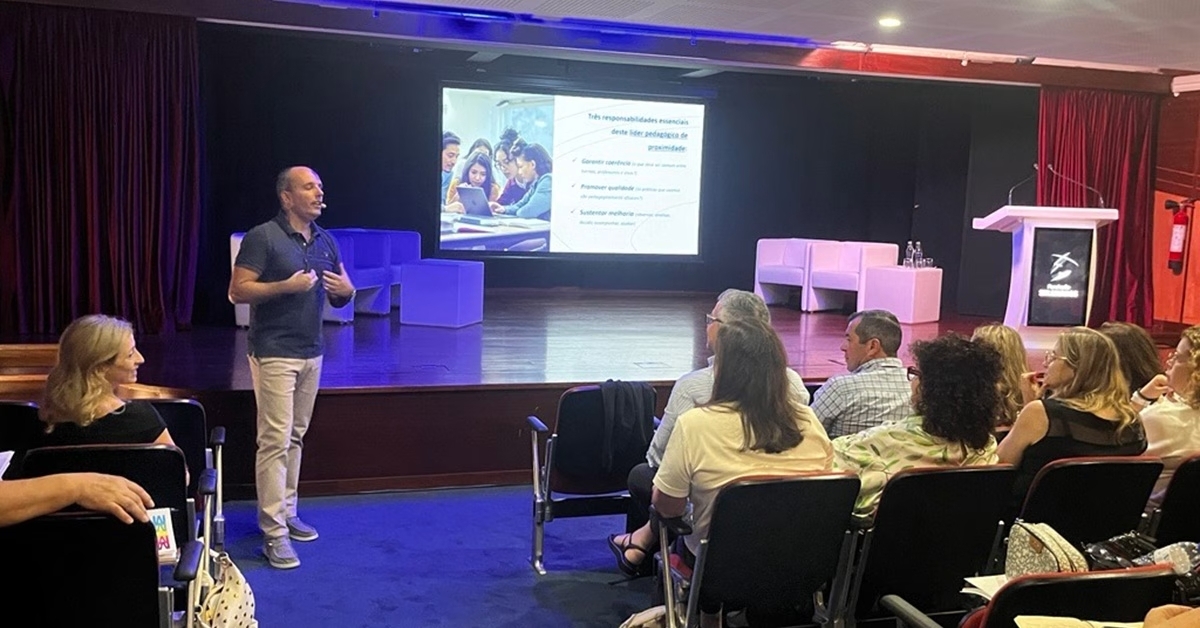
(ANS – Lisbon) – On 9 and 10 July 2026, the Fundação Salesianos of the Salesians of Portugal organised a national formation meeting for department coordinators and delegates responsible for teaching areas in schools, bringing together first- and second-level educational leaders from the six Salesian schools in the province – 74 participants in total – for an in-depth reflection on their role in promoting educational quality and improving learning.
Based on the conviction that the quality of a school depends not only on the individual competence of its teachers, but also on its ability to create a coherent and intentional educational experience for all pupils, the formation sought to redefine the role of coordinators and delegates as educational leaders, capable of translating the school’s educational vision into concrete practices in the classroom.
The meeting began with a thought-provoking question: ‘Are there perhaps different schools within the same school?’ Building on this challenge, participants were invited to reflect on the extent to which pupils experience a shared and coherent educational journey throughout their school career, and on the responsibility of middle managers in fostering such pedagogical coherence.
On the first day, discussions focused on clarifying the roles of the department coordinator and subject representatives, on the need to build a shared pedagogical vision, and on defining the criteria that characterise high-quality pedagogical and teaching practice. The role of middle management in implementing the guidelines of the Salesian Educational Proposal and the schools’ Educative and Pastoral Projects was also explored in depth, reinforcing the idea that curricular departments must take on the role of spaces for reflection, decision-making and pedagogical development.
The second day was devoted to tools for the continuous improvement of educational practices. Through the use of a notebook-diary designed to foster a culture of reflection – as envisaged by the Salesian Preventive System – participants analysed lessons as a tool for professional development, the use of data to support pedagogical decision-making, strategies for pedagogical differentiation, and the importance of classroom productivity as the ability to transform school time into effective learning. The workshop culminated in a reflection on the curriculum department as the driving force behind pedagogical quality, emphasising professional collaboration and the use of digital tools – in particular the ‘e-scola’ platform – to enhance learning.
The initiative provided an opportunity to reaffirm a vision of the school based on collective responsibility for pupils’ learning. In this regard, department coordinators and subject area representatives were called upon to take on an increasingly significant role in building collaborative professional cultures, capable of ensuring pedagogical practices that are consistent, rigorous and in line with the Salesian educational identity.
The initiative forms part of the commitment of the Salesian Schools in Portugal to quality education, centred on the individual pupil and inspired by Don Bosco’s Preventive System, with the aim of strengthening the capacity of their middle managers to promote processes of innovation, pedagogical support and continuous improvement within every educational community.
At the end of the two-day workshop, a shared conviction emerged clearly: pedagogical leadership is not measured by the management of procedures or the coordination of tasks, but by the ability to create the conditions so that all pupils can experience – in any group or class and in any subject – a coherent, meaningful and transformative educational experience.