An Adventure in the Amazon
The adventure began with a very high level of difficulty. “After landing in Manaus, I boarded a boat where they handed me a roll I had never seen before: it was a hammock,” he recounts. At night he unrolled it to sleep on board. “For lunch and dinner we ate whatever was caught, even turtles,” he says. With him Antonio carried a Paillard spring-driven camera with three optical lenses, which he used to film the life of the Yanomami people. “They lived almost completely naked in huts in the forest. At first they ran away from the camera, but then I took some Polaroids and showed them to the children: they were fascinated and kept touching them in disbelief.” In the Amazon he also experienced one of the most unusual moments of his life. “I was ill and they gave me a traditional drink served in a coconut shell,” he recalls. “Later I discovered that among the ingredients were powdered bones of a deceased Yanomami and banana.”
Among the Leper Colonies of India
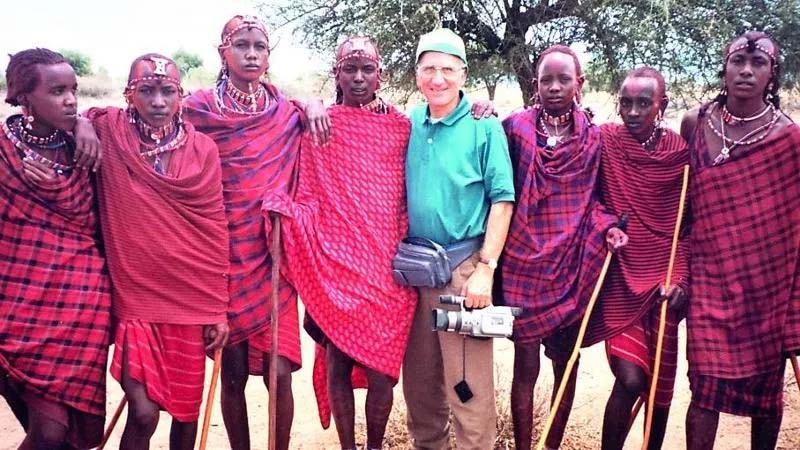
At first he traveled only during the summer, when the school was closed. Later, in the mid-1990s, after retiring, Antonio visited even more missions. “I must have made about seventy documentaries,” he says. Most of them have been digitized and are now preserved at the Experimental Center of Cinematography – National Archive of Industrial Cinema in Ivrea. He has traveled throughout Africa, “without ever contracting malaria,” and was captivated by the tribal dances of peoples dressed in brightly colored clothing. Yet the most powerful experience came in India when he entered the leper colonies. “Seeing those looks and those disfigured faces was terrible. Perhaps the most moving scene of all my journeys.”
Shipwreck in Papua New Guinea
There is hardly a corner of the planet, however remote, where Bro. Saglia has not been. He even ventured into towns controlled by drug traffickers in Colombia. “The soldiers warned us not to go, but missionaries were respected even by criminals.” During his “pilgrimage” he witnessed breathtaking natural landscapes: “Above all, crossing the Strait of Magellan in Tierra del Fuego between Chile and Argentina. But also the island of the lemurs in Madagascar—I have never seen such crystal-clear waters.” Of course, in forty-five years of travel there were also misadventures. One of the most dramatic occurred in Papua New Guinea. “The engine of the boat broke down and we had no phones to send an alarm. After a night drifting at sea, some Papuans rescued us, but they could not find our island. We reached it many hours later, after quite a bit of anxiety.”
Unexpected Romantic Advances
Like all Salesian coadjutor brothers—the lay Salesians desired by Don Bosco—Antonio Saglia made vows of chastity and poverty. This did not prevent him from receiving romantic advances during his travels, which he always declined. The boldest occurred in Belém, in the Brazilian Amazon, when a young woman near a river smiled at him and said: “I would really like to have a child with you.” In South Korea the courtship came during a traditional dance. “A young woman slipped a music box with her photo inside into my jacket pocket,” he recalls with a smile. Later the Korean girl began writing him letters that he had translated: “Between the paragraphs there was often the word ‘Censored,’” he adds jokingly.
The Last Journey and the Lesson Learned
In 2015, forty-five years after his first mission trip, his final journey took place: a tour of several missions in Africa. In those lands he learned optimism and still treasures the smiles of children. “They have nothing and yet they are happy, while we lose ourselves in a thousand trivial things, always looking down at our smartphones.”
Source: La Stampa