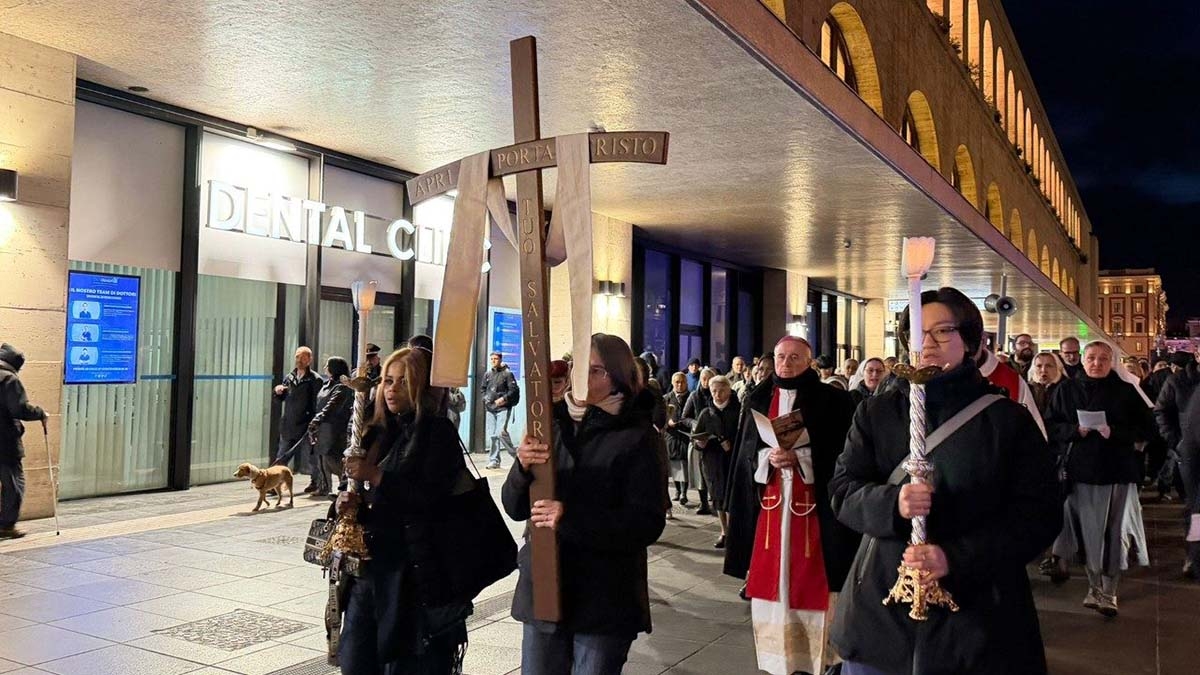
The Passion of Christ meets the path of the invisible, caressing the open wounds of a group of people in search of hope. Once again this year, for the third edition, the homeless were at the centre of the so-called “Way of the Cross of the Invisible”, organised by the Caritas Don Luigi di Liegro hostel together with the Salesian Basilica of the Sacred Heart of Jesus, alongside other organisations such as the John Paul II evening soup kitchen, which provides hundreds of hot meals to those in need, and the marquee at Porta San Lorenzo, open during the Jubilee Year to provide a bed and a meal to many homeless people – all institutions located near Termini Station, an area marked by a significant presence of men and women affected by profound loneliness, economic precariousness, forced migration and indifference.
The theme of this third year, “The Way of the Cross, the Way of Peace”, accompanied the entire journey, which began with Mass in the Basilica of the Sacred Heart and concluded at the Caritas hostel.
The basilica, filled to capacity, and the procession of the numerous participants – at least 200 – along the entire route brought time to a standstill for a few moments. And the faces of the homeless, often ignored, became a living presence.
Bishop Di Tolve: “God rejects no one”
The Auxiliary Bishop of the Diocese of Rome, who presided over the Mass, pointed out in his homily that the homeless, unlike what happens to human beings, are never forgotten by God. “Just as Jesus did, who was rejected despite standing alongside the suffering,” he said, “today we have a duty to help our neighbour, to make them feel welcomed, despite the walls and stones thrown by those who turn away.”
Bishop di Tolve’s hope was that everyone might follow the way of the Gospel, so that the invisible might become brothers and sisters to all and “all of us might increasingly become the Church of God’s love”.
At the end of the Way of the Cross, whose final stop was the Caritas hostel, the bishop reflected on the faithful’s journey in the footsteps of Christ, who always turns towards the least and the invisible, emphasising further how the cross, from an instrument of death, “has become a sign of hope thanks to the total love of Jesus, and how even in rejection and suffering, Christ continues to welcome without judging”.
His death represents a universal peace founded on love for all humanity.
The emotion of those present
“In these moments I realise that Christ is with me and that there is hope,” was the thought of Pierluigi, a 57-year-old man staying at the shelter, who was present at the Way of the Cross. With tears in his eyes, he confided that he had felt at home walking the path, even if only for a moment, at this difficult time in his life. “I have many sorrows behind me,” he recounted, “the greatest being the loss of a daughter twenty years ago. But now I have a new dream, inspired by this Way of the Cross: to be able to embrace my family and find peace again, seeing what is happening in the world”.
Beside him was Ahmed, a Muslim, who shares the space in the facility with Pierluigi. He spoke of his emotion in the church upon hearing the words of Bishop Di Tolve: “ I was in the house of God, I could feel it, and there I found many brothers”.
Stories of despair and redemption, of falling and resilience. Such as those of Edomwonyi and Paulo, she from Nigeria and he from South America, both homeless. Both find “refuge and a light” in the solidarity of Caritas and say they have “felt the city’s closeness through this celebration” . Just like an elderly guest at the “Di Liegro” hostel who, as the coordinator of the Caritas shelter, Luana Melia, recounted, “despite his illness, took part in the end: he was certain that the Lord would give him the strength to carry the cross, even if only for a few minutes”.
A tangible sign
At the end of the procession, what remained was not merely the memory of a celebration, but the tangible sign of an encounter. On a street all too often traversed with indifference, for one evening the “invisible” had a name, a face, a shared story. The Way of the Cross thus became a living experience, capable of uniting different sufferings under the same horizon of hope. And as the lights returned to illuminate Via Marsala and footsteps resumed their daily rhythm, a silent realisation remained: where a person stops and recognises the other, even pain can be transformed into brotherhood.
A Way of the Cross, that of the Invisibles, which “sought to reveal the face of God’s mercy towards the most disadvantaged, towards those wounded and lost sheep whom He comes to seek and places first”, commented Fr Javier Ortiz Rodriguez, Salesian and parish priest of the Basilica of the Sacred Heart, capturing the essence of the celebration.
Sources: Vatican News, Roma Sette