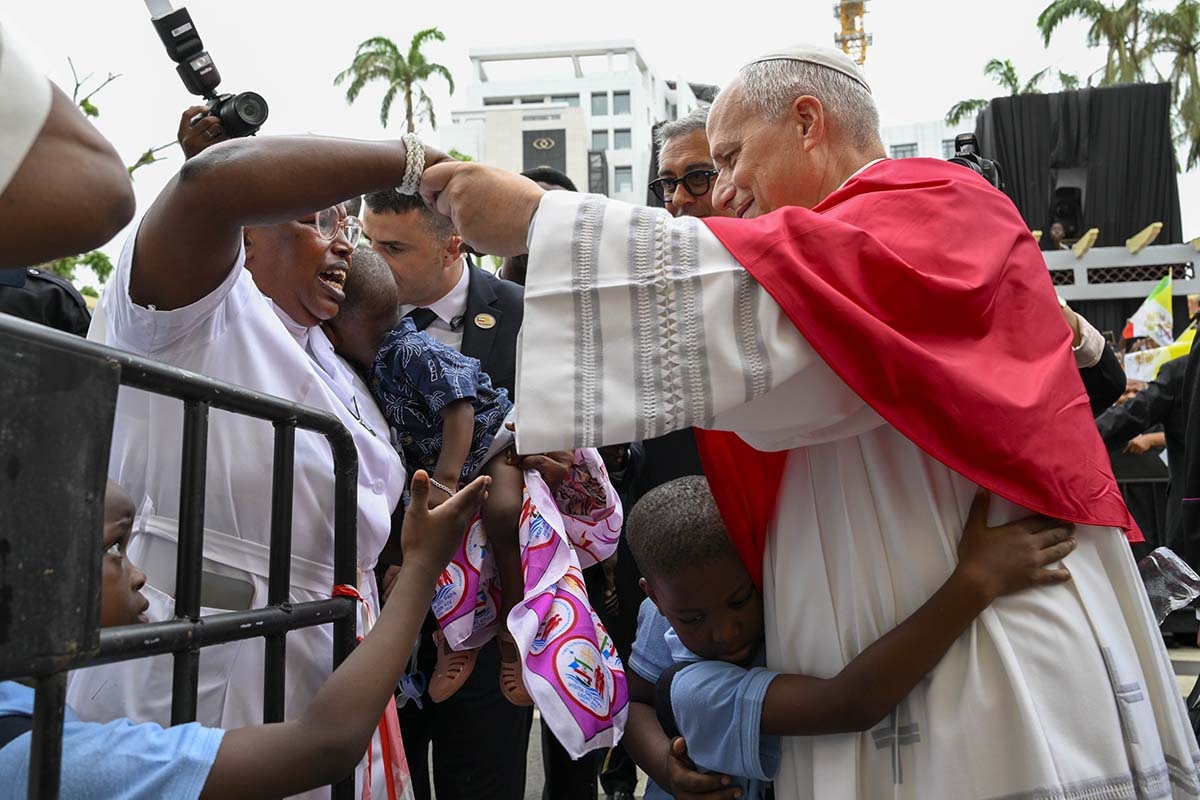
Arrival and Official Welcome
On his way back toward Europe, after reaching the southernmost point of his journey in Angola, the Holy Father arrived in Equatorial Guinea, a small Spanish-speaking Catholic enclave between Cameroon and Gabon. He landed at the international airport at 11:31 a.m. local time and was received with the customary welcome ceremony.
Meeting with Authorities and Social Realities
After visiting the President of the Republic, Teodoro Obiang Nguema Mbasogo, the Pope met with local authorities. The country, with fewer than two million inhabitants, is marked by deep inequalities: although it has one of the highest GDPs per capita in Africa, wealth is concentrated in the hands of a few, while much of the population lives in extreme poverty, often on less than one dollar a day.
A Strong Message on Justice and Peace
Faced with this reality, the Pontiff delivered a clear and direct message: “The proliferation of armed conflicts is largely driven by the exploitation of oil and mineral resources, without regard for international law and the self-determination of peoples.” His words urged leaders not to engage in choices that lead to destruction and environmental harm. “In a world wounded by oppression, people hunger and thirst for justice,” he repeated.
Integral Human Development and the Common Good
Pope Leo XIV emphasized that development must never undermine justice and human rights, echoing the legacy of Pope Francis, who visited the country exactly one year earlier. “Every human being should recognize that we are only passing through this earth,” he said, urging freedom from unjust wealth and illusions of domination. He also reaffirmed that it is the duty of civil authorities and good politics to remove obstacles to integral human development, founded on solidarity and the universal destination of goods. The Pope assured that the Church would continue to support genuine initiatives for progress, especially through the formation of responsible and free consciences.
Encounter with the World of Culture
Later, after a private lunch at the archbishop’s residence, the Bishop of Rome visited the university campus named after him, “Papa León XIV,” where he met representatives of the cultural and academic world. He encouraged universities to promote solidarity-based development through integral education. He stressed that educational quality should not be measured by appearances, such as the number of graduates, but by the fruits of “intelligence” and “service.”
A Symbolic Reflection on Knowledge
Using the image of a tree—with deep roots, a strong trunk, and wide branches—he explained that knowledge should resemble the tree of the Cross, firmly rooted in truth, rather than the tree of the knowledge of good and evil, which led humanity toward a distorted understanding that bends reality to its own measures.
Visit to the Psychiatric Hospital
The final stage of the day was a visit to the “Jean-Pierre Olié” psychiatric hospital, where the Pope met staff and patients. “God loves us as we are,” he told them, expressing both his sorrow for the suffering of patients and their families, and his admiration for the care offered at the facility. “A place like this can become a sign of the civilization of love,” he affirmed.
Conclusion of the Day
The day concluded with a private meeting followed by dinner at the archbishop’s residence with the bishops of Equatorial Guinea, bringing to a close this meaningful stage of the Pope’s apostolic journey.