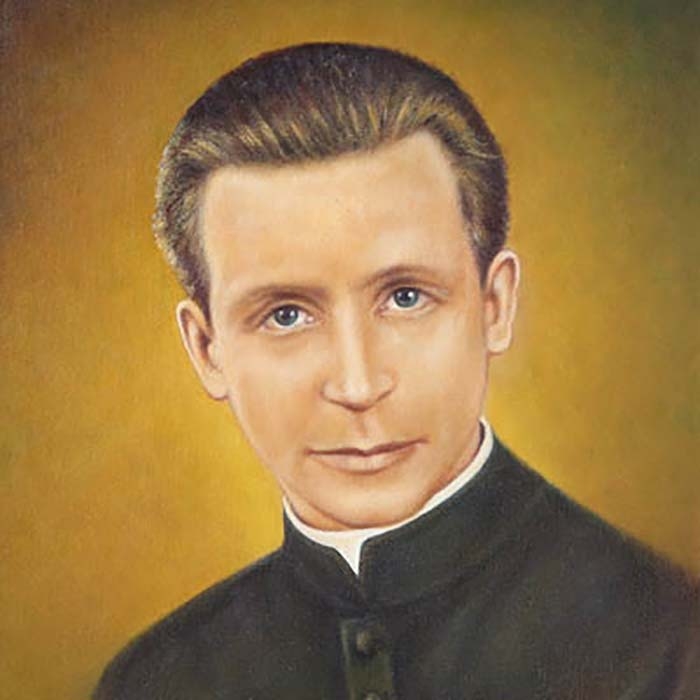
He was distinguished by a deep and edifying piety. He frequently received Holy Communion and gladly adored the Blessed Sacrament.
At one point, he came into contact with Salesian students from Oświęcim. Their stories about life in the boarding school and community captivated him. He was then 13 years old and resolved, at all costs, to be admitted to Oświęcim.
Those responsible for the boarding school initially rejected his request. He personally went to the director and was accepted—though conditionally. That was enough for him. His parents tried to dissuade him, explaining that life in such an institution might be too difficult for him and presenting him with prospects of a comfortable future in the world.
Yet they already sensed that in the heart of their young son there had arisen a desire to dedicate his life entirely to God. At that time, young Karol repeated the words of Saint Stanislaus Kostka: “I was born for greater things.”
From that moment, God led him along a path not always easy, but certain—a path of truth and salvation. His school years were marked by diligent study and steady moral growth. He was characterized by conscientiousness in fulfilling his duties and by a warm attitude toward his superiors and fellow students. He was also a good sportsman, showing agility, strength, and grace.
Salesian Path
At the age of only 16, in 1931, he was admitted to the novitiate of the Salesian Congregation in Czerwińsk. One of his companions wrote of him: “Despite his very young age, he showed that he took the formation of his spirit very seriously.” On 23 July 1932, he made his temporary vows, thus completing the novitiate.
He continued his formation in Marszałki, where he completed the final two years of secondary school. He then undertook thorough studies in philosophy and the sciences. He was exceptionally helpful toward his fellow students, assisting the weaker ones not only in their studies but also in various practical matters. It is therefore no surprise that he received a very favourable evaluation from his superiors:
“Cleric Karol Golda—distinguished by a good spirit, very talented, fond of mathematics and philosophy, ready for any work.”
This opinion enabled him to be sent in the future to Rome to study at the Gregorian University.
After completing his secondary education, he was sent for practical training (the so-called “assistantship”) to Daszawa, where he worked with boys. There he had the opportunity to demonstrate his educational abilities.
He made full use of all the pedagogical knowledge he had acquired. His love for sport attracted dozens of boys to him. He was able to organize them, energize even the slowest and most reluctant, and was present everywhere, attentive to everything.
He encouraged the less active, calmed the more impetuous, and did all this with such kindness and fairness that no one protested—everyone accepted his guidance with goodwill.
Given such remarkable abilities, his superiors shortened his practical training and, in 1935, sent him to Rome for theological studies.
There, the deepening of theological knowledge became his principal occupation. He did not distract himself with secondary interests, which allowed him to grasp many complex issues. His favourite subjects were dogmatic theology and Sacred Scripture.
On 15 January 1937, he made his perpetual vows in Rome, and on 18 December 1938 he was ordained a priest by Bishop Rotolo in the Salesian Basilica of the Sacred Heart in Rome. The following day he celebrated his first Holy Mass in the Catacombs of Saint Callixtus. After obtaining a licentiate in theology, he returned to Poland in July 1939.
The outbreak of the war found him in Poznań. Together with others, he went to the Salesian house in Ląd. During the hostilities, he remained remarkably calm, doing good to everyone around him.
In October, he returned to Poznań, where he assisted in pastoral ministry at the Salesian church on Wroniecka Street.
He wished to continue his biblical studies, but the German authorities refused permission. His superiors then appointed him as a councillor (director of studies) for a group of theology students in Oświęcim.
He carried out this responsibility with seriousness and dedication. At the same time, he willingly engaged in all forms of priestly ministry, even serving for a time in the parish of Mysłowice.
His piety deepened continually. He came to love deeply the common religious life, in which he found warmth and a family-like atmosphere—something every human heart longs for.
Arrest
On 31 December 1941, he was arrested by the Gestapo and imprisoned in the nearby death camp of KL Auschwitz. The reason for his arrest was particular. Fr. Karol devoted himself zealously to the confessional, reconciling people with God. He served everyone, including those who spoke German.
For some time, one of the German soldiers had been coming to him quite frequently for confession. He was a sincere Catholic, conscripted into the German army.
It was well known that the military regulations of Hitler’s time forbade soldiers to receive the sacraments privately. Moreover, Polish priests were not permitted to administer priestly ministry to Germans. Fr. Karol was aware of the grave consequences that awaited him for this reason. The vigilant eye of the Gestapo soon detected the “offence” of the Polish priest.
Fr. Karol was arrested and taken to the concentration camp, while the penitent was sent to the Eastern Front.
Martyrdom and Death
Fr. Karol endured five months of true martyrdom, during which he was not spared torture or confinement in the starvation bunker.
Among the local SS men themselves, there prevailed the opinion that Fr. Golda died as a victim of the seal of confession. One of his confreres wrote of him:
“He fell at his priestly post. Supernatural love compelled him to embrace it. If his entire life had been a mastery of the will over trying circumstances and nerves, then in a heroic manner he accomplished this in his final experiences in the camp. Even those ill-disposed toward him were forced to pay tribute to his holy and unyielding priestly will.”
On 14 May 1942, Fr. Karol Golda died in the concentration camp in Oświęcim, a young Salesian priest, only 28 years of age.
A merciless and martyr’s death tore from the ranks of the Salesians a priest full of zeal, an exemplary religious, and a gifted educator.
He died at the age of 28, in the 9th year of his religious profession and the 3rd year of his priesthood. He bore the camp number 18160.
Beatification Process
Fr. Karol Golda is one of the 122 Servants of God for whom the second beatification process of the second group of Polish martyrs of the Second World War began on 17 September 2003.
On 24 May 2011, the diocesan phase concluded in Pelplin, and all documentation was forwarded to the Congregation for the Causes of Saints in Rome.
The Positio was submitted on 21 July 2022, and its relator was Fr. Szczepan Tadeusz Praśkiewicz, OCD.
The postulator of the cause is Fr. Pierluigi Cameroni, General Postulator for the Causes of the Salesian Family, who collaborates with Dr. Mariafrancesca Oggianu.
On Tuesday, 28 March 2023, the historical consultors of the Dicastery for the Causes of Saints issued a positive opinion regarding the Positio suppletiva super martyrio of Fr. Jan Świerc and eight companions, priests of the Society of St. Francis de Sales, murdered in odium fidei in German extermination camps in the years 1941–1942.
On 24 October 2025, Pope Leo XIV ordered the promulgation of the Decree on Martyrdom and its inclusion in the acts of the Dicastery for the Causes of Saints.
Golda – video
https://youtube.com/shorts/3DMBE569x2Q?feature=share
{gallery}Polonia – Don Golda 2026{/gallery}