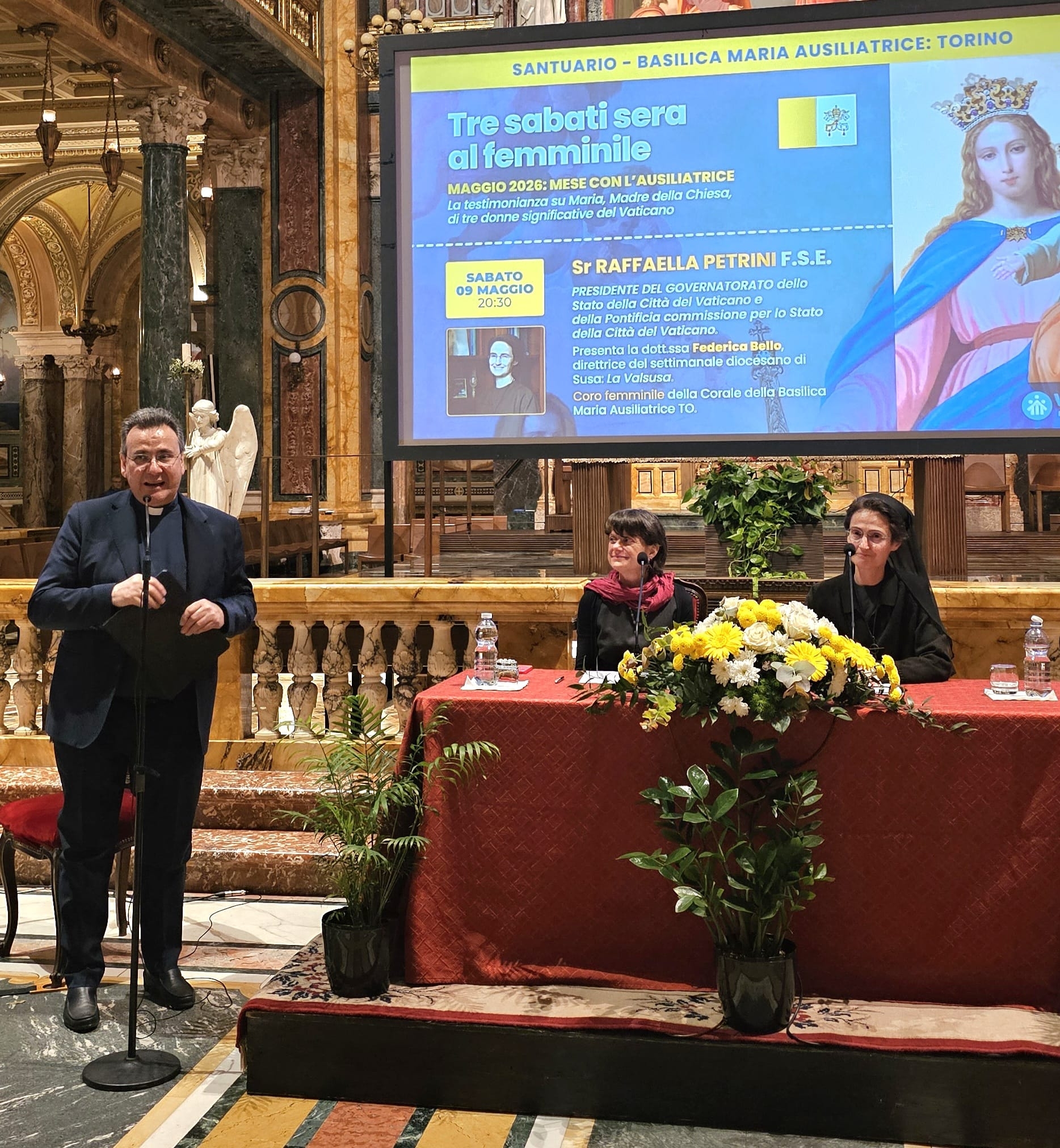
These points for reflection were offered by the guest speaker of the second evening of the series, Sr Raffaella Petrini, F.S.E., who since 15 February 2025 has been President of the Pontifical Commission for the Vatican City State, as well as President of the Governorate. Since last February, she has also been a member of the Commission for Confidential Matters.
Sr Raffaella Petrini was preceded at the first meeting by Sr Simona Brambilla, Prefect of the Dicastery for Institutes of Consecrated Life and Societies of Apostolic Life, and will be followed on 16 May by Sr Yvonne Reungoat, FMA, former member of the Dicastery for Bishops and former Mother General of the Daughters of Mary Help of Christians. In her address, Sr Raffaella was tasked with conveying, through her testimony, how the Church, even in its highest institutions, is close to and stands alongside the people of God, and how Mary is the ‘Mother of the Church’.
The evening – which also featured a performance by the Corale (the women’s choir) of the Basilica of Mary Help of Christians – was introduced by the Rector, Fr Michele Viviano, who read out the message of greeting that Cardinal Repole had sent to Sr Petrini and to the many faithful gathered in the Basilica to hear her speak. This was a further reminder of that ‘institutional’ yet at the same time ‘fraternal’ bond that is lived out and built up within the Church.
Also present for the occasion was Fr Giorgio Degiorgi, recently appointed Provincial of the Special Circumscription of “Mary Help of Christians” in Italy, Piedmont and Valle d’Aosta (ICP), who joined in greeting the Sr Petrini.
From the outset of her talk, Sr Petrini – after explaining her role in the Vatican – highlighted from her own perspective the relationship with the figure of Mary, recalling and citing the recent doctrinal note from the Congregation for the Doctrine of the Faith, “Mater populi fidelis”.
Mary, the “Mystery of inexhaustible love”, was described as the defining element of her presence. A presence which, in turn, makes visible the presence of Christ on the Church’s journey. A presence which, as described in the Gospels, teaches us to “ask with the awareness that everything is a gift”, to “knock”, to “seek”.
The speaker then focused on Mary as Mother and, as such, a model of relationship, welcome, the ability to embrace and accept change, protection and sacrifice.
Furthermore, in the nun’s words, there was a call to consider Mary as a “mediator” and as a “servant”. This latter aspect is particularly valuable for those in leadership roles, which must be lived out in a spirit of service, responsibility, care and trust. With the ability to “work as a team”, through a collaboration that always values the talents of each individual.
In the nun’s words, in her testimony regarding an “administrative” role, there emerged the ability to convey a “living” relationship with the figure of Mary, a point of reference in relationships and choices. Mary is venerated in shrines “close” to her personal vocation and – following the evening in Turin – also as “Our Lady Help of Christians”, before whose image she prayed with the Rector. It was a moment of entrustment for her task and for all the women invited to always look to Mary with trust in every situation of life.
Sr Raffaella Petrini belongs to the Franciscan Sisters of the Eucharist; she was born in Rome on 15 January 1969, obtained a degree in Political Science from the Guido Carli Free International University of Studies and a doctorate from the Pontifical University of St Thomas Aquinas. To mention just two of the many points in her extensive and distinguished educational background, thanks to which she now heads the seven sectors (as she explained in her introduction to the meeting) into which the Vatican Governorate is organised, the body that exercises the executive and legislative power of the Vatican City State. These are the ‘seven directorates’: for the economy, security and civil protection services, health and hygiene, museums and cultural heritage, infrastructure and services, telecommunications and IT systems, and the papal villas.
Federica Bello