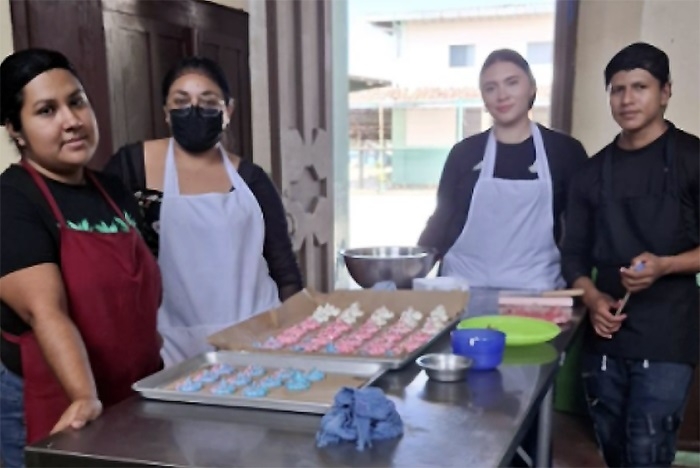
The goal for the four-year project aimed to improve training through expanding and diversifying the courses offered. Twelve new short courses and four longer courses were offered. These new courses taught nontraditional technical skills for women.
The Salesian institutions also reviewed policies on gender, the environment, human resources and risk management. Progress was made in reducing the environmental footprint of the workshops, including reforestation campaigns and optimization of waste management.
Finally, Salesians aimed to ensure a smooth transition from coursework to the labor market. The Labor Intermediation Offices supported graduates in their transition, consolidating 166 agreements with companies. A key milestone in 2025 was the first Salesian Employability Congress, which brought together representatives from the business, education and social sectors to address the challenges of today’s labor market.
The young women who enrolled in the coursework were from situations of socioeconomic vulnerability from areas with limited access to quality technical training and high unemployment rates. They came from families with incomes below the poverty line, and many were at risk of irregular migration or recruitment by criminal groups. These women face additional barriers to employment with added responsibilities at home, gaps in access to technical training and lower participation in the formal labor market.
As a result of the project, Salesians were able to increase the number of women graduates. During the four years, 1,169 women were enrolled and 974 graduated, exceeding the goal of all six institutions.
One of the women who benefited was Josseline Beatriz García de Aguilar, who is from Chalchuapa, El Salvador. García de Aguilar described a life defined by the tension between deep family love and the harsh reality of economic scarcity. In a town where traditional roles often limit women’s options, she lived in a state of extreme vulnerability.
She said, “I remember a day that marked a turning point in my life. It was a day that I couldn’t even afford to buy milk for my son. That feeling of helplessness is a burden that only those who have experienced it can understand.”
Her primary motivation to gain employment skills was the survival and dignity of her children. Initially, her goal was simply to change her immediate reality, but it evolved into a desire for professional independence and mastery of a craft. García de Aguilar noted, “I decided to enroll with a heart full of doubts but hands ready to work. Knowing that I had that support made me value every minute of training. It was the perfect boost.”
The project directly eased her financial burden by providing free training and materials. It also provided the soft skills that allowed her to move from home-based selling to formal entrepreneurship. She added, “The workshops not only taught me a trade. They gave me back my dignity. Today, we have two stalls in the Chalchuapa Municipal Market, a home delivery service and three people who help us.”
Looking ahead, García de Aguilar aims to scale her micro-business further, using social media for wholesale advertising.
Close to 22% of El Salvador’s population lives in poverty, according to the World Bank. Youth in El Salvador are confronted not only with poverty but with instability, high levels of violence and inadequate access to educational opportunities. Despite ranking high for economic indicators, the need for practical education in El Salvador is more important than ever with 12% of youth aged 15-24 unemployed and 41% underemployed.
Source: Mission Newswire