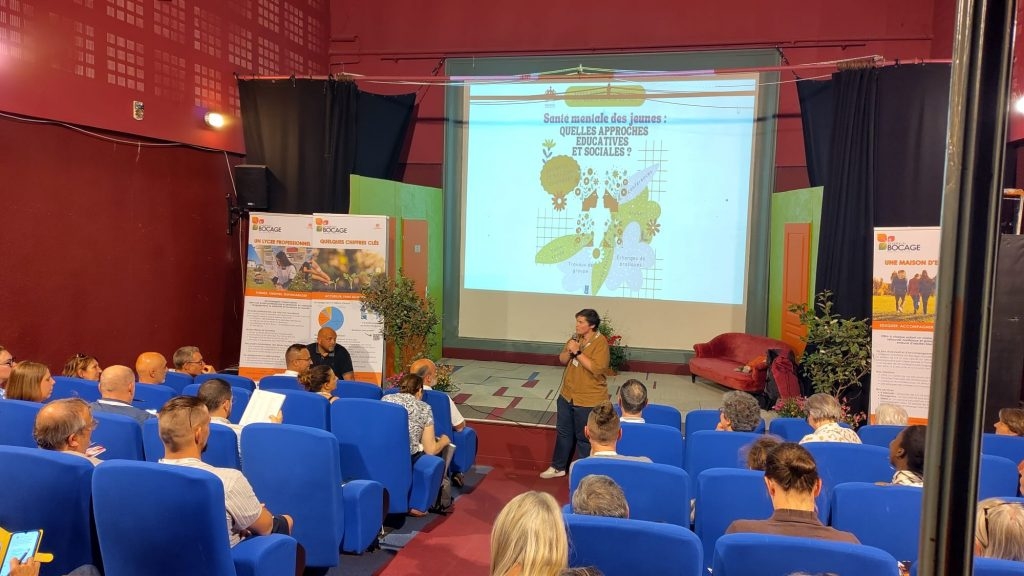
During the proceedings, one of the key presentations was given by psychotherapist Jean-Paul Gaillard, who began with an observation made in the early 2000s: young people “no longer lower their gaze”, a sign, in his view, of a social shift that produces a “misalignment”.
The speaker explained that value systems, which he described as “signalling systems” between young people and adults, have become incompatible. Traditional vertical authority (obedience, hierarchy, inequality as a matter of principle…) has been permanently weakened. Adolescents now grow up in a horizontal hierarchy, in autonomy, in self-authority, in equality as a matter of principle…
The problem therefore stems from this misalignment between adults who continue to impose top-down rules (often contradictory: “Look down when you look at me!”) and young people socialised in horizontality (“It’s not polite to look down!”). This incompatibility generates tensions, opposition, violence, school dropout, emotional neglect and psychological suffering.
A crisis in the educational bond
Jean-Paul Gaillard does not, therefore, attribute young people’s malaise to individual fragility or to a ‘sick generation’. He believes that part of the current unease stems from a crisis in the educational bond and the absence of relational frameworks. Adults lose their points of reference when old forms of authority cease to be effective. Adults must remain the guardians of a protective relational framework, whilst demonstrating kindness and recognising the dignity and voice of young people.
Faced with worrying data on the rise in mental health issues among young people, he emphasised the need to rely on sound educational practices based on collaboration with other adults, teamwork, consistency, explaining the rules and the ability to listen.
Gems to share
The previous day, in various workshops, participants had shared some ‘gems’ drawn from their experiences within the network; the topics are listed below:
– Measuring the impact of our actions on young people
– Promoting academic success among young people
– Then, celebrating the successes of young people
– Enabling young people to engage through tailored civic service
– The challenge of citizenship: meaning and commitment among adolescents
– Protecting young people from the risks of sexual exploitation
– Preparing internal and external evaluations
– Supporting vulnerable young people leaving the Child Welfare Services (ASE, in French)
– Growing up without violence
– Building a culture of well-being within one’s institution
Fr Xavier Ernst, SDB
Source: Don Bosco Aujourd’hui