The long day of Monday 8 June 2026 began for Pope Leo with a twenty-minute meeting with the President of the Spanish Government, Pedro Sanchéz Pérez-Castejón, whom the Pontiff had received at the Vatican just a few days before his trip. The topics of the meeting remained private, but on the occasion of the first meeting between the two, on 27 May, the Vatican Press Office had noted both “matters of common interest, such as the need to foster fruitful dialogue between the local Church and government authorities, as well as among the various components of civil society, based on mutual respect and aimed at promoting the common good”; “issues of an international nature, with particular reference to the repercussions of conflicts around the world, migration, the importance of multilateralism and respect for international law, as well as the urgency of a constant commitment to supporting peace.”
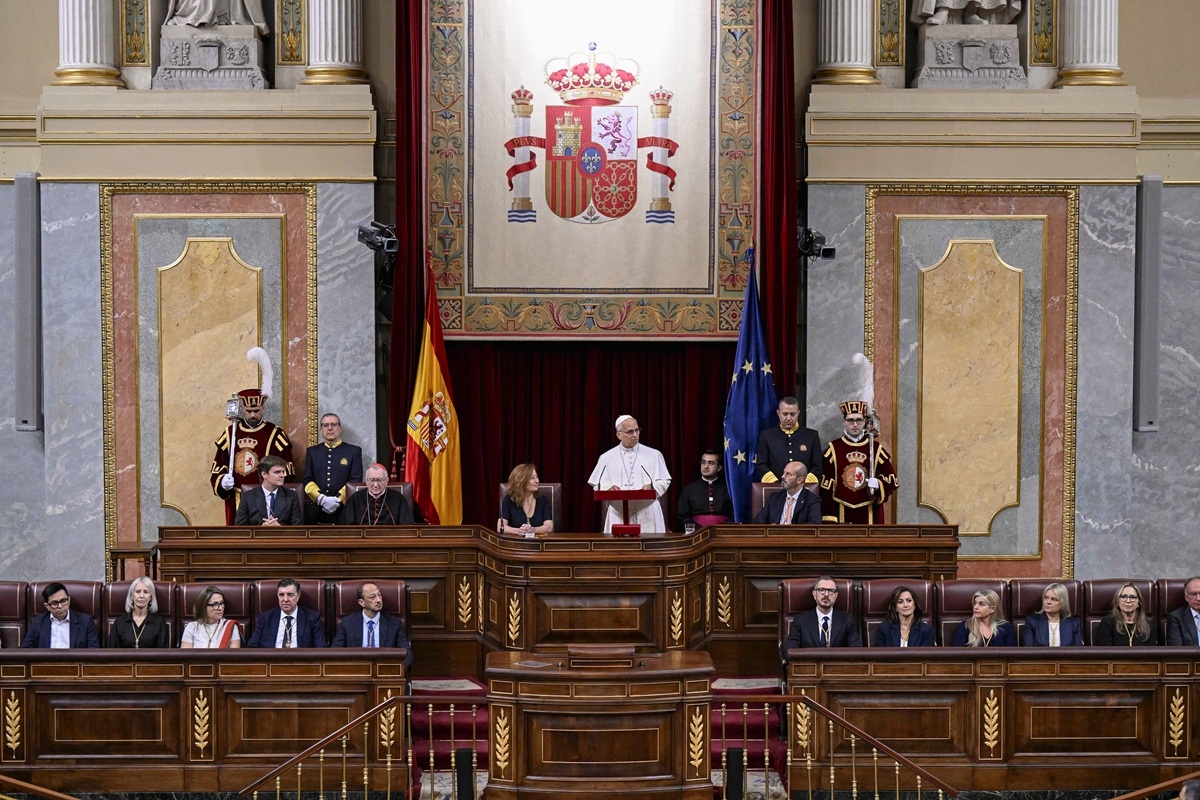
The Holy Father then went on to the Congress of Deputies, the seat of the country’s institutional, legal and democratic life, for a meeting with members of the Spanish Parliament. Before an audience of some 500 MPs and senators, Leo XIV – the first Successor of Peter to be granted this opportunity – delivered a lengthy address that consistently focused on human dignity as the guiding principle for all political action.
He touched upon many themes: from peace, not merely as a “political aspiration” but as a “genuine moral imperative”; to security, which arises “from justice, patient dialogue, respect for international law and a policy capable of prioritising the lives of peoples over interests that profit from war”; from the family, “the natural foundation of the community” and “a school of humanity” where one learns “the basic rules of coexistence”; to the dangers of the “culture of waste” – quoting Pope Francis – which often affect the most vulnerable individuals: the unborn, the elderly and migrants.
“Every human life must be recognised and protected from conception until its natural end, in every circumstance of its existence,” the Pope affirmed.
“When this certainty is obscured, the most vulnerable are the first victims and the law loses its deepest meaning: to serve and protect every person”.
At the same time, speaking of the phenomenon of migration, he called for a multifaceted approach, capable of “offering safe and legal routes, a respectful welcome and real opportunities for integration” for those who migrate; and to promote, at the same time, “the right to remain in one’s own land, working to ensure that no one has to leave their home due to a lack of peace, security or decent living conditions, or because of economic inequalities and the effects of the climate crisis”.
Finally, looking up at the paintings adorning the Hall of Sessions, some of which evoke the Gospel, the Successor of Peter reiterated that “the poor belong fully to the community”, “the stranger must be welcomed in accordance with his dignity” and “human life can never be treated as a commodity”.
In the afternoon, meeting the Bishops of the Spanish Episcopal Conference, Leo XIV urged them to continue the synodal journey they had embarked upon and to open themselves to dialogue with everyone, through a “process of deep listening” aimed at “recognising the voice of God speaking through the ecclesial community”, in a process that knows how to combine “freedom and courage prudently”.
Furthermore, he invited the bishops to create communities capable of communicating their own experience of faith and of fostering communion, healing divisions and accompanying the People of God, paying particular attention to those “going through dark times” and to “those who have been hurt by very those who were supposed to care for them, including members of the clergy”.
Before concluding his address, the Pontiff pointed to “St John of Avila, patron saint of the Spanish clergy” – whose 500th anniversary of priestly ordination is being commemorated this year – as an example of that “priestly life which every bishop is called to safeguard and foster within his own presbyterate”.
And precisely to give concrete expression to his words of concern for everyone, and for the most wounded in particular, at the Apostolic Nunciature in Madrid, which hosted him during these first days of his apostolic journey, the Holy Father held a private conversation lasting about an hour, characterised by listening and empathy, with six people who had suffered abuse at the hands of the clergy; they presented a number of proposals “to make the Church’s response to such tragic cases more effective”.
During the penultimate stage of his long day, whilst praying before the Virgin of Almudena at the Cathedral of Santa María la Real de la Almudena, Leo XIV recalled the “miraculous collapse” of the cave where the statue of Mary had been hidden to preserve it during the Arab domination, allowing it to be venerated once more by her people, and interpreted this as a metaphor still relevant today: the world must not limit itself to propping up or ignoring barriers, but must be willing to open up spaces to restore possibilities and “catch a glimpse of the horizon”.
Finally, during his meeting with the diocesan community of Madrid at Real Madrid’s “Santiago Bernabéu” stadium, Pope Leo XIV spoke with the city’s Christians, provocatively asking them whether “what we are and do as Christians” reaches the heart of the city. For this reason, he urged them to “re-learn the spiritual art of attentiveness”, trusting that “one can return to the faith or come to know it for the first time in adulthood”.