During Leo XIV’s meeting with the 17,000 people who had given their time to the visit in the Spanish capital, the Pontiff listened to the words of gratitude from those who had worked to ensure the success of the event; such as Mercedes, who thanked the Church for having supported her in the worst of times and rejoiced with her in the best, and Nuño, who summed up the work of volunteers by observing that when one gives the best of oneself, this “is not consumed, but grows”.
These words were perfectly echoed in the address by the Archbishop of Madrid, Cardinal José Cobo Cano, who on this occasion emphasised that the “hidden love” of those who serve is the manifestation through which the Gospel touches the heart of the city: “The Church lives when it serves, when it gives of itself, and when it does so united, looking together towards the same missionary horizon.”
The Pope then boarded a flight from Madrid’s Adolfo Suárez International Airport and travelled to Barcelona, the capital of the Autonomous Community of Catalonia, during which the crew invited him into the cockpit to view the Basilica of the Sagrada Familia from above – Leo XIV himself will open the last and highest tower, that of Jesus, during this trip – and during which he joked about his presence “dressed in white” (the colour of Real Madrid) in a city that historically supports the “blaugrana” team.
Upon his arrival in the Catalan city, Leo XIV prayed Midday Prayer in the city’s cathedral; and, commenting in his homily on St Paul’s Letter to the Corinthians, he asked the diocesan Church to be harmonious members of the body of Christ: “To work together and give of oneself without reserve” as “one people” was his invitation.
“The Church is the fruit of an act of love that precedes her and comes from God, and she grows first and foremost by allowing herself to be loved by Him, united, with a humble and grateful heart, for only those who allow themselves to be loved by God can build, together with others, the works of love,” stated Leo XIV in his reflection. He then added, as an exhortation to all: “In a world torn apart by wars and divisions, in an increasingly fragmented and individualistic society, we wish to be ‘martyrs’, that is, witnesses and prophets, of unity, of welcome, of harmony and of peace, even at the cost of sacrifice and renunciation.”
After reciting the prayer of the universal Church, having descended the stairs to the cathedral crypt, the Pope paused for a few minutes of silent prayer before the tomb of Saint Eulalia, one of the most beloved saints of Spain and of the Catalan capital.
In the afternoon, at the Archbishop’s Palace in Barcelona, the Pope devoted himself to a more informal gathering, meeting with a group of men and women religious from the Augustinian family hailing from various parts of Spain – including his confreres from the international community who carry out their pastoral ministry in the troubled ‘Raval’ district of the Catalan metropolis – “in a warm and friendly atmosphere”, he spent about half an hour with them.
There were also a number of more formal meetings, such as those with the President of the Catalan Autonomous Community, Salvador Illa i Roca, or with the 200 participants at the “MED26 Mediterranean Meeting” dedicated to “peace-building” in the Mediterranean, currently taking place in Barcelona, to whom he addressed words of gratitude and encouragement, urging them to travel, both geographically and spiritually, to reach those ports where men and women await the good news.
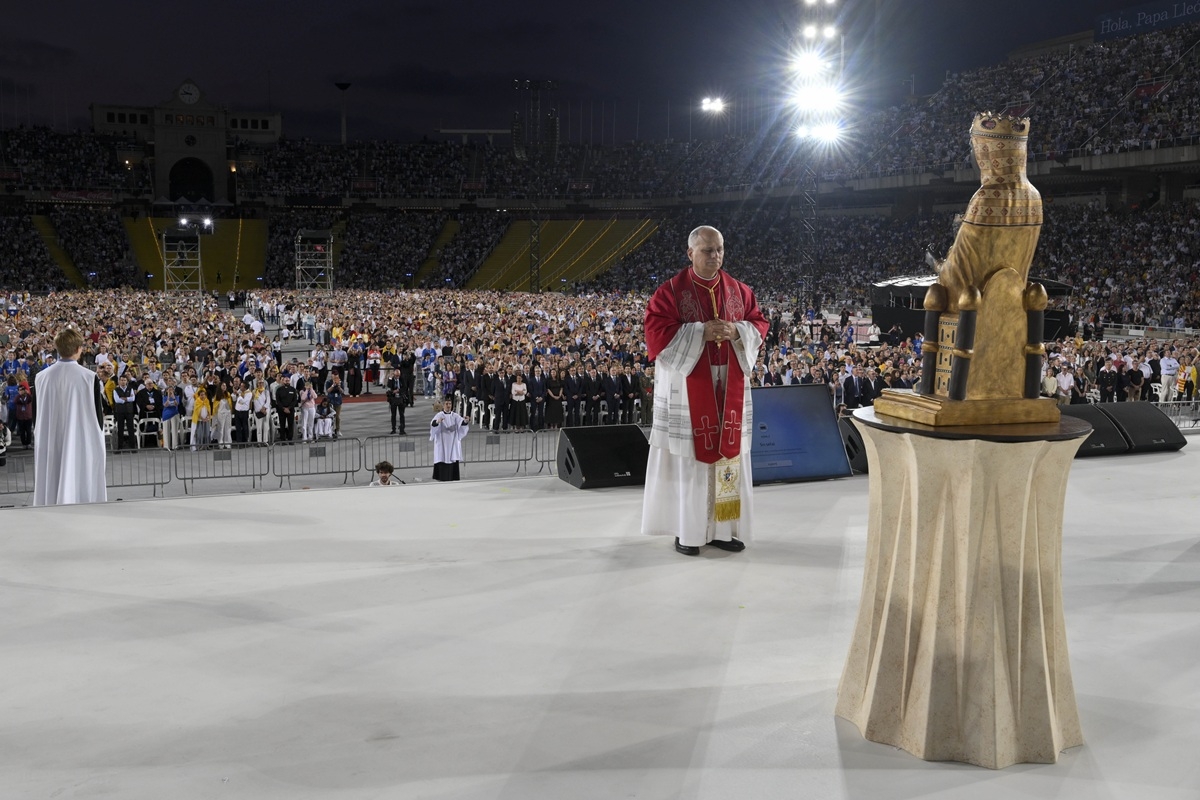
Finally, in the evening, the most eagerly awaited moment: the prayer vigil with the young people. After a few performances by the young people, Leo XIV listened to three significant testimonies (on the emptiness of a life devoid of a spiritual perspective, on depression and on domestic violence), and responded to each with an injection of confidence: the world creates anaesthetics for the conscience, but the unease that arises is not a bad thing; on the contrary, it should be nurtured, because it can lead to the discovery of God.
Similarly, the Pontiff noted how mental health is at risk in the most advanced societies and called for “a healthcare system that includes among its priorities this invisible and widespread malaise, which also affects young people”, whilst encouraging them to “trust in Him with perseverance”, because, as Pope Francis said, “with God, life is always reborn”.
Finally, faced with the mystery of evil and violence, which gives rise to the question in our hearts, ‘Where is God?’, the Holy Father turns the question on its head: ‘Should we ask ourselves “Where was God?”, or should we ask ourselves about man and humanity? (…) If violence exists, if selfishness triumphs, if even love between family members turns to hatred, we must ask ourselves some questions about ourselves, about the dynamics of our society, about the culture of individualism, about the temptation to violence, and not about God”.
Thus, with a brief passage in Catalan too – which delighted the 40,000 people present – Leone delivered a message of hope to young people, inviting them not to view setbacks as definitive failures but as “opportunities to remove the masks we wear”.