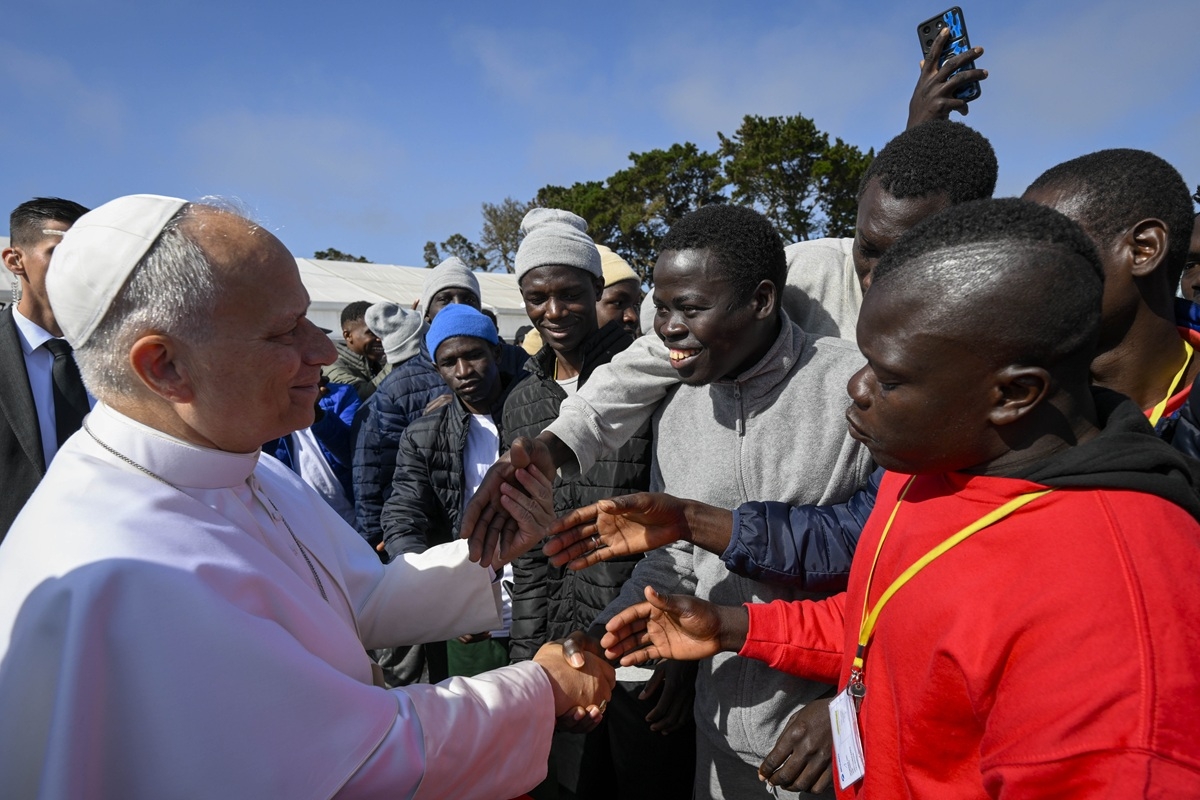
On the penultimate day, Thursday 11 June, the Pontiff first travelled to Las Palmas and at the port of Arguineguín – a symbol of dramatic arrivals and unconditional welcome – met with organisations actively providing aid to migrants. Here he offered numerous messages and gestures evoking concrete closeness to those in need, together with a lucid and attentive analysis of the migration phenomenon and the responsibility of all to manage it wisely.
Dear migrants, before saying anything else to you, I want to bow before your dignity. You are not just numbers or files. You are people who have left behind families and homes. You have dreams that no one has the right to despise
the Pope said, who on this occasion also cast a wreath of flowers into the sea in memory of the thousands of people who have died on journeys of hope along the infamous ‘Atlantic route’. With a father’s heart, the Pontiff added:
Every boat that arrives brings a question along with the migrants: what kind of world have we built, if so many brothers and sisters must risk death to seek life?
The Pope’s address was directed at many: after listening to the testimony of a young woman forced to leave due to a lack of opportunities in her own country, he remarked:
To the many women who are victims of trafficking and exploitation: If others have put a price on your body, know that God has never ceased to recognize your inestimable worth.
To all migrants, alongside his affirmation of their inalienable dignity, he also pointed the way towards prudence:
Do not surrender your lives to those who trade with them. Do not believe those who promise easy paradises in exchange for your body, money, silence or freedom. Those false promises are “siren songs”; they are industries of death.
He then sent another message to the whole Church:
Welcoming migrants cannot be a secondary matter that is left to a few volunteers. We kneel before the altar to adore Christ present in the Eucharist, from whom we receive the strength and the motivation to live charity; for this reason, we cannot then “pass by” the small boats and rafts, for all service and every commitment spring from prayer and lead back to it.
He then addressed civil authorities, parliaments, governments and international organisations, as well as all men and women of good will, broadening his gaze and discourse to the roots of the migration phenomenon:
Human dignity demands legal and safe pathways, rescue and assistance, real cooperation against traffickers, effective protection for victims, serious processes of reception and integration, and policies that allow every person to live with dignity in their own land. While there is a right to seek refuge when life is threatened, there is also the right not to have to migrate: the right to remain in one’s own home without hunger, war, persecution, violence, the land becoming uninhabitable, corruption stealing the bread from the poor or weapons destroying the future of children. We cannot grow accustomed to counting the dead. Human dignity has no passport and does not lose its value when crossing a border.
With these highly significant remarks, the Holy Father recognised the inviolable dignity of migrants; he advised caution to those who, in desperation, consider entrusting themselves to human traffickers; he lashed out at the West, which has now grown accustomed to a Mediterranean reduced to a graveyard; and he also reaffirmed the right to remain in one’s own land, finding there the right conditions of peace and prosperity.
The Pontiff returned to the issue of migration the following day, Friday 12 June, the Solemnity of the Sacred Heart of Jesus, during the final half-day of his apostolic visit. On this occasion, in Tenerife, he symbolically completed the journey begun in Las Palmas; whereas there he had addressed organisations active in reception, this time he engaged in dialogue with those working on integration.
Here too, his wide-ranging address brought everything together with true catholicity, looking to the work that everyone is called to carry out for genuine integration.
First, he clearly defined the terms of the discussion:
We are speaking, above all, of people created in the image and likeness of God, rather than of legal categories or problems to be managed. After difficult journeys and, at times, several attempts they look for someone to tell them through actions rather than with words: your life is not a waste; your suffering is not invisible; your dignity has not been washed away in the waters you have crossed.
He then issued a clear condemnation of those who exploit the plight of migrants:
I wish to address a clear message to those who take advantage of people’s desperation, to those who organize death routes, traffic in human beings, withhold documents, exploit workers, threaten women, deceive families and turn the suffering of others into a business. Stop. Repent (cf. Mk 1:15). The tears and blood of these brothers and sisters cry out to God, and their suffering reaches him (cf. Gen 4:10; Ex 3:7–9). The money wrested from the vulnerability of the poor will bring neither peace, nor honor, nor a future (cf. Jer 22:13; Job 5:1–6).
For every life lost, every family deceived, every body subjugated, every woman threatened, every worker exploited, you will have to appear before divine justice (cf. 2 Cor 5:10). Break those chains and free those you hold in bondage (cf. Is 58:6). Return what has been taken and make amends as much as you can.
Repent while there is still time, for God’s mercy can reach even the most hardened sinner, but it enters only through the narrow gate of truth, justice and conversion (cf. Ez 33:11).
Finally, looking at the phenomenon of migration from a vertical perspective as well, he issued an appeal to Catholics active in the integration of migrants:
that integration not be reduced to a social undertaking, however necessary that may be. Those who come to our parishes need bread, shelter, language assistance, work and protection. They also must find a community capable of offering paths to knowing Jesus Christ through the witness of life and word, while always respecting the conscience and freedom of each person. Evangelization is sharing, with respect and humility, the treasure that sustains our action and our hope. A Church that welcomes is also a Church that proclaims, offering Christ without imposing him and which, at the same time, receives the Gospel from the hands of the poor.
The conclusion, then, significantly renewed the call for solidarity and mutual fraternity:
Dear brothers and sisters, we are all – in some way – migrants; we are all pilgrims journeying towards our heavenly homeland. Let us help one another to make this journey a more humane experience for all, offering whatever is within each person’s means.