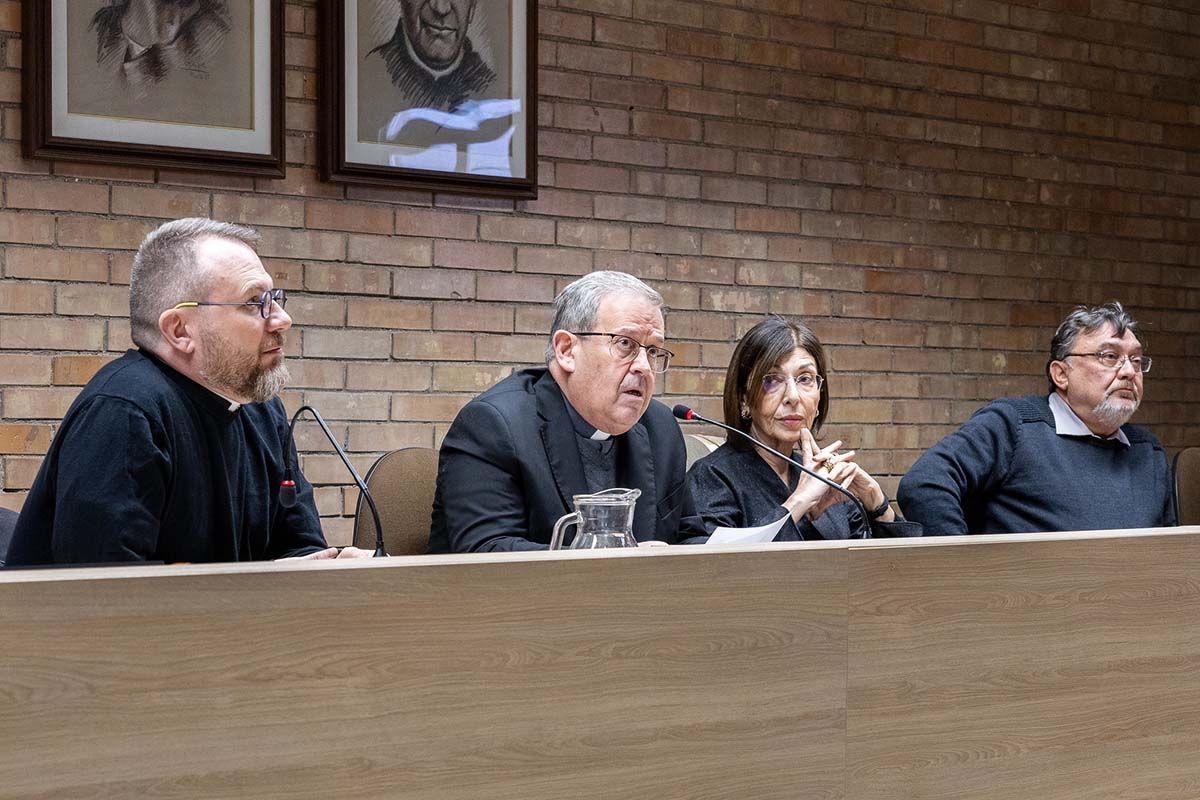
The programme included an opening address by the Rector Magnificus of the University, Fr Andrea Bozzolo, but it was the Rector Major of the Salesians, Fr Fabio Attard, who officially opened the proceedings. In his introductory speech, after thanking the promoters of the initiative – the Don Bosco Study Centre in collaboration with the Faculty of Social Communication Sciences – he emphasised the relevance of the proposed theme, defining it as crucial not only in the academic field, but also in training and education. He pointed out that returning to the sources of the history of the Salesian charism is essential in order to make its message relevant without betraying its authenticity. In this process, the university institution plays a decisive role,because it is capable of combining fidelity to tradition and interpretative creativity, scientific rigour and dialogue with the languages of the present.
This was followed by presentations by Prof. Lina Scalisi, Vice-Rector of the University of Catania, and Prof. Roberto Alessandrini, lecturer at the Pontifical Salesian University. Professor Scalisi addressed the topic of The story of virtue. Biography and holiness in modern history, placing the biographical genre within a broader historical and cultural context that goes beyond the specific case of Don Bosco and fits into the historiographical debate on the construction of models of holiness in the modern age. Professor Alessandrini, with his speech The holy educator. Don Bosco in the popular imagination, showed how the figure of the Salesian saint has been reworked in the languages of mass communication, particularly in biographical comics, highlighting narrative and symbolic dynamics shared with contemporary popular culture. The choice of speakers from outside the narrow circle of Salesian studies allowed for a broader perspective, fostering a fruitful comparison between the Salesian tradition and the interpretative categories of contemporary historical, anthropological and communicative research.
The official opening of the exhibition was entrusted to the director of the Don Bosco Study Centre, Fr Michal Vojtàš, who invited the numerous participants to appreciate the ‘graphic and content balance’ of the exhibition. The exhibition combines works of great scientific rigour with popular and informative biographies, creating an effective visual and narrative dialogue. The ‘clear black and white’ of documented historical biographies – such as those of Fr Pietro Stella, Fr Francis Desramaut and Fr Pietro Braido – is complemented by the ‘warm, watercolour tones’ of narratives designed for young people: from illustrated biographies of the 1930s, by authors such as Giovanni Cassano, Giovan Battista Calvi and Augusto Piccioni, to the famous comics by Jijé from the 1940s and the more recent Japanese manga.
Guided tours, conducted by members of the Don Bosco Study Centre, allowed visitors to discover the extraordinary wealth of the heritage on display: over 600 titles dedicated to the life of Don Bosco. Among the most significant works are the first biographies by D’Espiney, Du Böys and Biginelli, the impressive project of the Memorie Biografiche (Biographical Memoirs) by Lemoyne, Amadei and Ceria, and works related to the period of beatification and canonisation, such as the famous biography by Johannes Jørgensen – written in Danish and translated into numerous languages – and the richly documented biography by Monsignor Carlo Salotti (1929). For the contemporary age, Don Bosco. Una biografia nuova by Teresio Bosco stands out. With a journalistic and narrative style, it has been translated into at least 21 languages and is a point of reference for knowledge of the saint among the latest generations of the Salesian Family.
In addition to its documentary value, the exhibition stands out for a number of exhibition choices that enrich the experience. The bilingual panels (Italian and English) and audio guides available in four languages – Italian, English, French and Spanish – make the exhibition accessible to an international audience. Particularly appreciated is the concluding ‘reading corner’, a space designed for visitors to pause, read selected passages from the biographies and share their impressions and reflections.
The entire initiative is the result of a collaborative effort involving not only the promoters but also numerous departments and institutions of the University and the Salesian community: the Biblioteche Don Bosco and the Salesian Historical Institute, the LAS and LDC publishing houses, and various experts who contributed their expertise to a common project.
Source: unisal.it