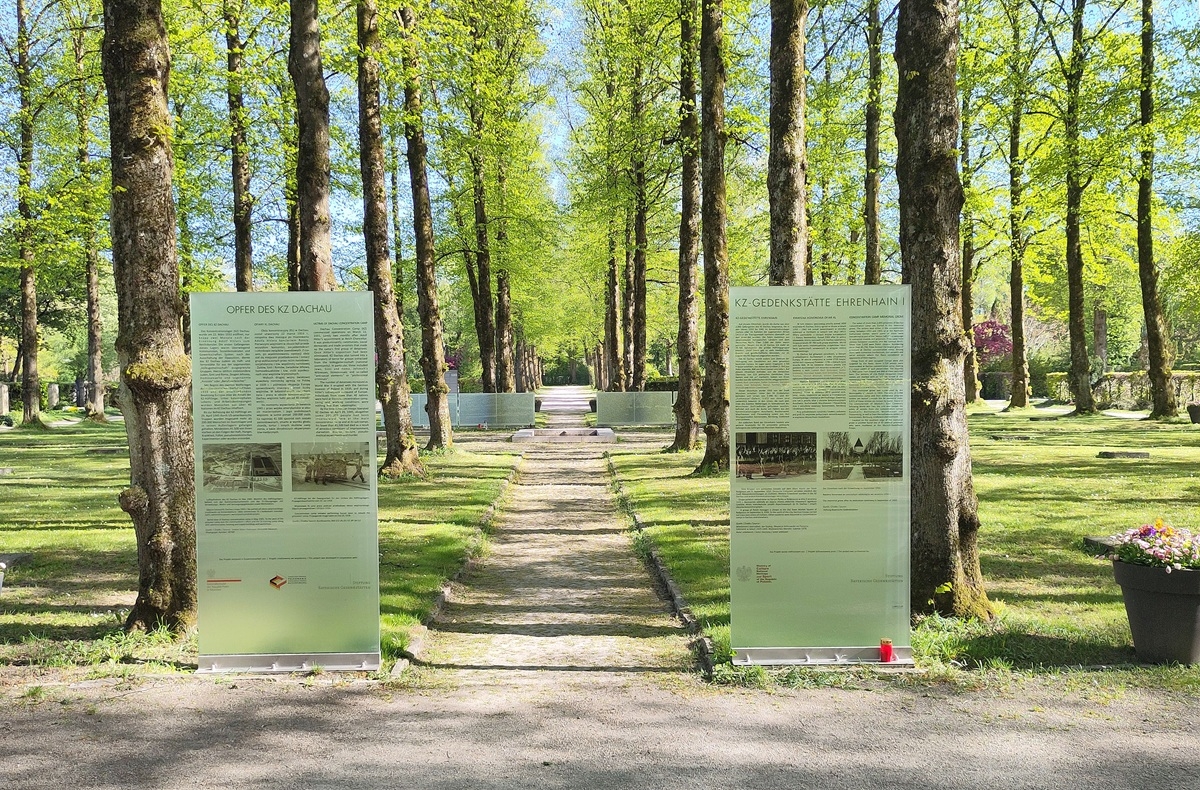
An exception is Father Franciszek Miśka (*5 December 1898, †30 May 1942), who is also among the nine Salesian martyrs beatified in Kraków on 6 June. Unlike the other newly beatified martyrs, he was initially imprisoned in the Salesian institution at Ląd, which had been converted by the Nazis into a prison for priests and of which he had been director. He was later deported to the Dachau concentration camp, located approximately 30 kilometres north of Munich, where he arrived on 30 October 1941. Only a few months later, on 30 May 1942, he succumbed to the inhumane conditions of imprisonment and the torture inflicted by the guards.
His name can now be seen by all on one of the glass panels at Memorial Grove I of the concentration camp memorial site in Munich’s Perlacher Forst Cemetery, located on Stadelheimer Straße in the Obergiesing district.
After the end of the Second World War, nearly 4,000 urns containing the ashes of numerous victims of National Socialism were discovered in the crematorium of Munich’s Ostfriedhof cemetery. These were the mortal remains of members of all victim groups: Jews, Sinti and Roma, Jehovah’s Witnesses, homosexuals, so-called “asocials” and “criminals,” political resisters, and Catholic clergy. More than 3,000 of the urns contained the ashes of victims from Dachau concentration camp who died there between 1933 and 1942 and whose bodies were subsequently cremated. The remaining urns contained the ashes of victims from other concentration camps and killing centres. More than 2,000 of the victims from Dachau were Polish citizens, who, with 40,700 prisoners, constituted the largest group of inmates at Dachau. They included primarily intellectuals, civil servants, clergy, and other members of the leadership class regarded as opponents of the Nazi regime.
In 1950, the City of Munich established a memorial grove at Perlacher Forst Cemetery in memory of these victims of Nazi terror. Beneath 44 grave slabs, the urns of 3,996 concentration camp and euthanasia victims — whose names are almost all known — are stacked in small burial chambers. Until a few years ago, only a relatively inconspicuous stone commemorated all these victims.
In the summer of 2021, the memorial grove was completely redesigned. At its centre is a water basin bearing the inscription:
TO HONOUR THE DEAD, TO WARN THE LIVING
Surrounding the basin are twelve glass panels on which the names of the 3,972 identified victims are recorded, grouped according to their seventeen countries of origin. This represents a very important contribution to rescuing the victims from oblivion. By publicly displaying their names for everyone to see, the intention is also to restore their dignity. One of the degrading measures employed in the concentration camps was the deprivation of prisoners’ names, reducing them to mere numbers.
Behind every name lies an individual biography and a personal fate; naming the victim rescues them from anonymity and makes it possible to remember a specific person and their story.
The redesign of the memorial grove also revealed that the buried urns include the mortal remains of 216 Polish clergymen, several of whom have since been beatified by the Catholic Church.
Dachau concentration camp, with its so-called “Priests’ Block”, was a central site for the persecution of clergy. Altogether, nearly 2,800 bishops, priests, members of religious orders, and clergy of other denominations from across occupied Europe were imprisoned there. The largest group, numbering 1,780, came from Poland, and approximately half of them — 868 individuals — died in Dachau.
The list of Polish victims also includes the name “MIŚKA Franciszek 1898–1942.” Curiously, unlike the names of the other priests, this name is not marked with an “x,” which, according to the information board at the entrance to the memorial grove, identifies the 216 Polish clergymen.
An inquiry to the responsible cemetery administration produced the following information:
“According to our records, under serial number 35, urn 669: Franz Mischka, born 5 December 1898, in Tannendorf, deceased on 30 May 1942 in Dachau.”
“Mischka” is the Germanized spelling of the Polish surname “Miśka.” Father Miśka’s biography states that he was born in Świerczyniec. It is known from the Positio that “Tannendorf” is the German translation of the Polish place name Świerczyniec. Accordingly, the imprisonment records from Dachau concentration camp sometimes use the German and sometimes the Polish name of his birthplace. Everything therefore suggests that the mortal remains of the newly beatified Father Franciszek Miśka are located at the indicated site in Memorial Grove I at Munich’s Perlacher Forst Cemetery.
In total, Franciszek Miśka is now the eighth blessed person whose mortal remains are buried in Memorial Grove I. Among the other seven is Blessed Michał Woźniak (1875–1942), who is well known to the Salesian Family in Poland. A former pupil of Don Bosco, he attended the secondary school in Valdocco from 1897 to 1900, later became a diocesan priest, and, as parish priest in Kutno, founded an oratory for the young people of his parish in the spirit of Don Bosco.
With the beatification of Father Franciszek Miśka, the list of officially recognized blessed and saintly martyrs of Dachau has grown to sixty-three blessed individuals. The only canonized saint among them is the Dutch Carmelite priest Titus Brandsma (1887–1942).
The martyrologies of various countries contain approximately 300 additional names of former Dachau prisoners who, according to experts, may also be regarded as martyrs. Among them is the German Salesian Father Theodor Hartz (1887–1942).
Since 2017, the Archdiocese of Munich and Freising has commemorated the blessed martyrs of Dachau with a dedicated memorial day on 12 June. This date was deliberately chosen because it is also the memorial day of the 108 blessed martyrs of Nazi persecution in Poland, whom Pope John Paul II beatified in Warsaw on 13 June 1999.
In the future, the Munich local Church will also commemorate Blessed Salesian martyr Franciszek Miśka on 12 June.
A total of thirty-two Salesians of Don Bosco were imprisoned in Dachau concentration camp: two Germans, one Belgian, one Austrian, one Czech (the future Cardinal Štěpán Trochta, 1905–1974), and twenty-seven Polish Salesians. Twenty-five were priests, two were brothers, and five were still in formation. Ten Salesians died in Dachau as a result of the mistreatment they endured there; one was released shortly before the liberation of the camp. Eighteen Salesians were among those who, completely emaciated and exhausted, were liberated by the Seventh U.S. Army on 29 April and had to bear the consequences of the inhumane conditions of imprisonment for the rest of their lives. Three Salesians were only temporarily held in Dachau before being transferred to Gusen concentration camp in Upper Austria, where they were liberated on 5 May 1945.
According to current research, in addition to the urn of the newly beatified martyr, the mortal remains of three other Salesians who died in Dachau concentration camp are also buried in Memorial Grove I at Perlacher Forst Cemetery: Father Teodor Budnikowski (1897–1942), Father Karol Chrapla (1905–1942), and Father Jan Podkul (1893–1942).
One further detail is noteworthy: Father Franciszek Miśka has found his final resting place not far from the grave of the Munich Salesian community. In the future, the community will include his memory and veneration in a special way and, in these troubled times, will invoke his intercession together with the many devotees in the homeland of the new blessed martyr.
Text and photos by Father Reinhard Gesing
{gallery}Germania – Memoriale don Miska 2026{/gallery}