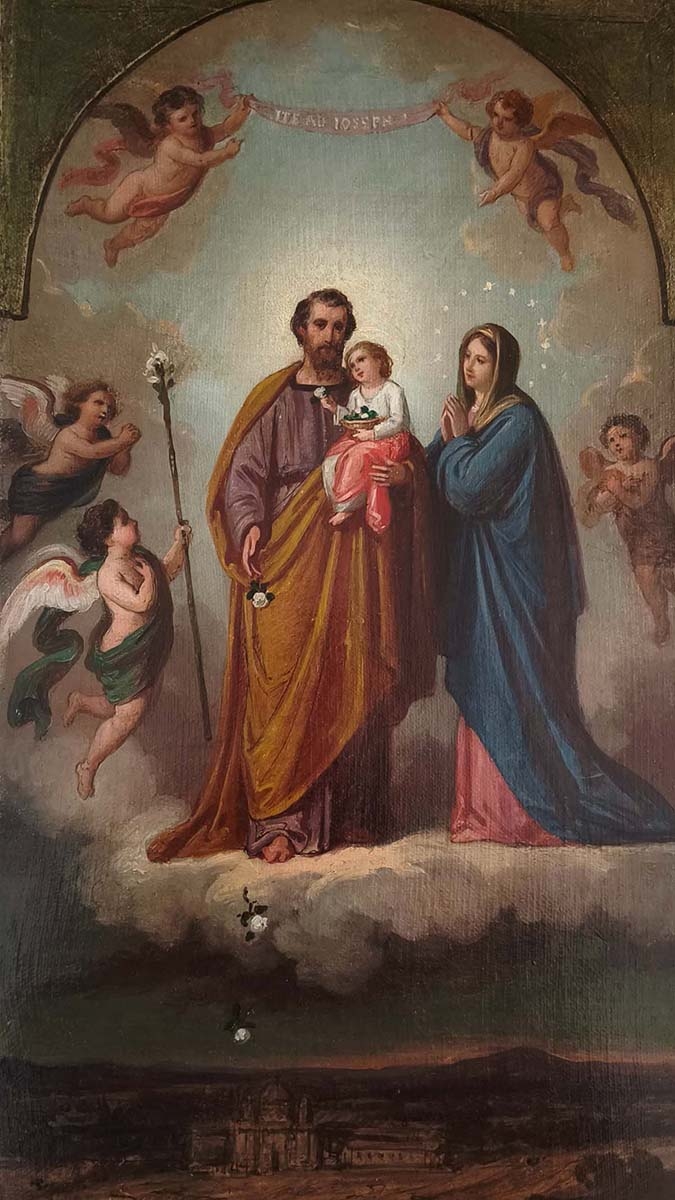
This precious preparatory study, likely executed after 1868, has recently been added to the permanent collection on the first floor of the museum. The canvas, originally discovered at a second-hand market by a private buyer and kept until now in a private collection, represents an added value for the cultural heritage of Valdocco and the entire Salesian Family. This new acquisition joins another important study already owned by the institution: one of the sketches produced by Lorenzone himself for the monumental altarpiece of Mary Help of Christians.
Biographical and artistic profile of the artist
Tommaso Andrea Lorenzone trained at the Accademia Albertina in Turin, where he enrolled in 1838. Under the guidance of masters of the calibre of Giovanni Battista Biscarra (1790–1851), the artist developed a stylistic approach rooted in classicism, progressively enriched by Romantic influences.
His exhibition career began at the annual exhibitions of the Società Promotrice di Belle Arti in Turin and continued in the salons of the Accademia Albertina. In 1859, having established a solid reputation within the Turin art scene, Lorenzone chose to abandon exhibition work to devote himself entirely to private and institutional commissions. His output, which ranged with ease from genre painting and historical narrative to portraiture for the aristocracy, the bourgeoisie and the high clergy, nevertheless reached its zenith in sacred themes, so much so that Don Bosco wrote in 1875: “Lorenzone, whose talent, especially in works of a religious nature, needs no words to be recognised.
The relationship with Don Bosco and the genesis of the work
The bond between the painter and Don Bosco was deep and synergistic. Lorenzone was, in fact, the artist chosen to create the large altarpiece for the high altar dedicated to Mary Help of Christians. For the 1872 painting of St Joseph, the creative process followed the same dynamic of close collaboration. According to historical sources and the later notes of Fr Fedele Giraudi, the iconographic design arose directly from the client’s wishes: “Don Bosco himself had given the painter the sketch of the symbolic composition he desired.”
Although there are no contemporary documents to formally confirm this, the structure of the work reflects the precise theological dictates of the Saint, who visited the painter’s studio on several occasions to monitor the progress of the work and urge its completion for the work of Mary Help of Christians. Fr Giraudi also recalls that: “The figures are all in the foreground because Don Bosco, whilst wishing to honour St Joseph in a special way – to whom the altar is dedicated – wanted the painting to depict the Holy Family.”
Compared to other compositions, in the 1872 canvas Lorenzone expanded the space in the lower part of the painting to include, in minute detail, the Church of Mary Help of Christians itself and the surrounding area in which it stood. The effectiveness of this compositional approach and the study of the main figures remained a constant feature in the artist’s later work, which he reproduced almost identically in subsequent works, such as the Holy Family of 1899, now in Asti.
The chronology of the painting’s completion is also documented in the correspondence. Don Bosco, whilst away from Turin, wrote to Fr Rua: “Between Fr Cagliero and Fr Savio, please look into the painting of St Joseph, which is with Mr Lorenzone and finished; all that is missing is the frame, after which it can be put in place”.
Spiritual iconography in the words of Don Bosco
On the occasion of the monographic publication following the consecration of the Church of Mary Help of Christians in 1868, it was Don Bosco himself who described in detail the complex symbolic structure of the painting, which was still unfinished: “In the left transept there is the altar dedicated to St Joseph. The painting of the saint is the work of the artist Tommaso Lorenzone. The composition is symbolic. The Saviour is depicted as a child in the act of offering a basket of flowers to the Blessed Virgin, as if to say: flores mei, flores honoris et honestatis. His august Mother says she is offering it to St Joseph, her spouse, so that through his hands they may be given to the faithful who are waiting with outstretched hands. The flowers represent the graces that Jesus offers to Mary, whilst she makes St Joseph their absolute dispenser, just as the Holy Church greets him: constituit eum dominum domus suae”.
The identification and exhibition of this preparatory sketch represent a moment of considerable significance for iconographic, artistic and historical studies on the Salesian heritage. The initiative bears witness to the ongoing commitment of the Don Bosco House Museum to the preservation, scientific research and dissemination of the artistic and cultural heritage linked to the Salesian Congregation.
Dr Ana Martín García, Ph.D.
General Coordinator of the Don Bosco House Museum
{gallery}ICP – Bozzetto Lorenzone 2026{/gallery}