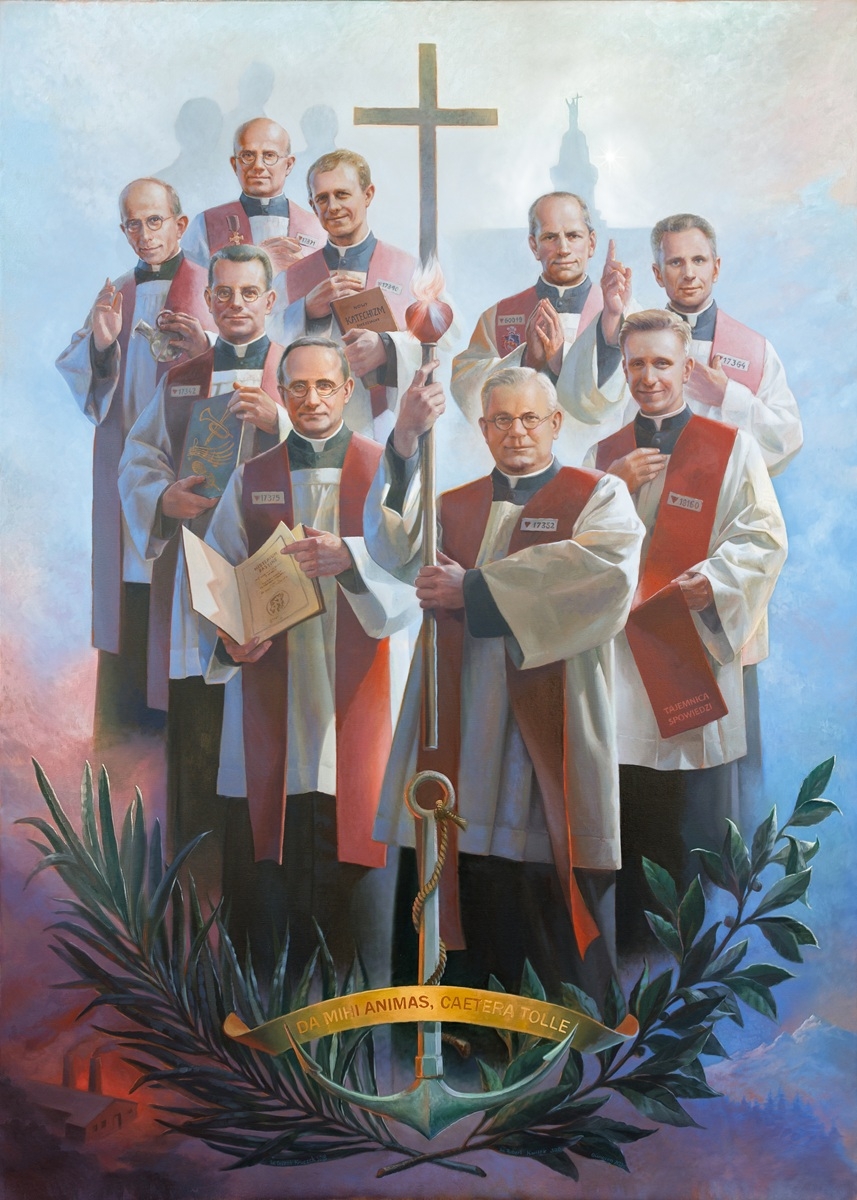
The new Blesseds – Fr Jan Świerc and eight companions – died between 1941 and 1942 as a result of torture, beatings and extreme hardship suffered in the concentration camps of Auschwitz and Dachau. Following the German invasion of Poland on 1 September 1939, persecution was unleashed with particular severity against the Catholic Church.
Cardinal Semeraro described that period as “a dramatic page in the nation’s history”. Yet, he emphasised, the celebration was not intended to commemorate the sorrow of those events, but rather to give glory to Christ, borne witness to by the nine priests, “sons of St John Bosco”, who “like Christ and with Christ gave their lives”.
Martyrs Known to the Young Karol Wojtyła
The beatification enriches the already numerous ranks of Polish saints and blesseds, among them St John Paul II – Archbishop of Kraków and later Supreme Pontiff – and St Faustina Kowalska, who from Poland spread throughout the world the powerful message of Divine Mercy.
Cardinal Semeraro also recalled the Venerable Servant of God Jan Tyranowski, the spiritual mentor with whom the young Karol Wojtyła took an active part in the life of the nearby parish of St Stanislaus Kostka in Dębniki, entrusted to the Salesians. Several of the newly beatified priests carried out their pastoral ministry there. St John Paul II himself wrote about them in his book Gift and Mystery.
Faithful to the Salesian Charism
In his homily, the Cardinal highlighted the Salesian charism embodied by Fr Świerc and his companions. Their vocation was expressed through concrete dedication to the education of young people and care for the poor and the suffering. Like Don Bosco, they saw in every boy “a beloved sheep, precious in the eyes of the Lord”.
In the face of anti-religious hatred, violence and injustice that raged during the last century, the nine Blesseds did not flee. Instead, they remained faithful to their calling until death, shedding their blood as a sign of peace.
An Appeal to the Young
The beatification, Cardinal Semeraro continued, represents a threefold invitation. First, it is addressed to young people, “the future of society and the living present of the Church”, in whom the Church places her trust.
In today’s world, he observed, freedom, happiness and success are often detached from truth, responsibility and sacrifice. The ideals offered may appear easy and immediate, promising much yet leaving the heart empty. Christ, by contrast, makes life “beautiful and great”, bringing to fulfilment humanity’s deepest desires.
He therefore urged young people to open their hearts to Christ, especially in moments of uncertainty, confusion and loneliness. “The Lord does not call us to renounce our dreams,” he said, “but to purify and enlighten them”, so that life may become full, authentic and capable of self-giving.
Encouragement for Salesians and the Faithful
The second invitation was directed to the Salesians of Don Bosco. The legacy of the new Blesseds, Cardinal Semeraro expressed the hope, would enable every priest to respond generously to the voice of the Good Shepherd. Quoting St John Paul II, he exhorted them: “Do not be afraid. Do not let yourselves be frightened by the vertigo of a holy priestly life.”
The third and final appeal was addressed to all the faithful. In an age marked by “digital loneliness”, where virtuality can create the illusion of genuine relationships through ever more sophisticated means, holiness consists above all in listening to God’s will without yielding to weariness or discouragement. What is required, he said, is to learn anew to recognise the voice of the Good Shepherd, in order to belong to Him more fully and to make courageous choices as true disciples of Christ and His Cross.
A Sign of Peace Amid Today’s Wars
In conclusion, Cardinal Semeraro turned his gaze to the present historical moment, “once again marked by the sadness and cruelty of war”. In this difficult context, the nine Salesian martyrs beatified today bear witness to “the gift of peace”, reminding the world that even in the darkness of history there are always those capable of bringing “a light of hope, love and fraternity”.